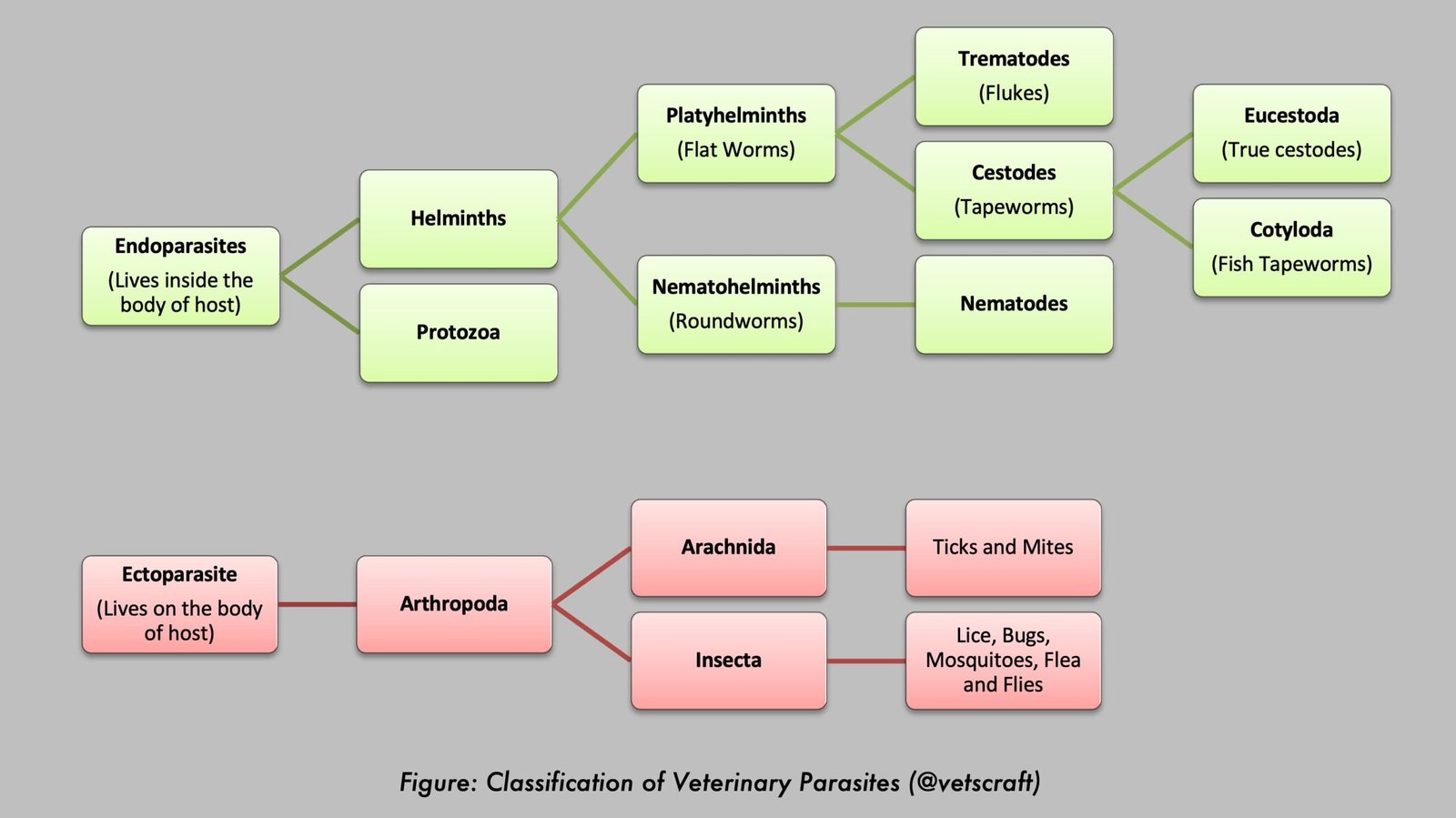
Veterinary Parasitology is a branch of parasitology that focuses on parasites affecting domestic and wild animals. The parasitology encompasses both endoparasites and ectoparasites. Endoparasites primarily include helminths—such as trematodes, cestodes, and nematodes—as well as protozoa, while ectoparasites mainly belong to the arthropods, including arachnids and insects.
General Parasitology
- Introduction to Veterinary Parasitology
- Types of Relationships of Parasites
- Classification of Parasites
- Types of Hosts
- Reproduction of Parasites
- Nutrition of Parasites
- Parasitic Adaptations and Survival Mechanisms
- Types of Parasitic Infection
- Systematics of Parasites
- Life Cycle of Parasites
- Dissemination of Parasites
- Mode of Transmission of Parasites
- Effects of Parasitism in Animals
- Parasitic Immunity
- Host Specificity
- Host-Parasite Relationship
- Control and Treatment of Parasitic Diseases
- Classification and General Characters of Parasitic Phyla
Trematodes
- General Characteristics of Trematodes
- Larval Stages of Trematodes
- Types of Cercariae
- Life Cycle of Trematodes
- Dicrocoelium dendriticum (Lancet Liver Fluke)
- Fasciola (Liver Fluke)
- Ovine and Bovine Fasciolosis
- Opisthorchis (Liver Flukes)
- Fasciolopsis buski (Largest Intestinal Fluke)
- Echinostomatidae (Intestinal Flukes)
- Paragonimus westermani (Oriental Lung Fluke) and P. kellicotti
- Prosthogonimus (Oviduct Flukes)
- Amphistomes (Rumen Flukes)
- Paramphistomum cervi (P. gotoi)
- Gigantocotyle explanatum (Bile Duct Amphistome)
- Cotylophoron cotylophorum (Rumen Fluke)
- Gastrothylax crumenifer (Pouched Amphistome)
- Gastrodiscus secundus
- Gastrodiscus aegyptiacus
- Gastrodiscus hominis
- Pseudodiscus collinsi
- Blood Flukes (Schistosomatidae)
- Intestinal or Visceral Schistosomosis
- Cercarial Dermatitis (Swimmer’s Itch)
- Control and Prevention of Trematode (Fluke) Infections
- Snail Control Methods for Prevention of Trematode Infections
- Ornithobilharzia (Orientobilharzia)
Cestodes
- Class Cestoda (Tape Worms)
- Types of Metacestodes
- Equine Tapeworms
- Ruminant Tapeworms
- Poultry Tapeworms
- Tapeworms in Dogs
- Dipylidium caninum
- Taenia hydatigena
- Taenia multiceps
- Echinococcus granulosus
- Spirometra mansonoides (Spirometra mansoni)
- Human Tapeworms
- Taenia saginata
- Taenia solium
- Mesocestoides lineatus
- Diphyllobothrium latum
Nematodes
- General Characteristics of Nematodes
- Digestive System
- Excretory and Nervous System
- Reproductive System
- Life Cycle of Nematodes
- Strongyle Worms (Strongyloidea)
- Family Strongylidae (Palisade Worms)
- Strongylus
- Chabertia ovina (Large-Mouthed Bowel Worm)
- Syngamus trachea (Gapeworm of Poultry)
- Oesophagostomum (Nodular Worm)
- Stephanurus dentatus (Kidney Worm of Swine)
- Dioctophyma renale (Giant Kidney Worm of Dogs)
- Ancylostoma (Hookworm)
- Cutaneous Larva Migrans (Creeping Eruption)
- Bunostomum (Hookworm of Ruminants)
- Trichostrongylus (Hair Worm)
- Ostertagia ostertagi (Brown Stomach Worm)
- Cooperia (Cattle Bankrupt Worm)
- Nematodirus spathiger
- Haemonchus (Barber’s Pole Worm)
- Self Cure Phenomenon
- Mecistocirrus digitatus
- Trichostrongylidae Parasite Control
- Proper Use of Anthelmintics
- Habronema (Equine Stomach Worm)
- Thelazia (Eye Worm)
- Spirocerca lupi (Park Worm)
- Gongylonema pulchrum (Gullet or Zigzag Worm)
- Physaloptera praeputialis
- Gnathostoma spinigerum
- Dirofilaria immitis & Dirofilaria repens
- Parafilaria bovicola and Parafilaria multipapillosa
- Onchocerca Species
- Setaria
- Stephanofilaria
- Dictyocaulus filaria (Large Lungworm of Sheep and Goats)
- Dictyocaulus viviparus (Lungworm of Cattle)
- Muellerius capillaris (Hair Lungworm of Sheep and Goats)
- Protostrongylus rufescens (Red lungworm of Sheep and Goat)
- Metastrongylus elongatus
- Guinea Worm (Dracunculus medinensis)
- Trichinella spiralis
- Capillaria hepatica
- Trichuris ovis (True Whipworm)
- Acanthocephala (Thorny-Headed Worms)
- Macracanthorhynchus hirudinaceus
Protozoology
- Veterinary Protozoology
- Locomotion in Protozoa
- Nutrition in Protozoa
- Reproduction in Protozoa
- Mastigophora (Flagellates)
- Family Trypanosomatidae
- Trypanosoma
- Trypanosoma evansi
- Trypanosoma equiperdum
- Trypanosoma brucei
- Trypanosoma congolense
- Trypanosoma vivax
- Trypanosoma gambiense and Trypanosoma rhodesiense
- Trypanosoma theileri
- Trypanosoma cruzi
- Leishmania
- Leishmania donovani
- Leishmania tropica
- Tritrichomonas foetus
- Trichomonas gallinae
- Giardia lamblia
- Subphylum Sarcodina (Amoebae)
- Entamoeba histolytica
- Intestinal Amoebiasis (Amoebic Dysentery)
- Histomonas meleagridis
- Phylum Apicomplexa
- Eimeria (Coccidia)
- Chicken Coccidiosis
- Bovine Coccidiosis
- Coccidiosis in Sheep and Goats
- Coccidiosis in Dogs and Cats (Isospora)
- Cryptosporidiosis in Humans and Animals
- Tissue Cyst-Forming Coccidia (Sarcocystidae)
- Toxoplasma gondii
- Toxoplasmosis
- Genus Sarcocystis
- Sarcocystis cruzi
- Neosporosis
- Hepatozoon canis
- Family Plasmodiidae
- Plasmodium gallinaceum
- Haemoproteus columbae
- Leucocytozoon simondi (Akiba simondi)
- Leucocytozoon smithi (Akiba smithi)
- Leucocytozoon caulleryi (Akiba caulleryi)
- Order Piroplasmida (Piroplasmorina)
- Babesia Species
- Bovine Babesiosis (Redwater Fever or Texas Fever)
- Canine Babesiosis
- Babesiosis in Sheep and Goats
- Equine Babesiosis (Equine Piroplasmosis)
- Theileria
- Bovine Theileriosis (Theileria annulata)
- Ovine and Caprine Theileriosis
- Balantidium coli
Entomology & Acarology
- Veterinary Entomology and Acarology
- External Anatomy of Insects
- Mouthparts of Insects
- Thorax and Abdomen of Insects
- Internal Anatomy and Physiology of Insects
- Development of Insects
- Order Diptera (True Flies)
- Culicidae Family (Mosquitoes)
- Difference Between Anopheles, Culex, and Aedes Mosquitoes
- Mosquito Management
- Phlebotomus (Sand Fly)
- Culicoides fulvithorax (Biting Midges)
- Simulium indicum (Black Fly)
- Tabanus (Horse Fly)
- Chrysops (Deer Fly and Mango Fly)
- Haematopota (Clegs)
- Musca
- Stomoxys calcitrans (Stable Fly)
- Haematobia (Lyperosia)
- Chrysomya
- Lucilia
- Sarcophaga ruficornis (Flesh Fly)
- Oestrus ovis (Sheep Nasal Fly)
- Hypoderma lineatum (Ox Warble Fly)
- Gasterophilus
- Myiasis (Fly Strike)
- Hippobosca maculata (Forest Fly)
- Melophagus ovinus (Sheep Ked)
- Pseudolynchia canariensis (Pigeon Fly)
- Hemiptera Order
- Cimex (Bed Bug) in Poultry
- Triatoma (Kissing Bug)
- Siphunculata (Anoplura)
- Suborder Amblycera (Amblyceran Lice)
- Menopon gallinae (Yellow Shaft Louse of Poultry)
- Menacanthus stramineus (Chicken Body Louse)
- Heterodoxus spiniger (Biting Louse of Dogs)
- Suborder Ischnocera (Lice)
- Lipeurus (Bird Louse)
- Damalinia (Bovicola) Lice
- Trichodectes canis (Biting Dog Louse)
- Amblycera vs Ischnocera Lice
- Sucking Lice (Siphunculata or Anoplura)
- Haematopinus Lice
- Linognathus Lice
- Pediculosis (Lice Infestation)
- Haematopinus vs. Linognathus Lice
- Mallophaga vs Anoplura
- Treatment and Control of Lice
- Siphonaptera (Fleas)
- Ctenocephalides (Dog and Cat Fleas)
- Xenopsylla cheopis (Oriental Rat Flea)
- Echidnophaga gallinacea (Sticktight Flea)
- Insects vs. Arachnids
- Tick Morphology
- Life Cycle of Ticks
- Questing in Ticks
- Tick Infestation in Animals
- Argasidae (Soft Tick)
- Argas Ticks in Birds
- Ornithodoros Tick
- Otobius megnini (Spinose Ear Tick)
- Tick Control and Treatment
- Ixodid Ticks
- Hard Ticks vs. Soft Ticks
- Ticks vs. Mites
- General Characters of Mites
- Characters of Sarcoptiformes (Astigmata)
- Sarcoptes scabiei
- Notoedres cati
- Psoroptes ovis
- Chorioptes bovis
- Demodex canis
- Otodectes cynotis
- Linguatula serrata (Tongue Worm)
This course is fully developed; however, corrections may still be needed. Please contact us at hello@vetscraft.com for any missing content or suggestions for improvement in the Veterinary Parasitology course.