Bunostomum (Hookworm of Ruminants): Life Cycle, Pathogenesis, Clinical Signs & Treatment
Bunostomum is a genus of blood-feeding hookworms that parasitize the small intestine of domestic and wild ruminants. The two most important veterinary species are Bunostomum phlebotomum, which primarily infects cattle, and Bunostomum trigonocephalum, which infects sheep and goats. These nematodes are widely distributed in tropical and subtropical regions and are particularly prevalent in warm, moist environments that favor larval development.
Although adult worms are relatively large, they can cause significant economic losses, especially in young animals, due to their blood-feeding habit. Heavy infections may result in anemia, poor growth, weight loss, reduced productivity, and, in severe cases, death. Infection occurs through ingestion of infective third-stage (L3) larvae or by percutaneous penetration of the skin, making pasture hygiene and strategic deworming important components of disease control.
For Bunostomum (hookworms of ruminants), only a few species are of major veterinary importance. The following list is accurate and consistent with standard veterinary parasitology references:
- Bunostomum phlebotomum: Hookworm of cattle (occasionally buffalo, rarely goats and deer)
- Bunostomum trigonocephalum: Hookworm of sheep and goats
Taxonomical Classification
- Kingdom: Animalia
- Phylum: Nematoda
- Class: Chromadorea (Secernentea)
- Order: Strongylida
- Superfamily: Ancylostomatoidea
- Family: Ancylostomatidae
- Subfamily: Bunostominae
- Genus: Bunostomum
- Important Species: Bunostomum phlebotomum (cattle), Bunostomum trigonocephalum (sheep and goats)
- Common Name: Hookworm of ruminants
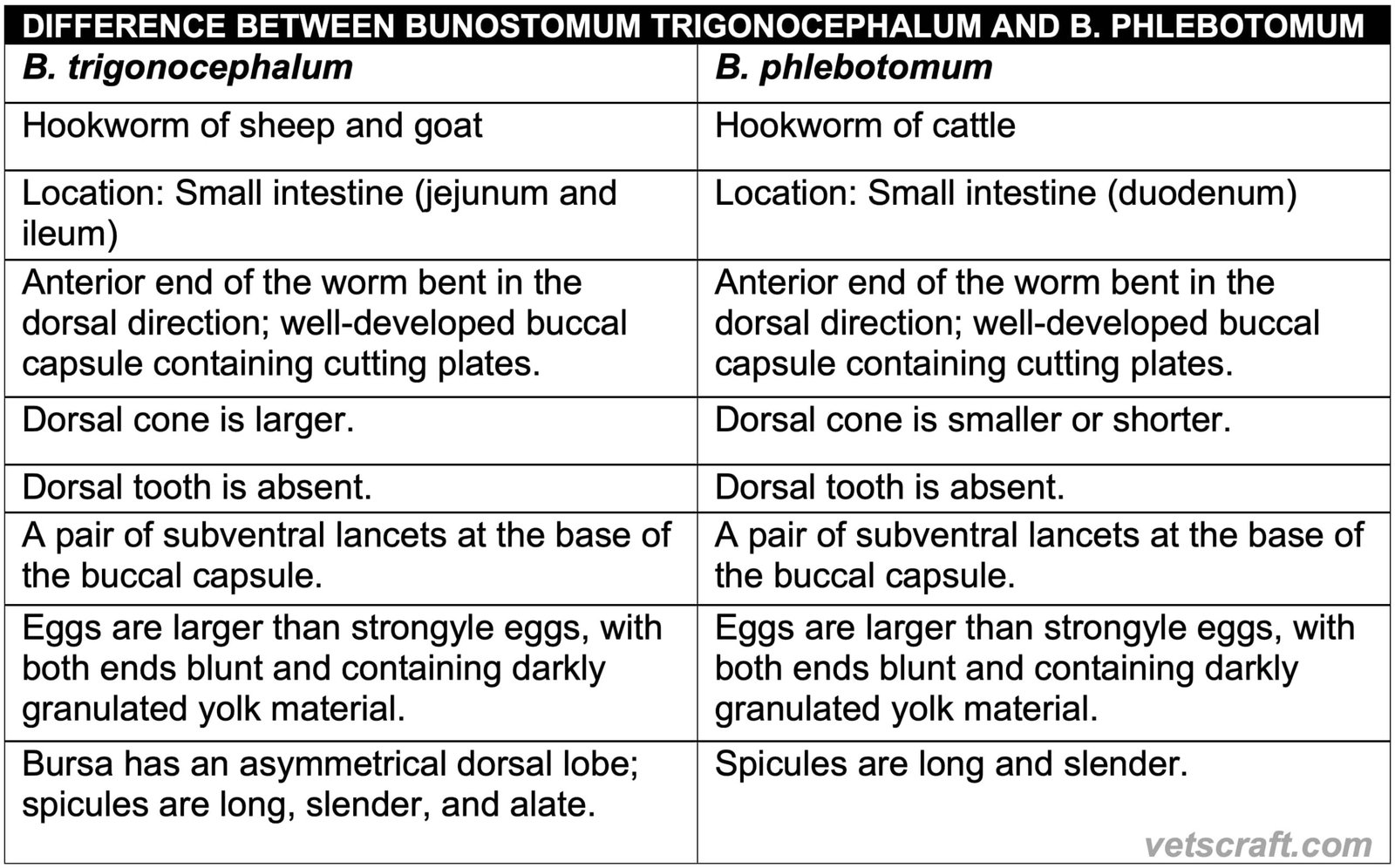
Difference Between Bunostomum trigonocephalum and Bunostomum phlebotomum
Life Cycle
Eggs are passed in the feces of the host. The development and bionomics of the larvae are similar to those of Strongyle spp. Under optimal conditions, the infective stage is reached within 5 days.
Infection of the definitive host occurs through skin penetration by L3 larvae or by oral ingestion. Following skin penetration, the larvae reach the lungs via the bloodstream.
In the lungs, L3 larvae molt into L4. The L4 larvae then migrate up the trachea to the pharynx, are swallowed, and reach the intestine. In the intestine, L4 larvae molt into L5. The prepatent period is 30 to 56 days.
Pathogenesis and Clinical Signs
B. trigonocephalum
- Adult worms are blood suckers, causing progressive anemia with associated changes in the blood picture, hydremia (watery blood), edema of the intermandibular region (bottle jaw), and occasional diarrhea.
- The feces are dark in color due to altered blood pigments. Death may occur due to prostration.
B. phlebotomum
- Diarrhea, anemia, marked emaciation, and submandibular edema.
- In stabled cattle, penetration of larvae through the skin of the legs causes stamping of the legs and licking of the feet due to itching.
Cutaneous Larva Migrans (CLM), also known as Creeping Eruption, is a condition that occurs in unnatural hosts, such as humans (especially children), following skin penetration by the larvae of Ancylostoma braziliense, A. caninum, A. duodenale, Uncinaria stenocephala, Necator americanus, Bunostomum phlebotomum, Strongyloides spp., and Gnathostoma spinigerum.
Postmortem Lesions
Lesions are similar to those caused by Ancylostoma caninum, including anemia, enteritis, hydrothorax, and pericarditis.
Diagnosis
Diagnosis is based on fecal examination, fecal egg detection, and fecal culture for larval identification. Adult worms may also be observed during necropsy.
Treatment
- Benzimidazoles: Albendazole, Fenbendazole, Oxfendazole, and Mebendazole are highly effective against adult Bunostomum spp.
- Imidazothiazoles: Levamisole is effective against both immature and adult stages.
- Macrocyclic lactones: Ivermectin, Doramectin, Eprinomectin, and Moxidectin provide excellent control of Bunostomum infections.
- Supportive therapy, including iron supplementation and blood transfusion (in severe anemia), may be required in heavily affected animals.
Control
Larvae commonly occur on moist pastures; therefore, avoid grazing animals in such areas. Ensure proper disposal of manure. Keep floors and bedding dry. The ground around water troughs should also be kept hard and dry.