Types of Relationships of Parasites
All living organisms in the universe can be broadly classified as dependent and independent. Independent organisms do not require the help of other organisms for their physiological or metabolic activities such as nutrition, developmental stimuli, digestive enzymes, and shelter. In contrast, dependent organisms require the help of other organisms for physiological or metabolic activities. So, living together is obligatory for dependent organisms.
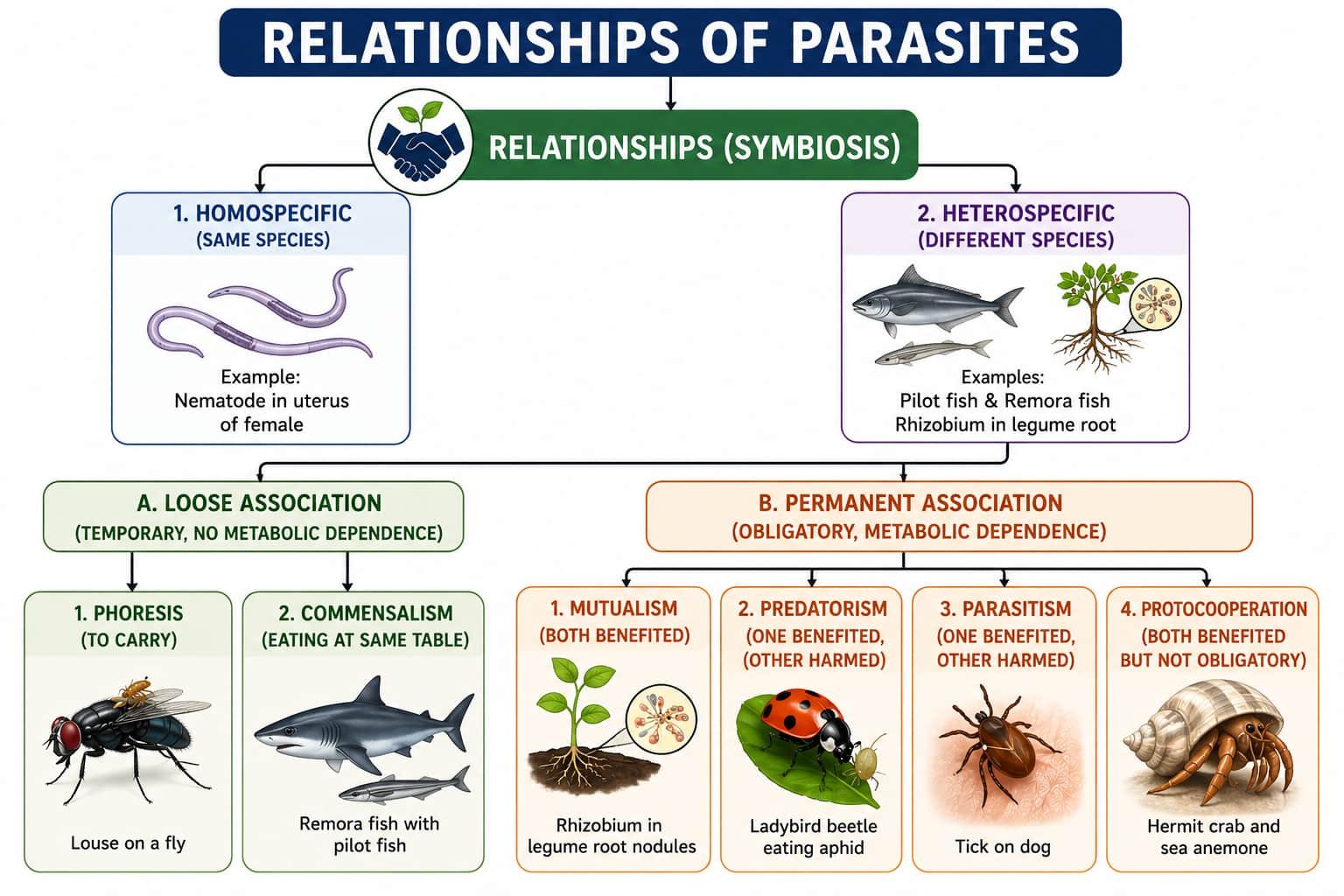
Living together of two organisms is known as a relationship or symbiosis. The word symbiosis was coined by Debary in 1879. In symbiotic life, the individuals are called symbionts. They may be individuals of different genotypes or of the same species. The relationship of dependent organisms is either homospecific or heterospecific.
Homospecific and Heterospecific Relationship
Association between two individuals of the same species is called homospecific, e.g., in the nematode Trichosomoides crassicauda, 4–5 males are found in the uterus of the female. Association between two individuals of different species or different genotypes is called heterospecific. Heterospecific relationship is classified into loose association and permanent association.
Loose Association and Permanent Association
The relationship between parasites and their hosts may vary in duration and degree of dependence. Based on the nature of association with the host, parasites may show either loose association or permanent association.
Loose Association
Loose association is a temporary association between two individuals. As there is no metabolic dependence between them, the individuals can survive on their own without association.
Types of Loose Association are:
- Phoresis (To Carry)
- Commensalism
1. Phoresis (To Carry)
Phoresis (to carry) is the travelling together of two organisms without metabolic dependence, and this association is not an obligatory one. The smaller organism is called the companion, while the larger one is the host. E.g., Columbicola columbae (louse) and Pseudolynchia canariensis (fly) are ectoparasites of pigeons. The louse attaches to the body of the fly and travels together with it.
2. Commensalism
Commensalism (eating at the same table) is a loose association between two individuals of different species without metabolic dependence. This association is not obligatory, in which one organism is benefited, called the commensal, while the other one is neither benefited nor harmed, called the host.
An example of commensalism is the association between pilot fish and remora fish. The remora fish clings to the dorsal fin of the pilot fish and travels to many places without harming the pilot fish. It also feeds on the food left over by the pilot fish.
Permanent Association
Permanent association is an obligatory association between two individuals with metabolic dependence. Permanent association is classified as mutualism, predatorism, and parasitism.
Types of permanent associations are:
- Mutualism
- Parasitism
- Predatorism
- Parasitoidism
1. Mutualism
Mutualism is an obligatory association in which the partners are called mutuals because both partners are mutually benefited. The individuals cannot survive without association.
An example of mutualism is termites and their intestinal flagellates. Termites cannot digest cellulose as they do not secrete cellulase, but the flagellates found in the intestine of termites are able to digest cellulose. The termites, for their survival, utilize the fermentation products excreted by the flagellates, while the intestinal flagellates get protective shelter and food with low oxygen, since they are anaerobic in nature.
2. Parasitism
Parasitism is an obligatory and intimate association between organisms of two different species. The smaller of the two organisms is called the parasite, which lives on or in another larger organism called the host.
Generally, the parasite is physiologically dependent on the host and is benefited by this association, while the host is always harmed by the parasite in many ways, such as tissue injury, poisoning of the host by released toxic metabolites, stealing of host nutrients, and sucking of blood. A parasite cannot live without a host. E.g., liver fluke in sheep (liver fluke is the parasite – smaller organism, and sheep is the host – bigger organism).
3. Predatorism
Predatorism is an association in which one organism kills and eats another organism for survival. The organism that kills another organism for food is called the predator, while the organism that is killed by the predator is called the prey. E.g., a spider kills and eats house flies.
4. Parasitoidism
Parasitoidism is an association between the arthropods of two different species. In this, the developmental stages of one arthropod species (parasitoid) parasitize and kill the developmental stage of another arthropod species (host/pest).
An example of parasitoidism is Spalangia and Dhirinus (parasitoids), which parasitize the pupal stage of Musca domestica and kill it. Parasitoids inject their eggs into the pupa of M. domestica. The larva that hatches feeds on the developing stage of the housefly and grows to become a pupa and then an adult. Finally, the adult parasitoid emerges from the pupa of the housefly. Different species of parasitoids are used as biological agents for the control of houseflies.
For more topics related to veterinary parasitology, including protozoology, helminthology, entomology, host–parasite relationships, parasitic diseases, diagnosis, and control measures, visit our main Veterinary Parasitology notes page where all chapter-wise topics and study materials are available in one place for easy learning.