Strongyle Worms (Strongyloidea): Classification, Characteristics & Life Cycle
Strongyle worms are a diverse group of parasitic nematodes belonging to the superfamily Strongyloidea. They are of major veterinary importance because they infect the gastrointestinal or respiratory tract of domestic animals, causing significant health problems and economic losses. Members of this superfamily share several characteristic morphological features, including a well-developed copulatory bursa in males and a direct life cycle with an infective third-stage (L3) larva.
A characteristic feature of strongyle worms is the presence of a well-developed caudal bursa (copulatory bursa) in males, which is supported by bursal rays at the tail end. Hence, they are called “bursate nematodes.”
Strongyle worms inhabit either the gastrointestinal tract or the respiratory tract of animals.
The life cycle is direct, and the L3 is the infective stage.
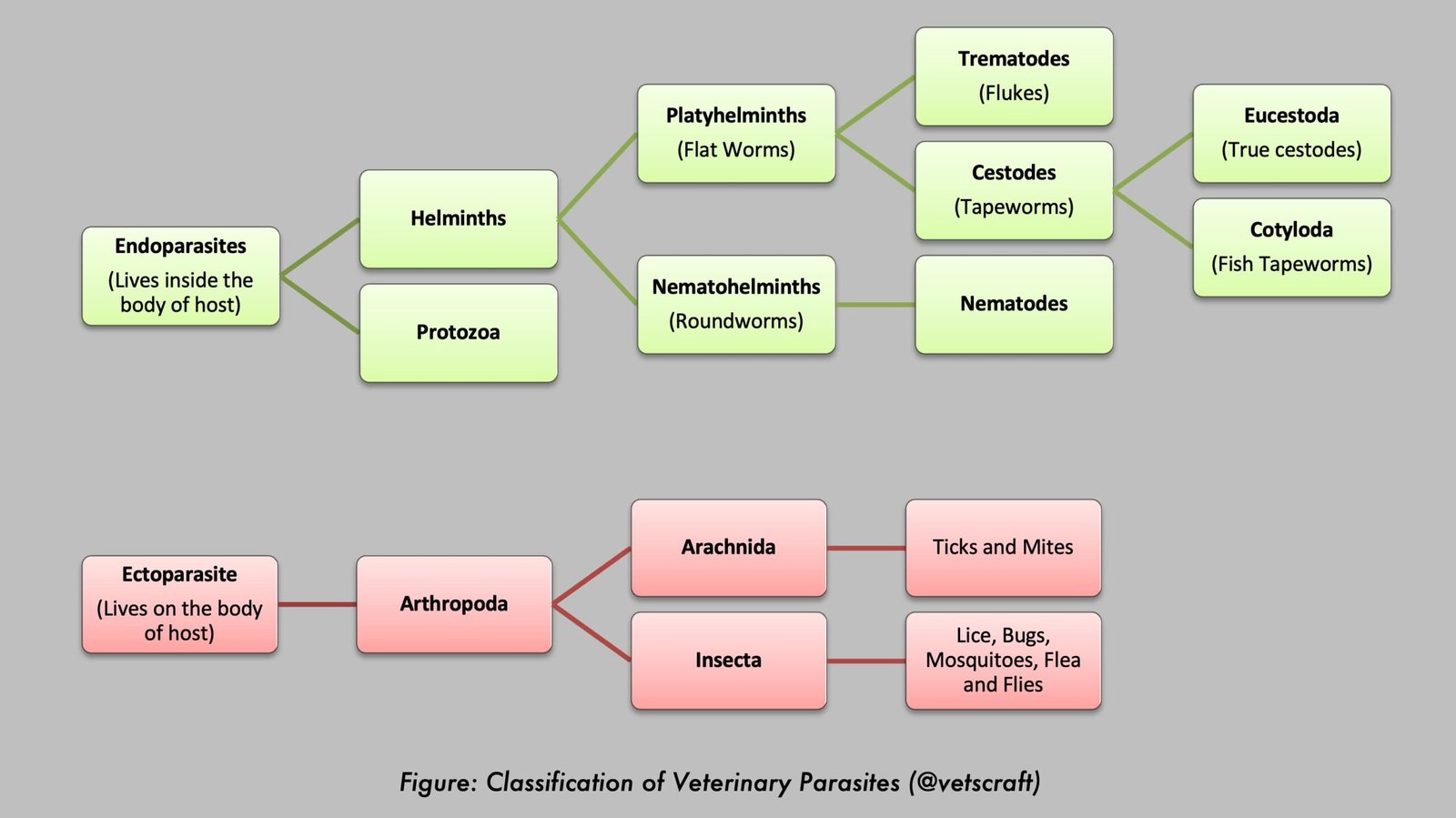
Taxonomical Classification of Strongyle Worms
- Kingdom: Animalia
- Phylum: Nematoda
- Class: Chromadorea (Secernentea)
- Order: Strongylida
- Superfamily: Strongyloidea
- Representative Families: Strongylidae, Chabertiidae, Trichonematidae, Syngamidae, Stephanuridae
- Representative Genera: Strongylus, Syngamus, Triodontophorus, Oesophagostomum, Chabertia
- Common Name: Strongyle worms
Life Cycle of Strongyle Worms
Strongyle worms have a direct (monoxenous) life cycle that does not require an intermediate host. The infective stage is the third-stage larva (L3), which develops in the external environment before being ingested by the definitive host.
- Eggs: Adult female worms produce strongyle-type eggs, which are passed into the environment through the feces of the infected host.
- Larval Development: Under favorable environmental conditions of adequate moisture, oxygen, and suitable temperature, the eggs hatch into first-stage larvae (L1). The larvae feed on microorganisms in the feces and molt to become second-stage larvae (L2).
- Infective Stage (L3): The L2 larvae molt to form third-stage larvae (L3), which retain the cuticle of the previous larval stage as a protective sheath. The sheathed L3 larvae migrate onto surrounding vegetation and represent the infective stage.
- Transmission: Animals become infected by ingesting infective L3 larvae while grazing or consuming contaminated feed or water.
- Development in the Host: After ingestion, the L3 larvae exsheath in the gastrointestinal tract or migrate to their predilection site, depending on the species. They subsequently molt to the fourth-stage larvae (L4), then to fifth-stage larvae (L5), and finally mature into adult worms.
- Egg Production: Adult worms reproduce in their predilection site, and female worms begin shedding eggs in the feces, thereby completing the life cycle.
Note: Although the general life cycle of strongyle worms is direct, certain genera exhibit tissue migration or unique developmental patterns before reaching their final predilection site.