Dipylidium caninum (Double-Pored Dog Tapeworm)
Dipylidium caninum, commonly known as the double-pored dog tapeworm or cucumber seed tapeworm, is one of the most common intestinal cestodes of dogs and cats. It is also a zoonotic parasite that can occasionally infect humans, particularly young children, through the accidental ingestion of infected fleas. This article covers the taxonomy, morphology, life cycle, pathogenesis, diagnosis, and treatment of Dipylidium caninum for veterinary students and practitioners.
Parasite Overview
- Common Name: Double-pored dog tapeworm
- Predilection Site: Small intestine
- Intermediate Hosts: Dog flea (Ctenocephalides canis) and dog louse (Trichodectes canis)
- Metacestode Stage: Cysticercoid
Taxonomical Classification
- Kingdom: Animalia
- Phylum: Platyhelminthes
- Class: Cestoda
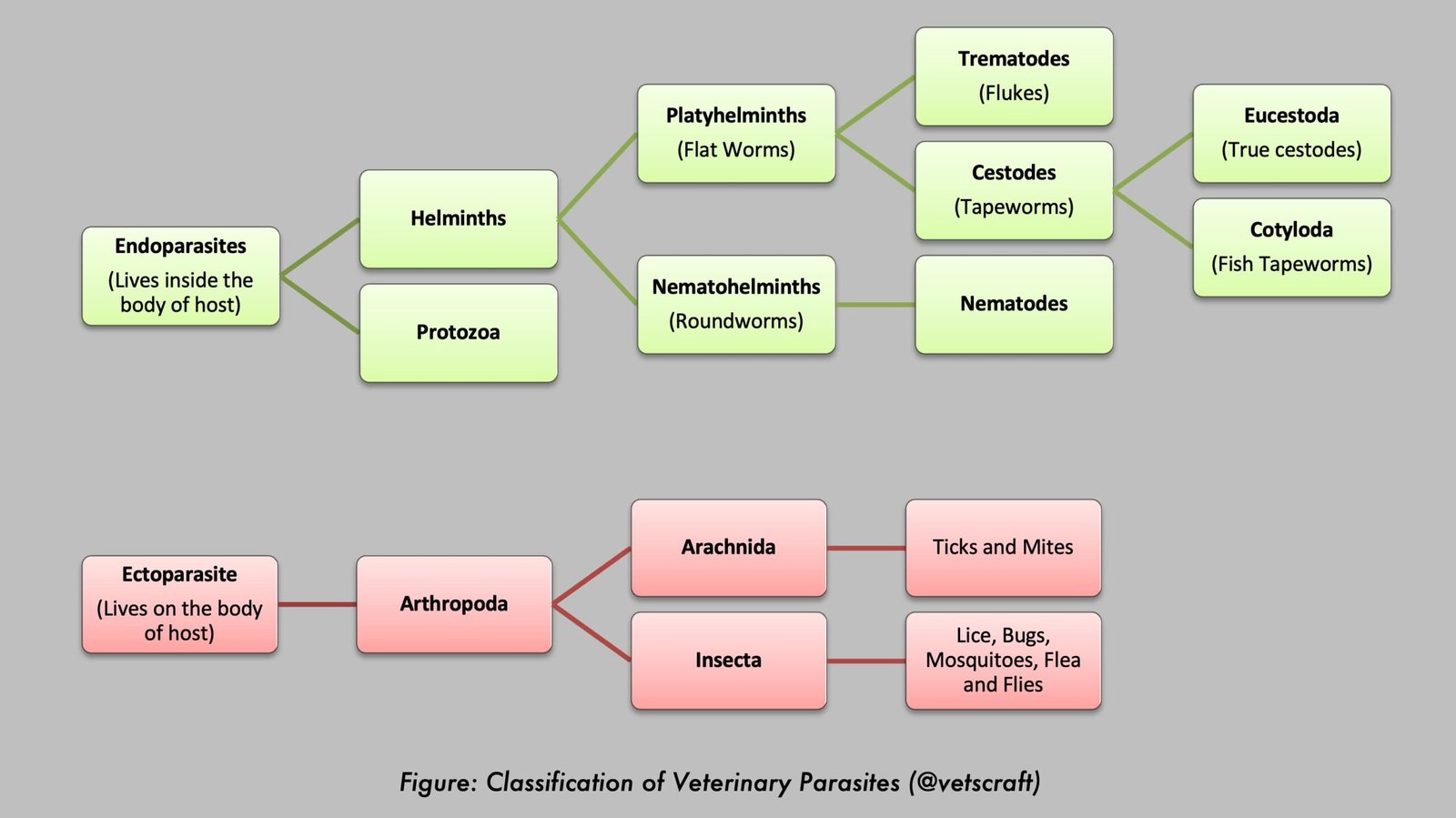
- Subclass: Eucestoda
- Order: Cyclophyllidea
- Family: Dipylidiidae
- Genus: Dipylidium
- Species: Dipylidium caninum
- Common Name: Double-pored dog tapeworm, cucumber seed tapeworm
Morphology
- Retractable rostellum armed with three or four rows of rose-thorn-shaped hooks.
- Each segment contains two sets of genital organs.
- The vitelline glands and ovaries form a mass on either side, resembling a bunch of grapes.
- In the gravid segment, the uterus is replaced by egg capsules or egg packets.
- Egg packets contain approximately 30 eggs per packet. Gravid segments are elongated and oval in shape, resembling cucumber seeds.
Life Cycle
- The gravid segments are passed in the feces or leave the host spontaneously, crawling on the host’s body surface or the floor. During this process, eggs are released.
- Eggs are ingested by the larval stage of fleas. However, cysticercoid development occurs in the adult flea.
- The definitive host (D/H) acquires infection by ingesting an infected adult flea.
- Humans acquire infection by accidentally ingesting infected fleas while playing with dogs and cats.
- Egg → Larval flea → Adult flea → D/H
Pathogenesis
Pathogenesis depends upon the age of the host. Adult worms are generally not pathogenic in dogs, but heavy infections may cause abdominal pain, unthriftiness, diarrhea, or constipation. In rare cases, intestinal obstruction may occur.
The spontaneous passage of gravid segments causes severe irritation around the perianal area. Due to constant irritation, the dog drags its anus along the ground. This condition is known as “anal pruritus.”
Diagnosis
- Demonstration of egg packets in feces.
- Macroscopic examination of feces for gravid segments.
Treatment
- Arecoline hydrobromide: 1 to 2 mg/kg body weight.
- Praziquantel: 5 mg/kg body weight.
- Niclosamide: 100 to 150 mg/kg body weight.
- Mebendazole: 100 to 200 mg/kg body weight, twice daily for 5 days.
- Bithionol: 200 mg/kg body weight.