Ruminant Tapeworms: Morphology, Life Cycle, Pathogenesis, Diagnosis & Treatment
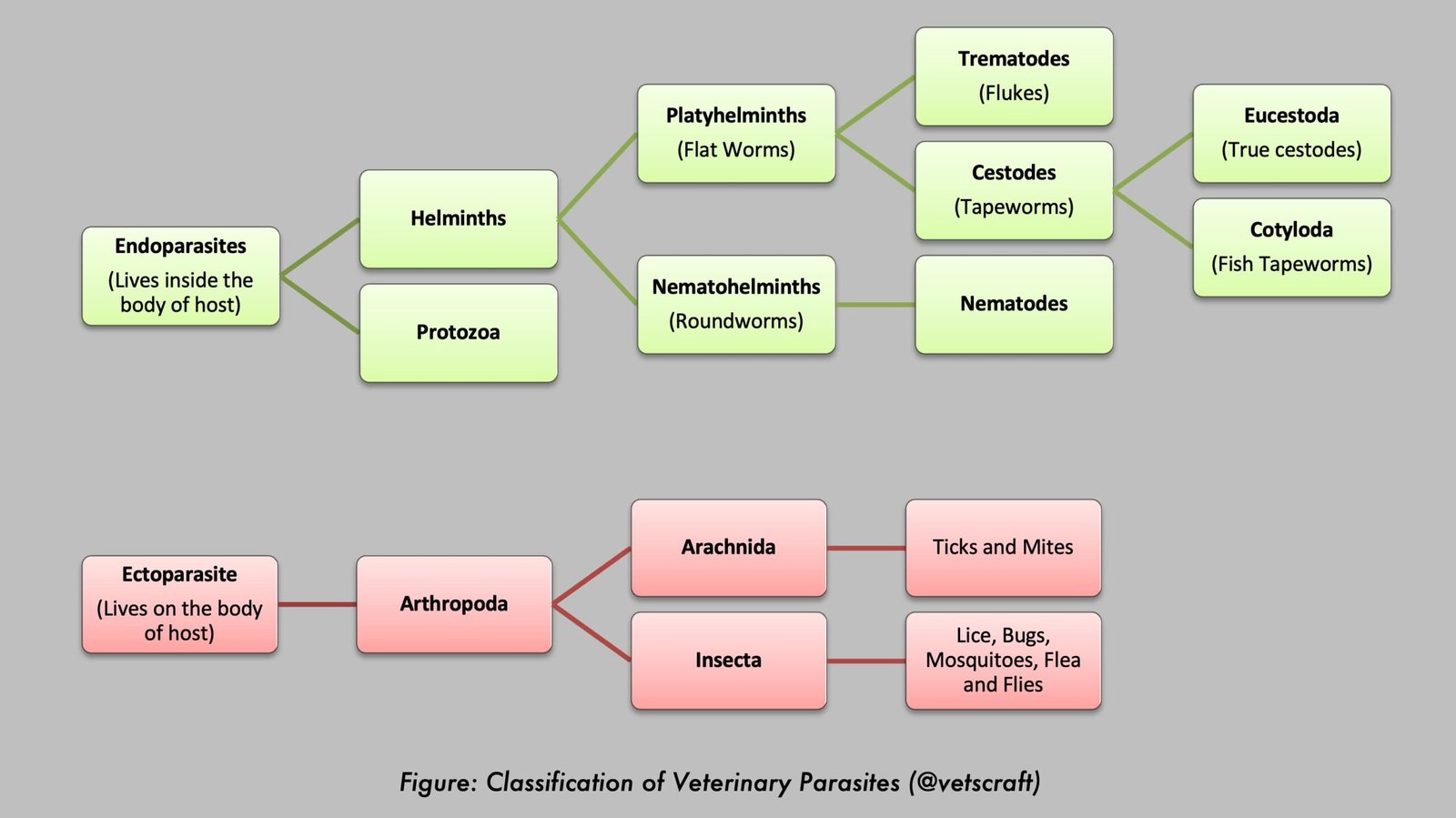
Ruminant tapeworms are intestinal cestode parasites that primarily infect sheep, goats, and cattle, especially young animals. The most important species include Moniezia expansa, Moniezia benedeni, Avitellina lahorea, and Stilesia globipunctata. Although infections are usually mild in adult animals, heavy parasite burdens in young ruminants can result in poor growth, malnutrition, reduced productivity, and, in severe cases, intestinal complications.
This article provides a comprehensive overview of the morphology, life cycle, epidemiology, pathogenesis, diagnosis, treatment, and control of the major tapeworms affecting domestic ruminants.
The major tapeworms affecting domestic ruminants include:
- Moniezia expansa
- Moniezia benedeni
- Avitellina lahorea
- Stilesia globipunctata
1. Moniezia expansa
- Adults are up to 6 m in length. The scolex is wide and has prominent suckers.
- Segments are wider than they are long.
- It has double sets of reproductive organs; therefore, it is known as the “double-pored ruminant tapeworm.”
- Vitelline glands and the ovary form a ring on either side.
- The genital pore is marginal. Testes are numerous and distributed in the central field of the segment.
- At the posterior border of each segment, a row of rosette-like interproglottidal glands is present.
- The function of these glands is unknown.
- The glands extend across the entire width of the segments.
Eggs
The eggs are triangular in shape, contain an oncosphere (hexacanth embryo), and possess a pyriform apparatus.
2. Moniezia benedeni
Morphology
The morphology of M. benedeni is similar to that of M. expansa, except that the interproglottidal glands are concentrated only at the center of the segment.
Moniezia benedeni occurs more commonly in cattle than in other animals.
Eggs
The eggs of Moniezia benedeni are square-shaped.
Life Cycle
- Oribatid mites act as the intermediate hosts (I/H). Common species include Scheloribates laevigatus and Scheloribates madrasensis (Anantaraman).
- Eggs are passed in the feces of the host and are ingested by grass mites, in which they develop into cysticercoids within four months.
- The final host acquires the infection by ingesting infected intermediate hosts.
- Prepatent period: 37–40 days.
Epidemiology
Monieziasis commonly occurs during November and December, and the infection is most common in young lambs and calves.
Pathogenesis
In adult animals, the infection is mildly pathogenic, whereas in young animals it is highly pathogenic, causing malnutrition that leads to reduced wool and meat production.
Monieziasis predisposes lambs to bacterial infections such as enterotoxemia caused by Clostridium perfringens type D.
Diagnosis
- Fecal examination for the presence of eggs.
- Gross examination of feces for the presence of gravid segments, which resemble “cooked rice grains.”
Treatment
- Albendazole: 10 mg/kg body weight (oral).
- Fenbendazole: 5 mg/kg body weight (oral).
- Praziquantel: 15 mg/kg body weight (oral).
- Niclosamide: 75–150 mg/kg body weight (oral).
Control
- Eliminate grass mites from pastures through plowing and cultivation.
- Deworm animals in early summer.
3. Avitellina lahorea
Avitellina lahorea commonly occurs in the small intestine of sheep and goats.
Morphology
Adults are approximately 3 m in length. The segments are short and cylindrical, and segmentation is indistinct at the posterior end. Each segment contains a single set of reproductive organs. The genital pore opens irregularly in an alternating pattern.
- In gravid segments, eggs are passed into the paruterine organ (a thick-walled, sac-like organ).
- The paruterine organ resembles a snail shell.
- The pyriform apparatus is absent.
Life Cycle
Psocids (booklice) act as the intermediate hosts (I/H).
Pathogenesis and Treatment
The pathogenesis and treatment of Avitellina lahorea are similar to those of Moniezia.
4. Stilesia globipunctata
Stilesia globipunctata commonly occurs in the small intestine of sheep, cattle, and goats.
Adults are approximately 60 cm in length. Each segment contains a single set of genital organs. The genital pore opens irregularly in an alternating pattern. The uterus is dumbbell-shaped.
Eggs are passed into two paruterine organs, and they lack a pyriform apparatus. The intermediate host of Stilesia globipunctata is the oribatid mite.
Pathogenesis
Worms are mainly attached at the junction of the duodenum and jejunum. Immature worms penetrate the mucous membrane and form nodules in the intestine. The scolex and anterior portion are embedded within the nodule, while the remaining posterior portion extends freely into the intestinal lumen. Heavy infections may cause death.
Treatment
- Praziquantel: 15 mg/kg body weight.
Ruminant tapeworm infections are common gastrointestinal parasitic diseases of sheep, goats, and cattle, particularly in young animals. Accurate identification of the causative species, along with appropriate diagnosis, timely anthelmintic treatment, and effective pasture management, plays an important role in minimizing production losses and maintaining herd health.