TABLE OF CONTENTS
Equine Tapeworms: Morphology, Life Cycle, Pathogenesis and Treatment
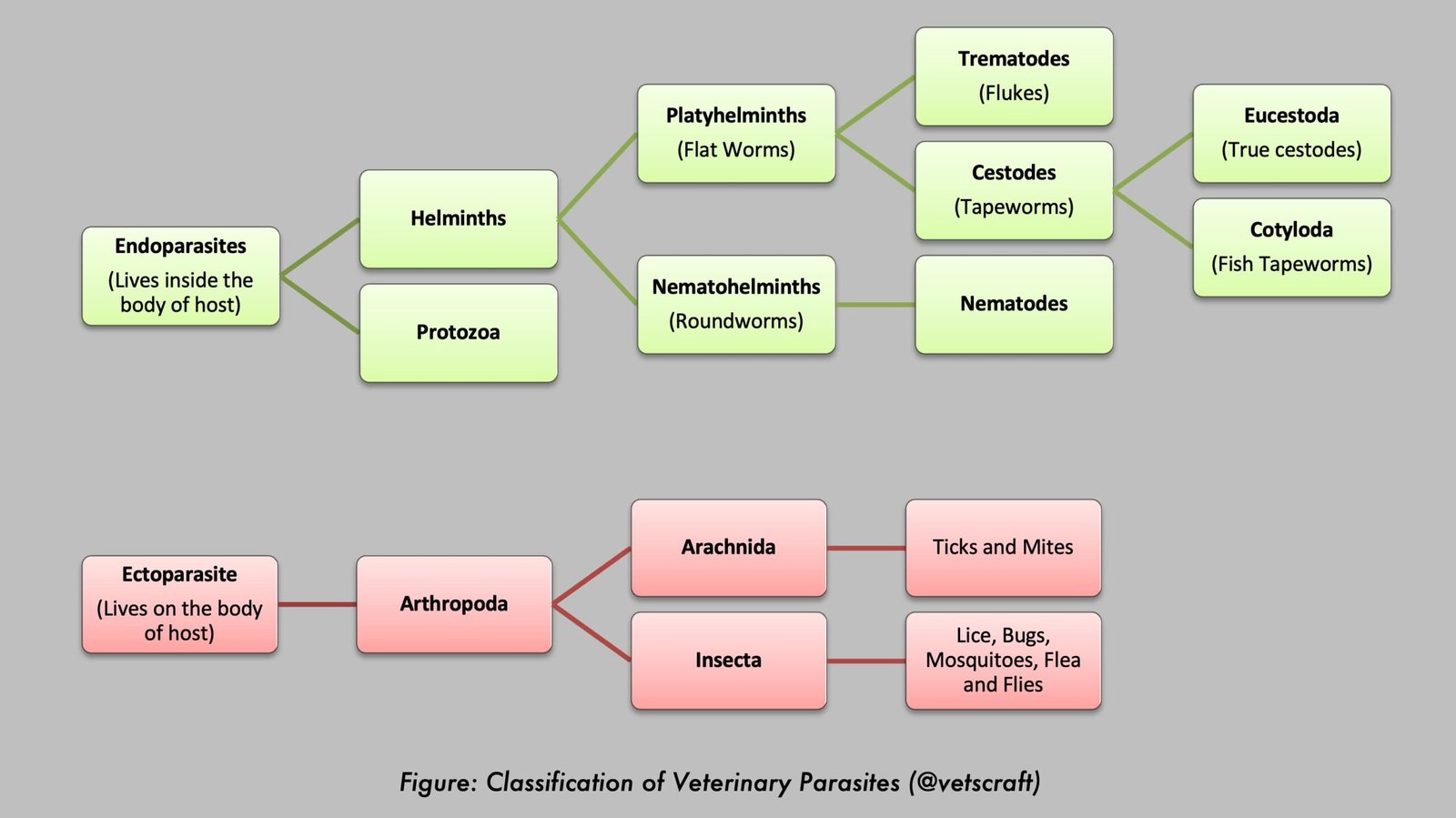
Equine tapeworms are cestode parasites that infect the intestinal tract of horses and other equids. Among them, Anoplocephala perfoliata is the most common and clinically significant species, frequently found at the ileocecal junction.
Although light infections are often asymptomatic, heavy infestations may lead to poor body condition, intestinal disturbances, colic, and, in severe cases, intestinal obstruction or perforation. Equine tapeworms have an indirect life cycle involving oribatid mites as intermediate hosts.
Anoplocephala perfoliata
- Species: Anoplocephala perfoliata
- Common Name: Dwarf tapeworm of horses, “lappet tapeworm”
- Location: Primarily at the ileocecal junction, cecum, and adjacent ileum
Morphology
- Adults are up to 5–8 cm in length.
- The scolex has a lappet behind each sucker.
- Segments are wider than long.
- Segments have a single set of reproductive organs.
- The genital pore is marginal.
Life Cycle
- Oribatid mites (grass mites) act as the intermediate host (I/H); a common species is Scheloribates laevigatus.
- Eggs are passed in the feces of the host and are ingested by the oribatid mite.
- Eggs hatch in the intermediate host and develop into cysticercoids in about 4 months.
- The final host acquires infection by ingesting infected mites along with herbage.
- The prepatent period is 4 to 6 weeks.
Pathogenesis
- Anoplocephala perfoliata is a common tapeworm of horses. Light infections usually cause no clinical signs.
- However, heavy infections may cause ill health, unthriftiness, and even death. The worms are usually localized at the ileocecal orifice, where they may cause partial occlusion.
- A small, dark, depressed ulcerative lesion may be seen at the site of scolex attachment.
- Intestinal perforation has also been reported.
Treatment
- Mebendazole: 15–20 mg/kg body weight (oral)
- Niclosamide: 88 mg/kg body weight (oral)
- Bithionol: 7 mg/kg body weight (oral)
- Praziquantel: 1 mg/kg body weight (oral)
Paranoplocephala mamillana
- They are smaller, measuring only 1–5 cm in length and approximately 0.5 cm in width.
- The scolex is narrow, and the suckers are slit-like rather than round.
- Lappets are absent.