TABLE OF CONTENTS
Haematopota (Clegs): Morphology and Veterinary Significance
Haematopota is commonly called the cleg, large gray fly, gad fly, etc. It belongs to the family Tabanidae and is a blood-feeding fly of veterinary importance. Adult flies are recognized by their mottled wings and distinctive banded eyes, while the larvae are carnivorous and develop in soil.
In veterinary parasitology, Haematopota species are important because they transmit several pathogenic organisms, particularly trypanosomes, affecting livestock. This article covers the morphology and veterinary significance of Haematopota.
Morphology
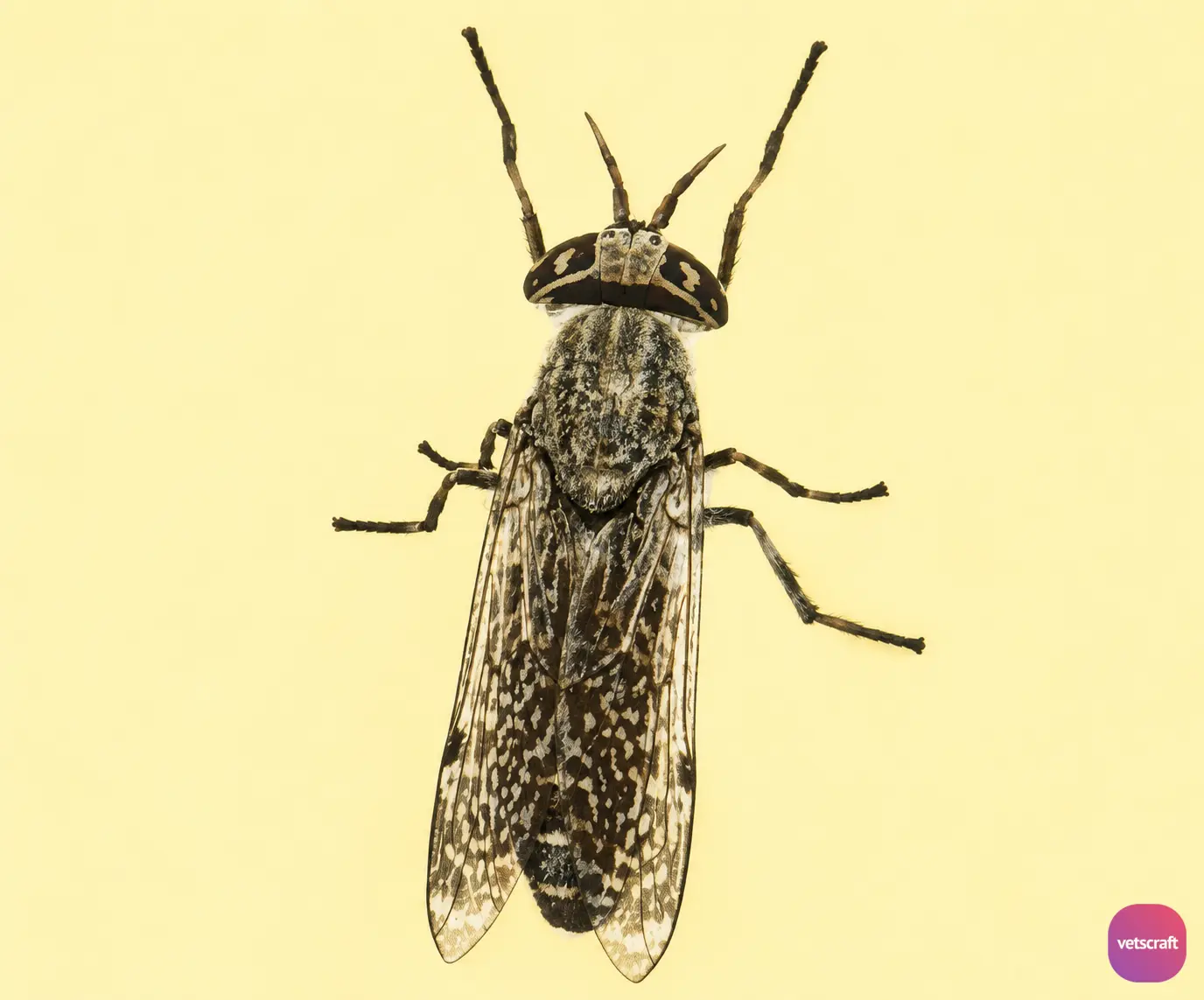
- These are medium-sized, dark-colored flies.
- Ocelli are present and have zigzag bands.
- The antennae have 3 segments, and the 3rd segment is longer than the 1st and 2nd segments combined and has 3 annulations.
- The wings show numerous pale blotches on a dark background, giving a mottled appearance. A broad brown crossband extends from the anterior border to the posterior border. The 3rd longitudinal vein is forked.
- Larvae are carnivorous, cannibalistic, and edaphic (occurring in soil).
Veterinary Significance
The fly acts as a mechanical vector for Trypanosoma evansi and a cyclical vector for Trypanosoma theileri in cattle.