Notoedres cati: Morphology, Life Cycle, Pathology, Treatment and Control
Notoedres cati is a burrowing sarcoptid mite that primarily affects cats and causes notoedric mange, a highly contagious and intensely pruritic skin disease. The infestation typically begins around the ears, face, and neck and may spread to other areas of the body. Understanding its morphology, life cycle, pathology, and transmission is important for diagnosis, treatment, and control of notoedric mange.
Notoedres cati is a mite belonging to the family Sarcoptidae. It is commonly seen in cats and is occasionally seen as a temporary parasite in dogs.
Notoedres cati has also been reported in rabbits, where it can cause severe mange of the face and head.
Morphology
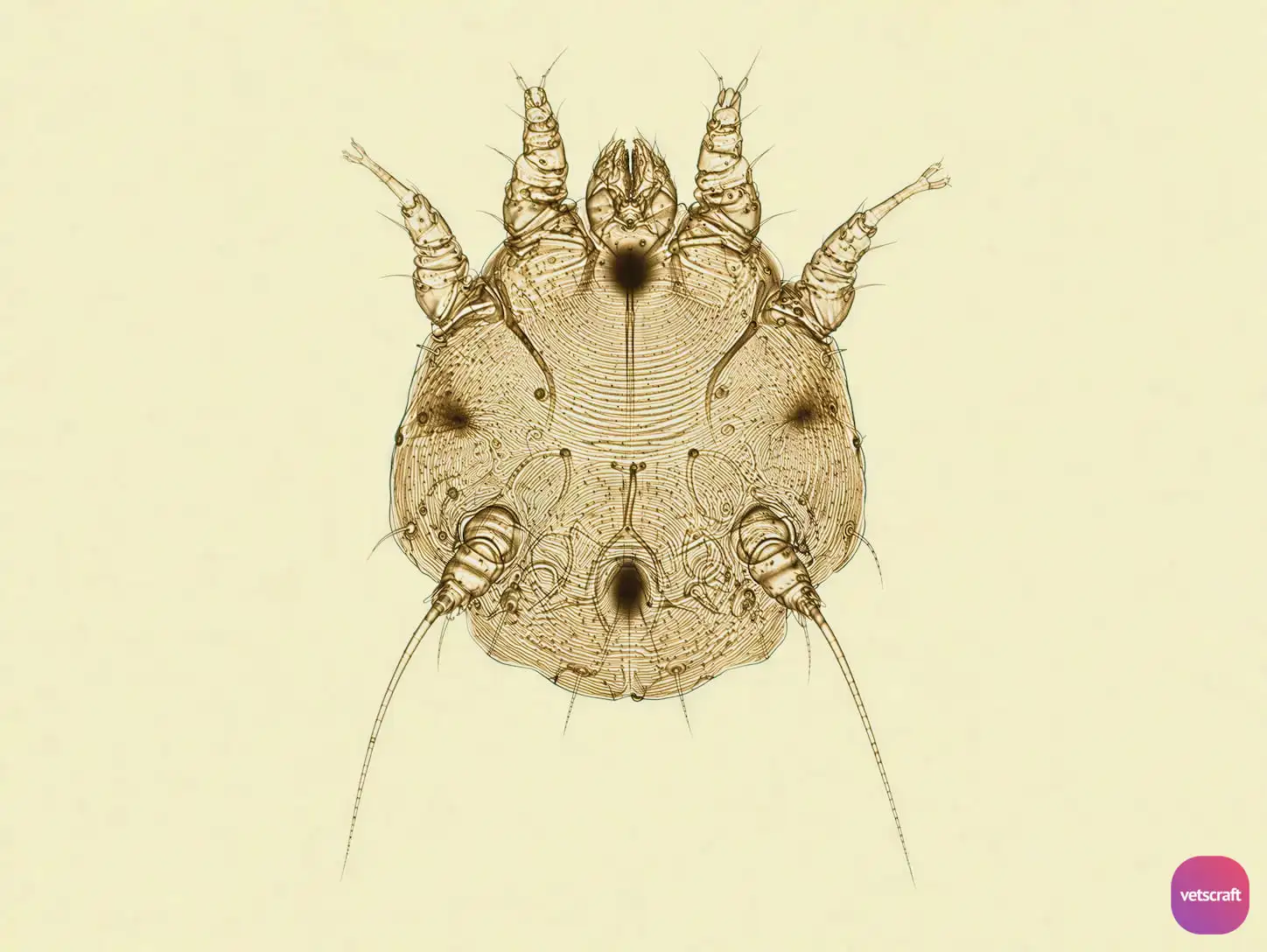
- Smaller in size than Sarcoptes; body is globose.
- Striae are interrupted by scaly or spinose areas. Dorsal striations tend to be arranged in concentric rings (thumbprint-like).
- Dorsal scales are rounded and arranged transversely; they are not projecting or pointed.
- Dorsal setae are simple and not spine-like.
- Two vertical setae are present on the dorsum of the propodosoma.
- Legs are short, and pedicels are unsegmented. The pattern of distribution of suckers and bristles on the legs of male and female mites is similar to that of Sarcoptes.
- A major point of differentiation is the dorsal anus in Notoedres compared with the posterior terminal location in Sarcoptes.
- The male has suckers on legs 1, 2, and 4, whereas the female has suckers on legs 1 and 2.
Life Cycle
The life cycle is similar to that of Sarcoptes. The female mite burrows into the epidermis and lays eggs. The eggs hatch into larvae, which develop through nymphal stages before reaching adulthood. The complete life cycle takes approximately 3 weeks.
Pathology
The burrowing activity of the female mite damages keratinocytes, leading to cytokine release and cutaneous inflammation.
Hypersensitivity may also be involved in the dermatitis. The mites occur in clumps in the skin around the head and ears and then spread to other parts of the body.
It is highly contagious and is transmitted primarily through close direct contact, with larvae and nymphs contributing to transmission between hosts. Infestation results in scale formation on the tips of the ears and over the face and neck.
The dermatitis causes intense scratching and hair loss. If untreated, the affected animal can become severely debilitated and may die within 4–6 months.
Treatment and Control
- Selamectin: Applied topically as a spot-on treatment. It is an effective and commonly used option for notoedric mange in cats.
- Moxidectin: Topical imidacloprid/moxidectin formulations have been used effectively in cats.
- Fluralaner: Isoxazolines, including fluralaner, have demonstrated efficacy against Notoedres cati and are increasingly used as convenient topical treatments in cats.
- Ivermectin: Ivermectin may be used extra-label at approximately 0.2–0.3 mg/kg by the oral or subcutaneous route, with treatment repeated according to the clinical response.
- Lime sulfur: A 2–3% lime sulfur dip can be applied at approximately weekly intervals for several treatments. It is an effective topical option, particularly when other acaricides are unsuitable.
- Treatment of in-contact cats: Because notoedric mange is highly contagious, all in-contact cats should be treated, including those that do not yet show clinical signs.
- Environmental control: Bedding, grooming equipment, and other items that have prolonged contact with affected cats should be cleaned regularly.
- Supportive treatment: Severe crusting, pruritus, secondary bacterial infection, and self-trauma should be managed as indicated. Thick crusts may be gently removed after appropriate softening of the affected skin.