Ticks vs. Mites: Key Differences in Veterinary Parasitology
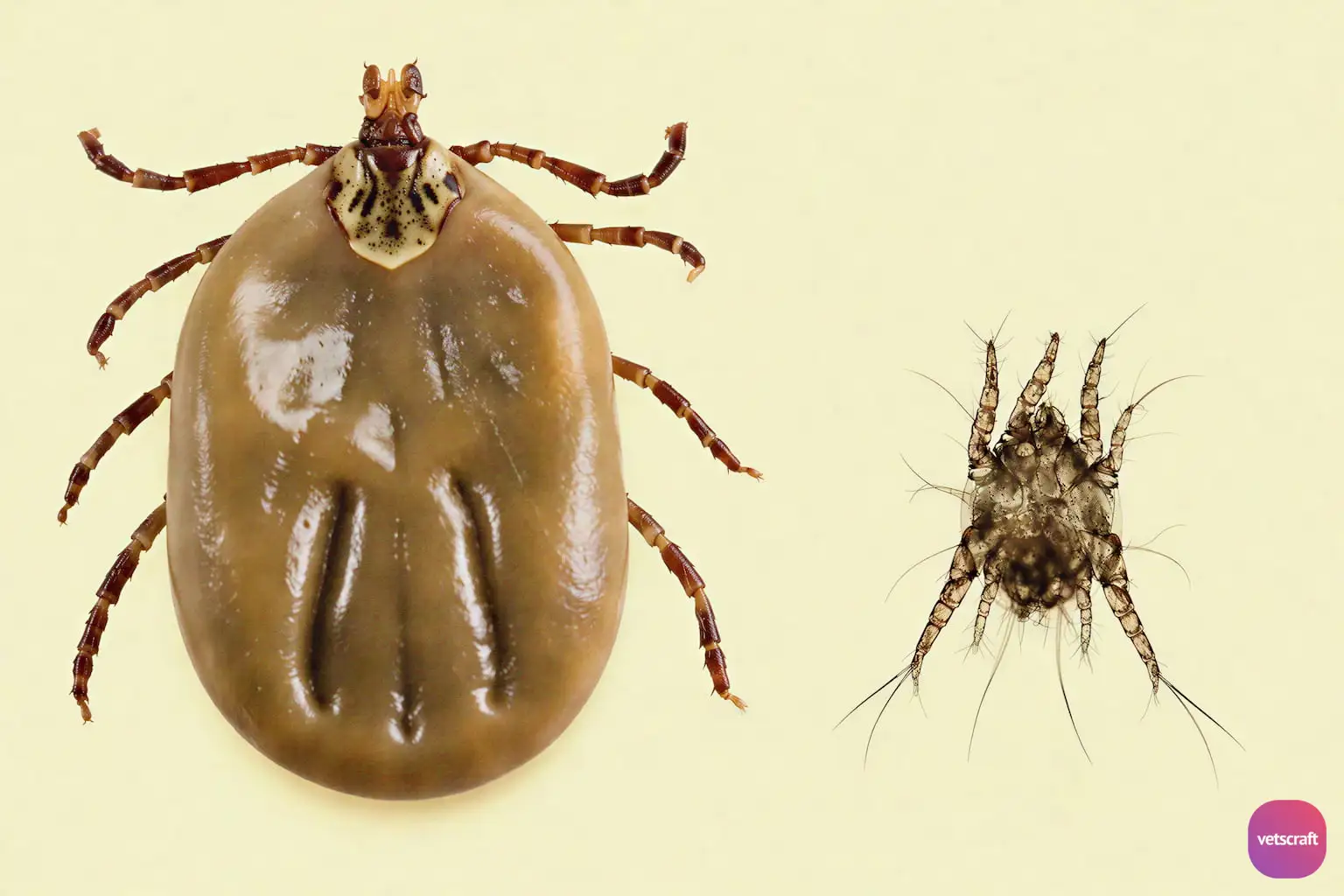
Ticks and mites are important groups of arachnids encountered in veterinary parasitology, with several species acting as significant ectoparasites of domestic animals. Although both belong to the class Arachnida, they differ considerably in their morphology, body structure, mouthparts, appendages, and other anatomical features.
The following table highlights the key differences between ticks and mites to aid in their identification and differentiation.
| Ticks | Mites |
|---|---|
| All are parasitic | Most are free-living, while some are parasitic |
| Larger in size; body lacks hairs | Very small; some are microscopic. The body has numerous hairs and bristles. |
| Chelicerae end in digits | Chelicerae may be needle-like |
| Pedipalps are jointed | Pedipalps are unjointed |
| Hypostome is well developed and armed | Hypostome is not well developed |
| Mammillations are present | Mammillations are absent; bristles, setae, and scales are present |
| Eyes may be present or absent | Eyes are absent |
| Legs end in pulvilli | Legs end in ambulacra |
| No divisions of the idiosoma | Idiosoma is divided into the notothorax and notogaster |
| Epimeres are absent | Epimeres are present. They are internal chitinous projections of the coxae that extend into the body as rod-like structures. |