Hard Ticks vs. Soft Ticks: Key Differences Between Ixodidae and Argasidae
Hard ticks (Ixodidae) and soft ticks (Argasidae) are two major families of ticks with distinct morphological, biological, and feeding characteristics. They differ in features such as the scutum, position of the mouthparts, pedipalps, spiracles, feeding behavior, nymphal stages, mating, and egg-laying patterns.
Understanding these differences is important for accurate tick identification and veterinary parasitology.
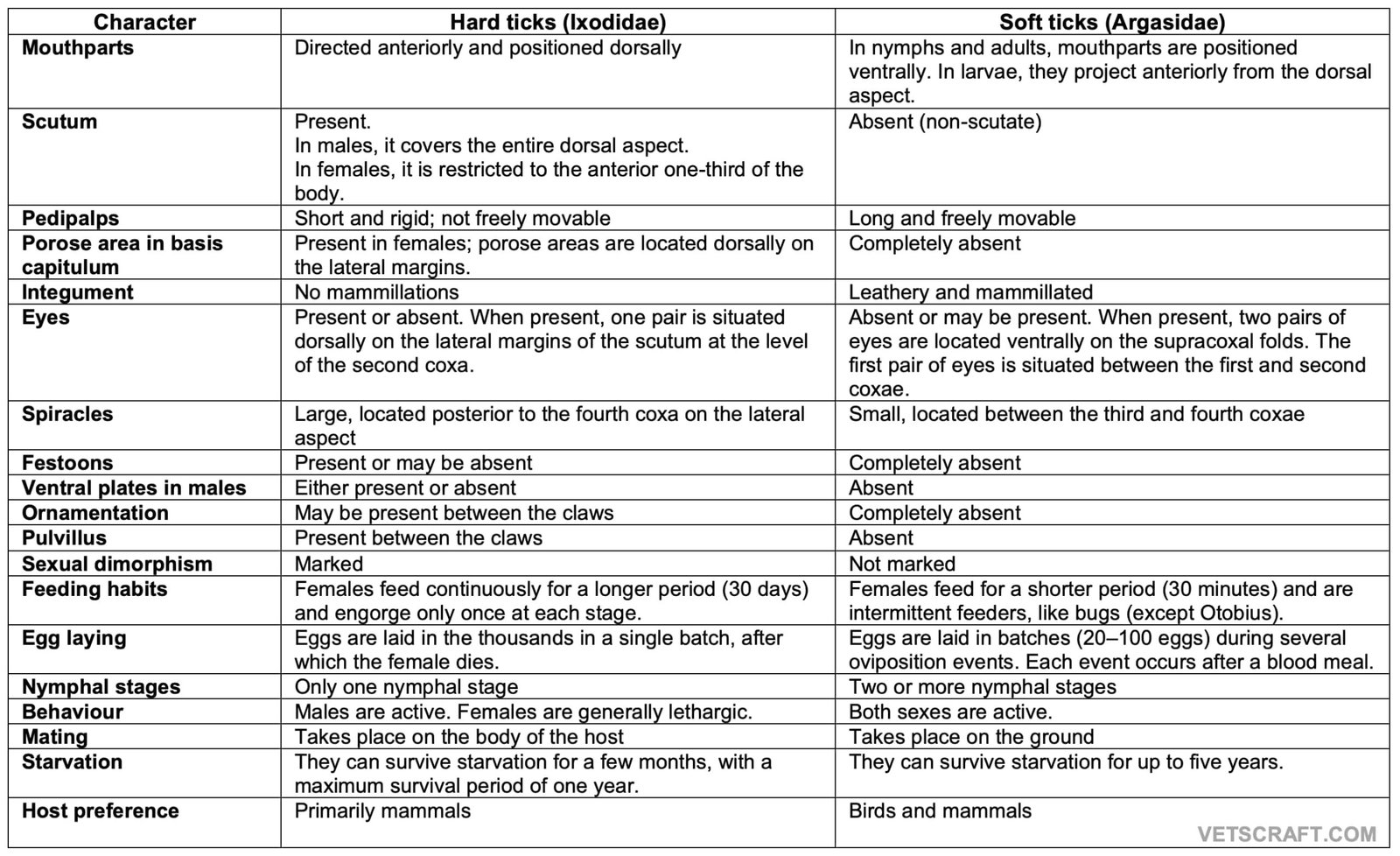
| Character | Hard ticks (Ixodidae) | Soft ticks (Argasidae) |
|---|---|---|
| Mouthparts | Directed anteriorly and positioned dorsally | In nymphs and adults, mouthparts are positioned ventrally. In larvae, they project anteriorly from the dorsal aspect. |
| Scutum | Present. In males, it covers the entire dorsal aspect. In females, it is restricted to the anterior one-third of the body. | Absent (non-scutate) |
| Pedipalps | Short and rigid; not freely movable | Long and freely movable |
| Porose area in basis capitulum | Present in females; porose areas are located dorsally on the lateral margins. | Completely absent |
| Integument | No mammillations | Leathery and mammillated |
| Eyes | Present or absent. When present, one pair is situated dorsally on the lateral margins of the scutum at the level of the second coxa. | Absent or may be present. When present, two pairs of eyes are located ventrally on the supracoxal folds. The first pair of eyes is situated between the first and second coxae. |
| Spiracles | Large, located posterior to the fourth coxa on the lateral aspect | Small, located between the third and fourth coxae |
| Festoons | Present or may be absent | Completely absent |
| Ventral plates in males | Either present or absent | Absent |
| Ornamentation | May be present between the claws | Completely absent |
| Pulvillus | Present between the claws | Absent |
| Sexual dimorphism | Marked | Not marked |
| Feeding habits | Females feed continuously for a longer period (30 days) and engorge only once at each stage. | Females feed for a shorter period (30 minutes) and are intermittent feeders, like bugs (except Otobius). |
| Egg laying | Eggs are laid in the thousands in a single batch, after which the female dies. | Eggs are laid in batches (20–100 eggs) during several oviposition events. Each event occurs after a blood meal. |
| Nymphal stages | Only one nymphal stage | Two or more nymphal stages |
| Behaviour | Males are active. Females are generally lethargic. | Both sexes are active. |
| Mating | Takes place on the body of the host | Takes place on the ground |
| Starvation | They can survive starvation for a few months, with a maximum survival period of one year. | They can survive starvation for up to five years. |
| Host preference | Primarily mammals | Birds and mammals |