Chorioptes bovis Mites in Animals: Morphology, Life Cycle, Pathology & Treatment
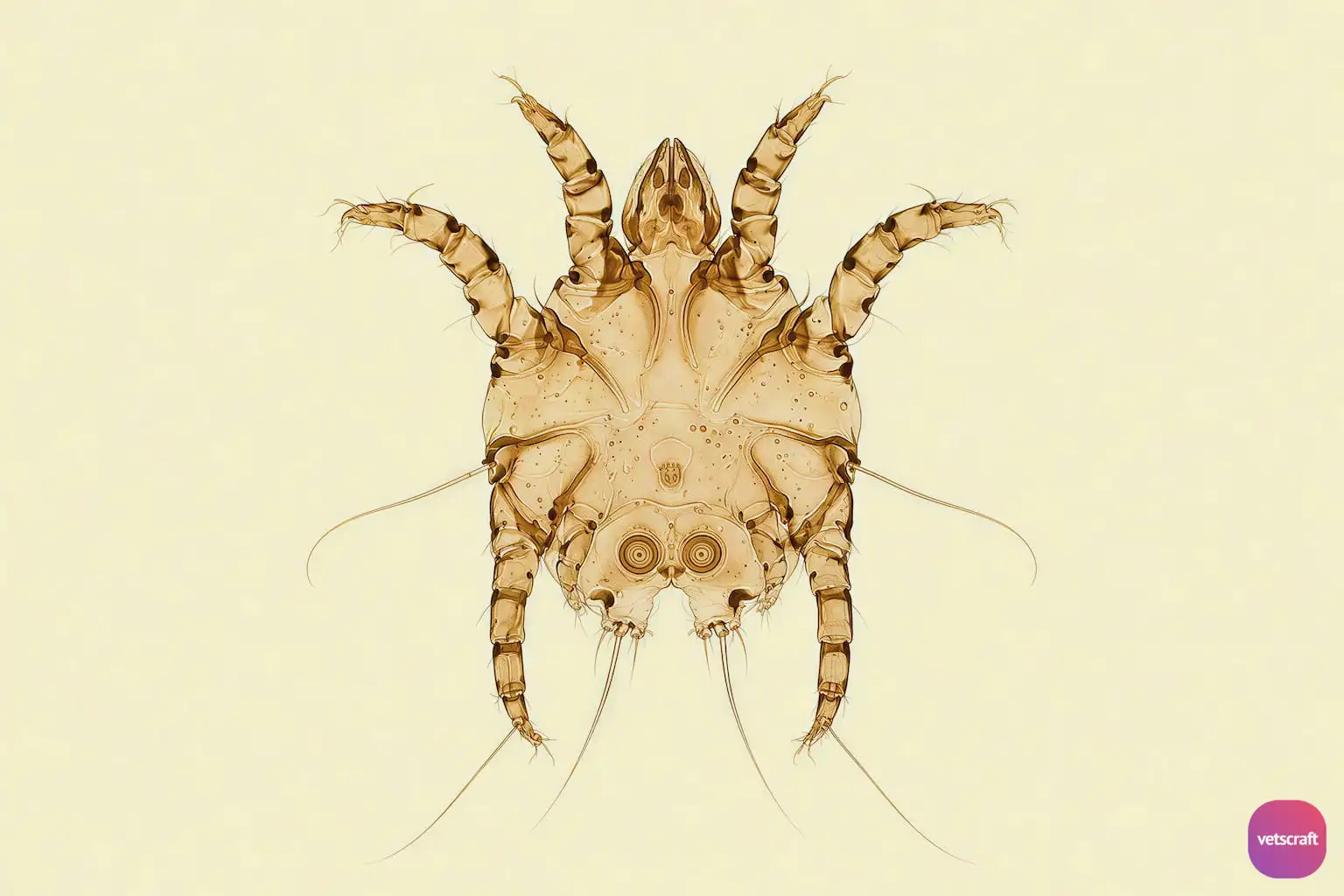
Chorioptes bovis is a mite belonging to the family Psoroptidae. Chorioptes mites cause tail or foot mange and are non-burrowing mites that live on the surface of the skin. They primarily affect cattle, sheep, goats, and horses and can cause irritation, crusting, scab formation, and pruritus. These mites can be identified by their very short, unjointed pedicels and cup-shaped suckers.
This article discusses the morphology, life cycle, pathology, clinical signs, and treatment of Chorioptes infestation in different animal species.
NOTE
Chorioptes bovis is an important species associated with chorioptic mange in domestic animals. The names C. ovis, C. caprae, and C. equi have historically been used for mites found on sheep, goats, and horses, respectively, and are generally treated as synonyms of C. bovis.
Morphology
Chorioptes mites are smaller than Psoroptes ovis. The mouthparts are rounded and adapted for chewing. The pretarsi are short and unjointed and bear cup-shaped pulvilli. The first and second pairs of legs are stronger than the others, and the fourth pair has long, slender tarsi.
In the male, all four pairs of legs possess short, unjointed pretarsi bearing cup-shaped pulvilli. The fourth pair is shorter and does not extend beyond the body margin. In the female, pretarsal suckers are present on the first, second, and fourth pairs of legs, while the fourth pair is relatively long. The male has prominent posterior abdominal lobes and a pair of copulatory suckers.
Life Cycle
The life cycle is very similar to that of Psoroptes mites.
Pathology
In cattle, the mites cause lesions at the base of the tail, perineum, and udder. If untreated, the condition may spread to the sacral region and other parts of the body. Scabs and scales develop on the skin of the lower parts of the body. There is some exudation and crust formation on the lower body and legs, but this does not spread over a wide area. Cattle may stamp and scratch the affected areas.
The mites cause irritation, and heavy infestations have been associated with decreased milk production. The mite feeds on the external surface of the skin, causing inflammation, exudation, and scab formation, leading to loss of condition, emaciation, and damage to hides.
In sheep (leg mange or foot scab), lesions occur on the pasterns of the hind limbs and the ventral abdomen, producing papules and scabs. Similar lesions may be seen on the scrotum of rams. Sometimes, crusts and ulceration may develop, which can lead to temporary infertility in rams if the scrotum is affected. Chorioptic mange is considerably less severe than psoroptic mange and, as with psoroptic mange, is primarily a “winter disease.”
In goats, infections usually begin on the lower legs and later spread to the hindquarters. Infections cause itching, crust, and scab formation.
In horses, this species causes “foot mange” or “itchy leg,” characterized by itching and scab-like lesions at the fetlocks (especially in horses with long hair in this region), which cause horses to rub, stamp, scratch, and bite their legs and kick frequently. The lesions include erythema, crusts, ulceration, and alopecia with marked pruritus.
Treatment
- Lime sulfur (5% solution) dip or spray, repeated at 7–10-day intervals for several treatments.
- Ivermectin at 200 microgram/kg body weight may be used in cattle and other susceptible species; the dose, route, and treatment interval vary with the species and product.
- Moxidectin may be used as an alternative macrocyclic lactone.
- Permethrin or other approved pyrethroid products may be used topically in some livestock species.
- In horses, topical lime sulfur treatment is an important option. Oral ivermectin or moxidectin may also be used, although treatment may require repeated administration and is often extra-label.
- Clipping long hair or feathering and removing crusts before topical treatment can improve treatment efficacy, particularly in horses with heavily feathered limbs.
- All in-contact susceptible animals should be examined and treated when necessary, and grooming equipment, housing, and other fomites should be thoroughly cleaned.