TABLE OF CONTENTS
Chrysops (Deer Fly and Mango Fly): Morphology, Veterinary Importance, and Disease Transmission
Chrysops is a genus of blood-feeding flies of veterinary and medical importance that includes species commonly known as deer flies and mango flies. These flies are important vectors of several pathogens, including the protozoan Trypanosoma evansi and the filarial nematode Loa loa. This article provides an overview of the morphology, important species, and disease transmission associated with Chrysops in veterinary parasitology.
Parasite Overview
- Genus: Chrysops
- Chrysops Species: Chrysops dispar (deer fly), Chrysops dimidiata (mango fly)
Chrysops dispar is known as the deer fly because its preferred habitat is woodland.
Chrysops dimidiata is commonly called the mango fly because it is most abundant during the mango season and is frequently encountered around mango orchards.
Morphology of Chrysops
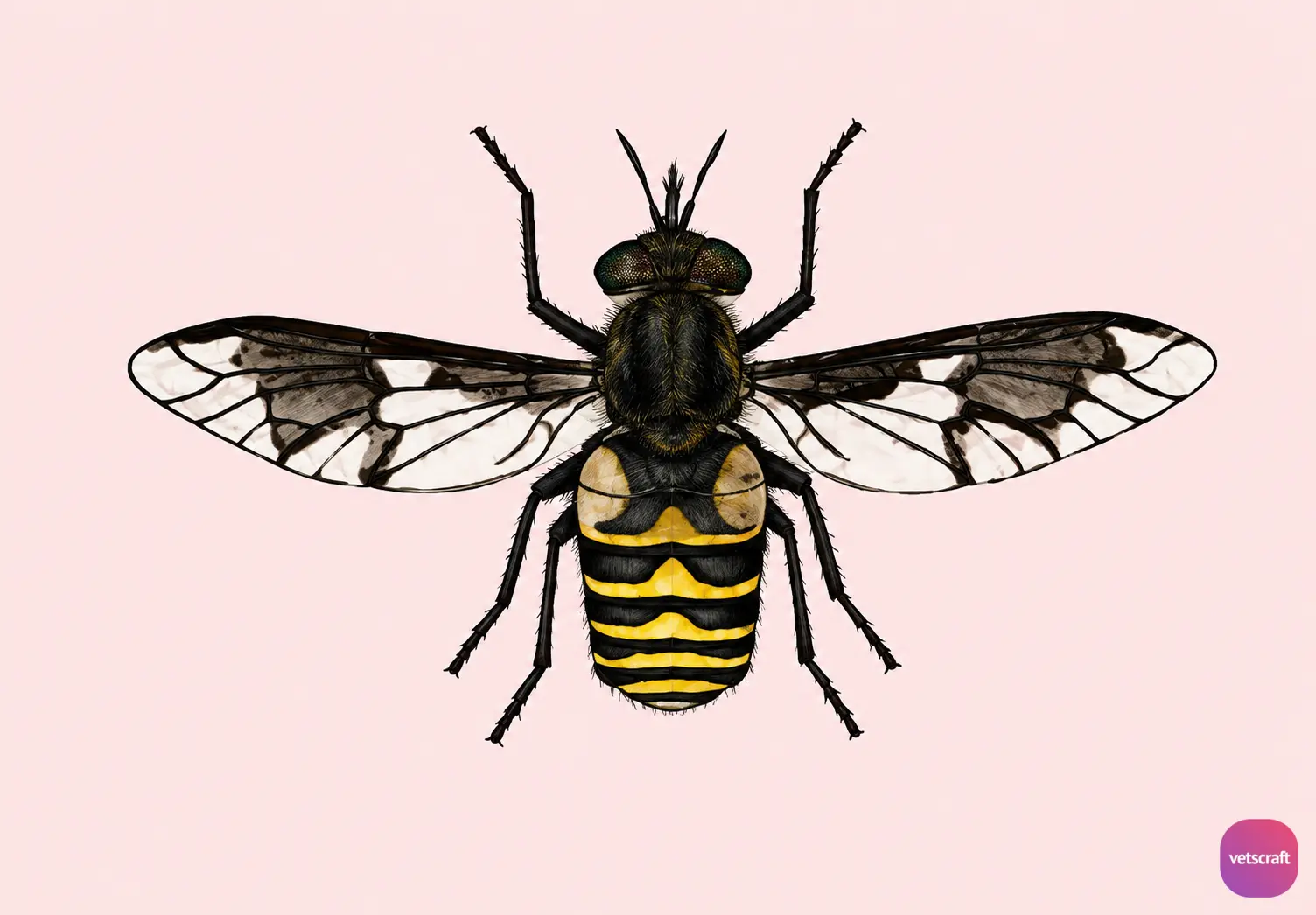
- Chrysops is somewhat smaller than Tabanus flies. It has two metallic-colored compound eyes. In addition, simple eyes (ocelli) are also present.
- The antennae consist of three segments of approximately equal length. The last segment does not have a spur but has four annulations.
- The wings show a broad brown crossband extending from the anterior border to the posterior border. The 3rd longitudinal vein is forked.
- The abdomen shows yellow bands.
- Larvae feed on decaying vegetation and are hydrobionts (occurring in the wettest areas).
Medical and Veterinary Importance
These flies have an affinity for human hair and transmit the filarial nematode Loa loa in humans, as well as tularemia in humans and animals.
These are very fast-moving flies and mechanically transmit the protozoan T. evansi, which causes surra.