TABLE OF CONTENTS
Tabanus (Horse Fly) in Veterinary Parasitology: Morphology, Life Cycle, Pathogenesis & Control
Tabanus (Horse Fly) is one of the largest flies of veterinary importance, belonging to the family Tabanidae. It possesses cutting and sponging type mouthparts, and the pseudotracheal membrane helps lap up blood during feeding. Female horse flies are aggressive blood feeders that attack livestock and other animals, causing painful bites, blood loss, stress, and reduced productivity.
In addition to their direct effects, they serve as important mechanical and biological vectors of several bacterial, viral, and parasitic pathogens. This article provides a comprehensive overview of Tabanus (Horse Fly), including its classification, morphology, life cycle, pathogenesis, veterinary importance, and control measures.
Parasite Overview
- Suborder: Brachycera
- Family: Tabanidae
- Genus: Tabanus
- Species: Tabanus striatus
- Common Names: Horse fly, Blind fly, Gad fly, Breeze fly, Green-headed fly, Marsh fly
Tabanus (Horse Fly) is known by various names:
- Horse Fly: Since the fly breeds around horse manure, it is called the Horse fly.
- Blind Fly: These flies bite randomly on any animal that comes in their path. Therefore, they are called Blind flies.
- Gad Fly: Animals fear the bite of these flies and try to avoid them by running away frantically; hence, they are called Gad flies.
Morphology of Tabanus (Horse Fly)
- The flies are large and robust.
- They have large compound eyes, which are holoptic in males and dichoptic in females, and ocelli are absent.
Antenna
The antenna is three-segmented. The 1st segment is short, the 2nd segment is even shorter, and the 3rd segment is as long as the first and second segments combined. The third segment has a basal spur and four annulations.
Mouthparts
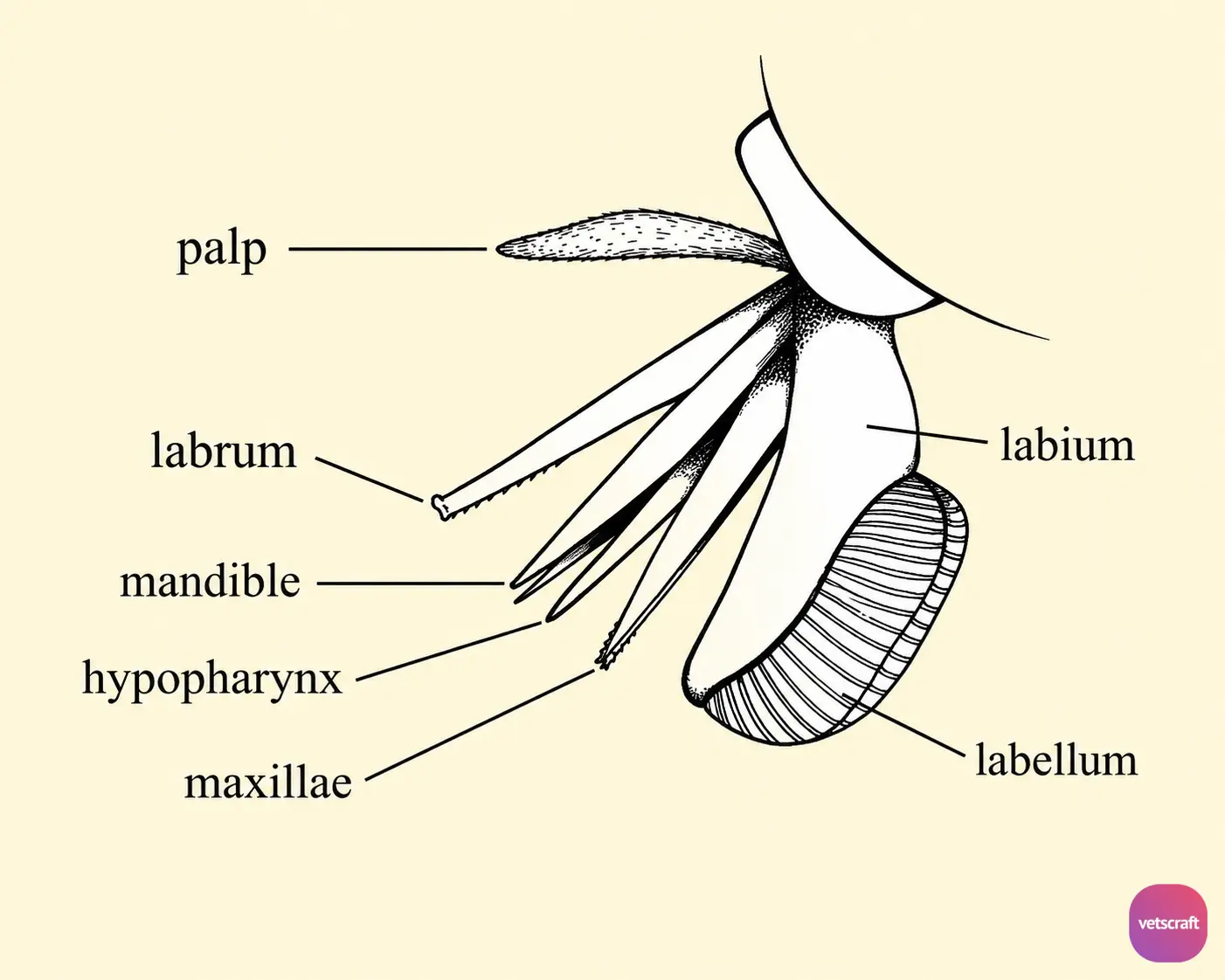
The maxillary palp is two-segmented. The labrum-epipharynx is elongate. They possess a hypopharynx for sucking blood, a pair of well-developed serrated mandibles, and well-developed maxillae. The labium ends in labella covered with a pseudo-tracheal membrane.
General Characteristics
- Only the female sucks blood, whereas the male feeds on plant juices.
- They have powerful wings. The third longitudinal vein is forked and forms a “Y” near the wing tip. During rest, the wings are held over the abdomen.
- The thorax has several longitudinal stripes on its dorsal surface.
- The abdomen is well developed and has numerous spots.
Life Cycle
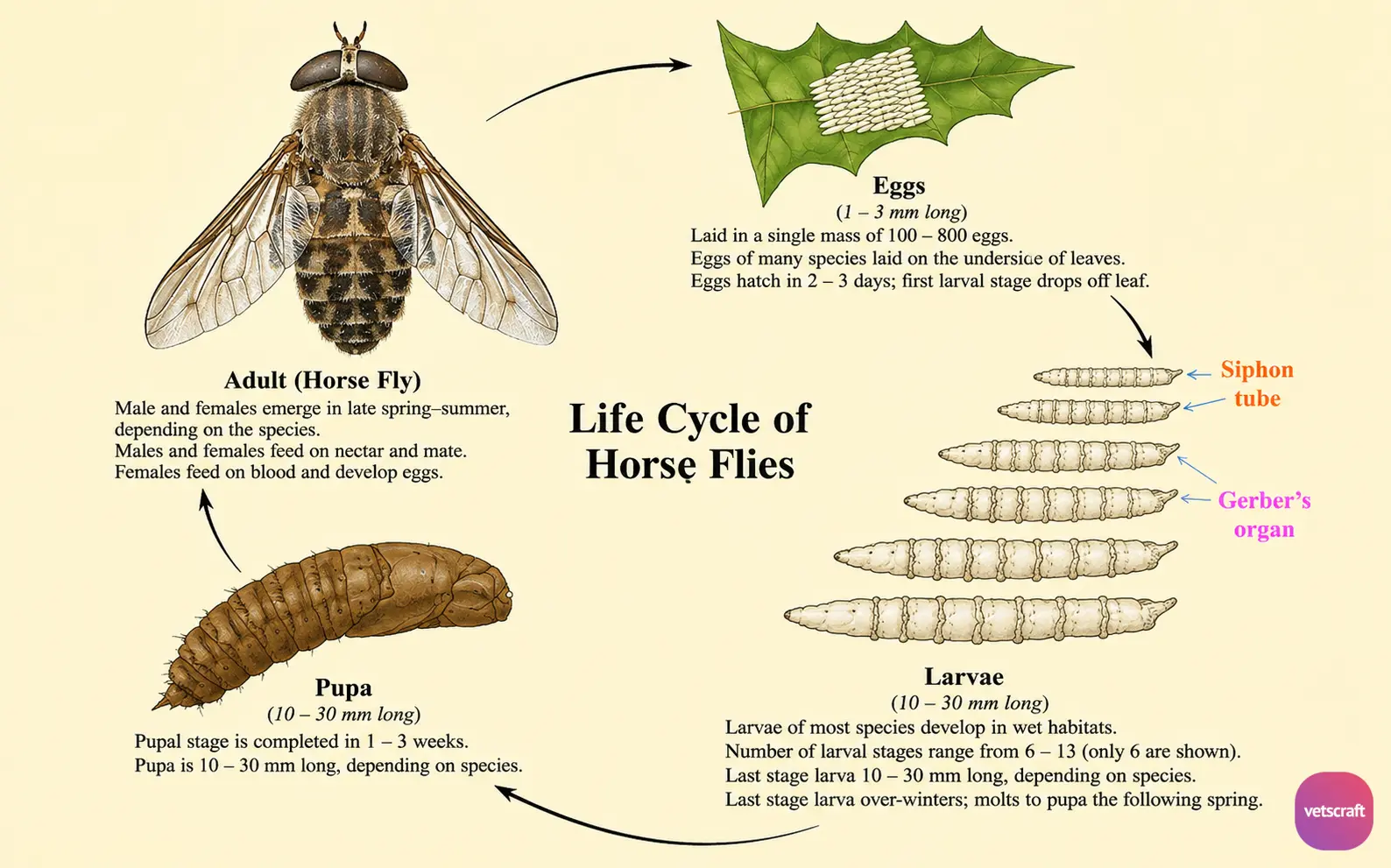
The life cycle of Tabanus (Horse Fly) is complete (holometabolous) and consists of four developmental stages: egg, larva, pupa, and adult. The duration of the life cycle varies depending on environmental conditions but is typically completed in about 4–5 months under favorable conditions.
Eggs
Eggs are laid by the female on mud, water, or overhanging vegetation such as plant stems, and also on the ventral surface of leaves. About 500–600 eggs are laid at a time and are firmly attached to the surface. These eggs are cigar-shaped and cream-colored.
Larva
The larva emerges from the egg by making a slit. There are six larval stages. Larvae are predaceous, carnivorous, cannibalistic, and hemi-hydrobionts (occurring in soil or mud near water). The larval period lasts 3–4 months. The larva has a head, three thoracic segments, and eight abdominal segments. The abdominal segments bear wart-like protuberances called pseudopods. The eighth segment has a breathing tube called a siphon tube. The pupa emerges from the larva.
Pupa
The pupa has a cephalothorax. It has eight abdominal segments and ear-shaped thoracic gills. The entire life cycle takes about 4–5 months under favorable conditions. Mating between males and females takes place near the breeding site. Adult flies are very strong fliers and can even chase a fast-moving train.
Pathogenesis
Tabanus (Horse Flies) are very fond of sunlight and are seen in large numbers during summer.
The flies attack many livestock animals such as cattle and horses. Birds are generally not affected. They commonly bite the underside of the abdomen, the navel region, neck, withers, back, and hind legs. They are intermittent feeders, strong fliers, and aggressive biters.
The bite of the fly causes painful swelling. Due to their intermittent feeding habit, animals become frightened and run about frantically. During this time, animals may collide with barbed wire, resulting in skin injuries. Once feeding has started, the flies are difficult to dislodge and leave behind an oozing wound. This can lead to secondary bacterial infection and attract myiasis-producing flies.
Animals become restless, and a single fly may suck up to 0.35 mL of blood per day. Due to the powerful bite, a large quantity of blood may ooze from the wound, and in thin-skinned animals, the bite produces wheals.
These flies act as mechanical vectors of Trypanosoma evansi and cyclical vectors of Trypanosoma theileri in cattle. They also transmit bacterial diseases such as anthrax, pasteurellosis, and Francisella tularensis; viral diseases such as rinderpest, equine infectious anemia, hog cholera, and bovine leukemia; and parasitic diseases such as Anaplasma marginale, Besnoitia besnoiti, and Loa loa.
Control
Control is very difficult. Where drainage is feasible, breeding sites should be eliminated. Animals should be kept away from areas where flies are abundant during the hot months. Control measures are similar to those used for mosquitoes. Residual insecticide sprays can be applied to the interior walls of animal housing using chlorinated hydrocarbons, organophosphorus compounds such as malathion, and synthetic pyrethroids.
The flies have a habit of skimming over water and occasionally dipping their bodies into it. Therefore, pouring kerosene on water can kill the flies when they come into contact with it.
Biocontrol
Hymenopteran insects such as Hunterellus hookeri and Telenomus spp. feed on the eggs of Tabanus. Some species of wasps also prey on the eggs.