TABLE OF CONTENTS
Simulium indicum (Black Fly): Morphology, Life Cycle, Pathogenesis & Vector Potentiality
Simulium indicum, commonly known as the Black Fly, belongs to the family Simuliidae and is a medically and veterinary important blood-feeding fly. It is widely distributed in hilly regions with fast-flowing streams, where its immature stages develop. Adult black flies are aggressive biters of humans, livestock, and poultry, causing irritation, blood loss, and, in some cases, severe toxic reactions.
They also serve as vectors of several pathogens, including filarial nematodes, protozoa, and viruses. This article covers the morphology, life cycle, pathogenesis, and vector potentiality of Simulium indicum.
- Family: Simuliidae
- Genus: Simulium
- Species: Simulium indicum
- Common Names: Black fly, Potu fly, Buffalo gnat, Turkey gnat
Simulium indicum (Black Fly) is primarily anthropophilic, although some species are zoophilic. They are virulent biters of humans and animals and also attack poultry. They are swiping fliers and are crepuscular in habit. They are found in hilly regions, particularly the Himalayas.
Morphological Characters
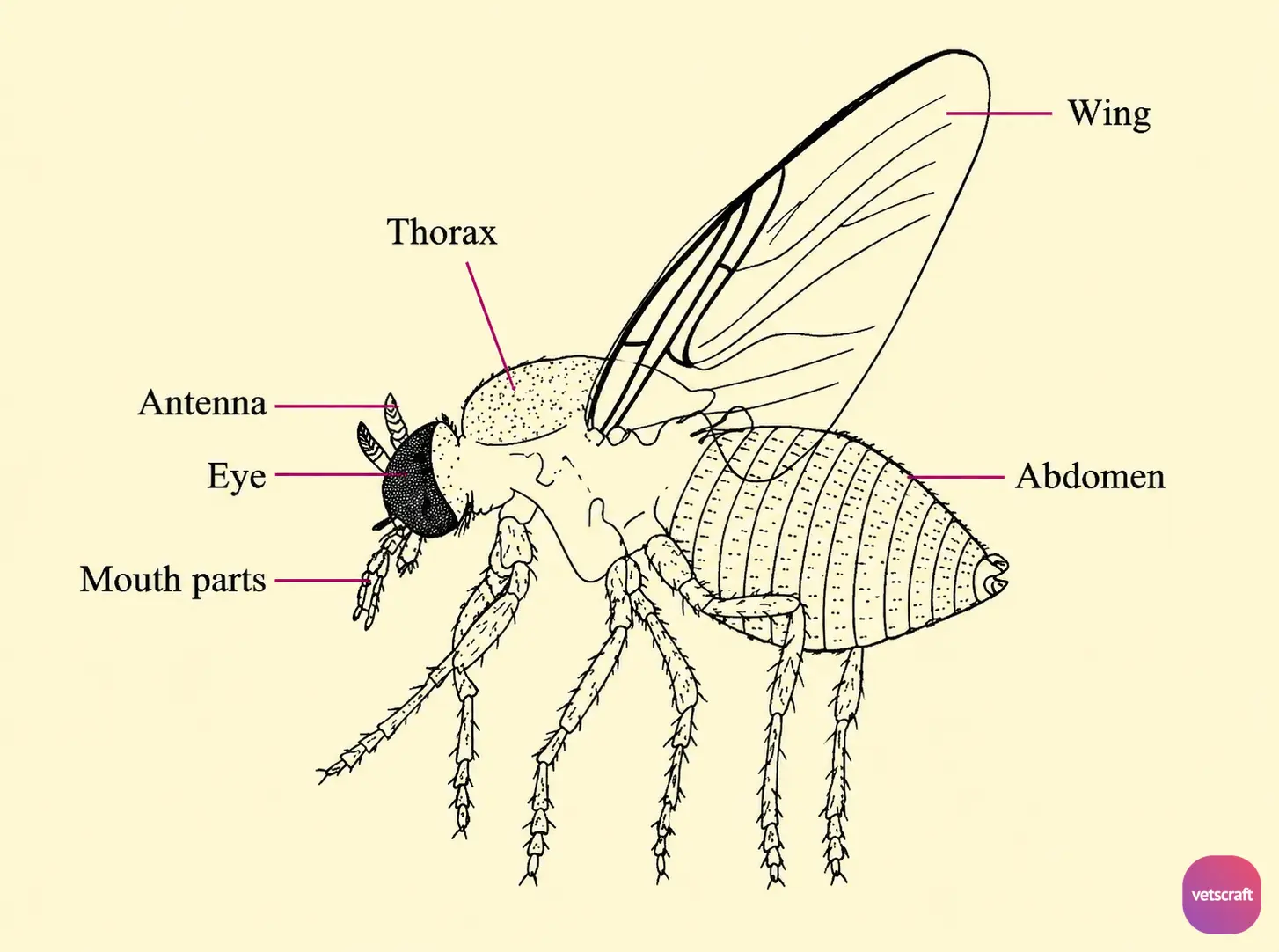
- Small, thickset, dark-colored fly.
- Mouthparts: Piercing and sucking type.
- Antennae are long, 11-segmented, bare, and project like horns.
- Thorax is humped over a small head.
- Eyes are holoptic in males and dichoptic in females.
- Maxillary palps are 4-segmented and carry a sensory pit called the Lutz organ on the third segment.
- Wings are broad and transparent. The anterior vein is thick, prominent, and bears bristles. The anal lobe is broad.
- The body is covered with silvery hairs.
Life Cycle
Egg
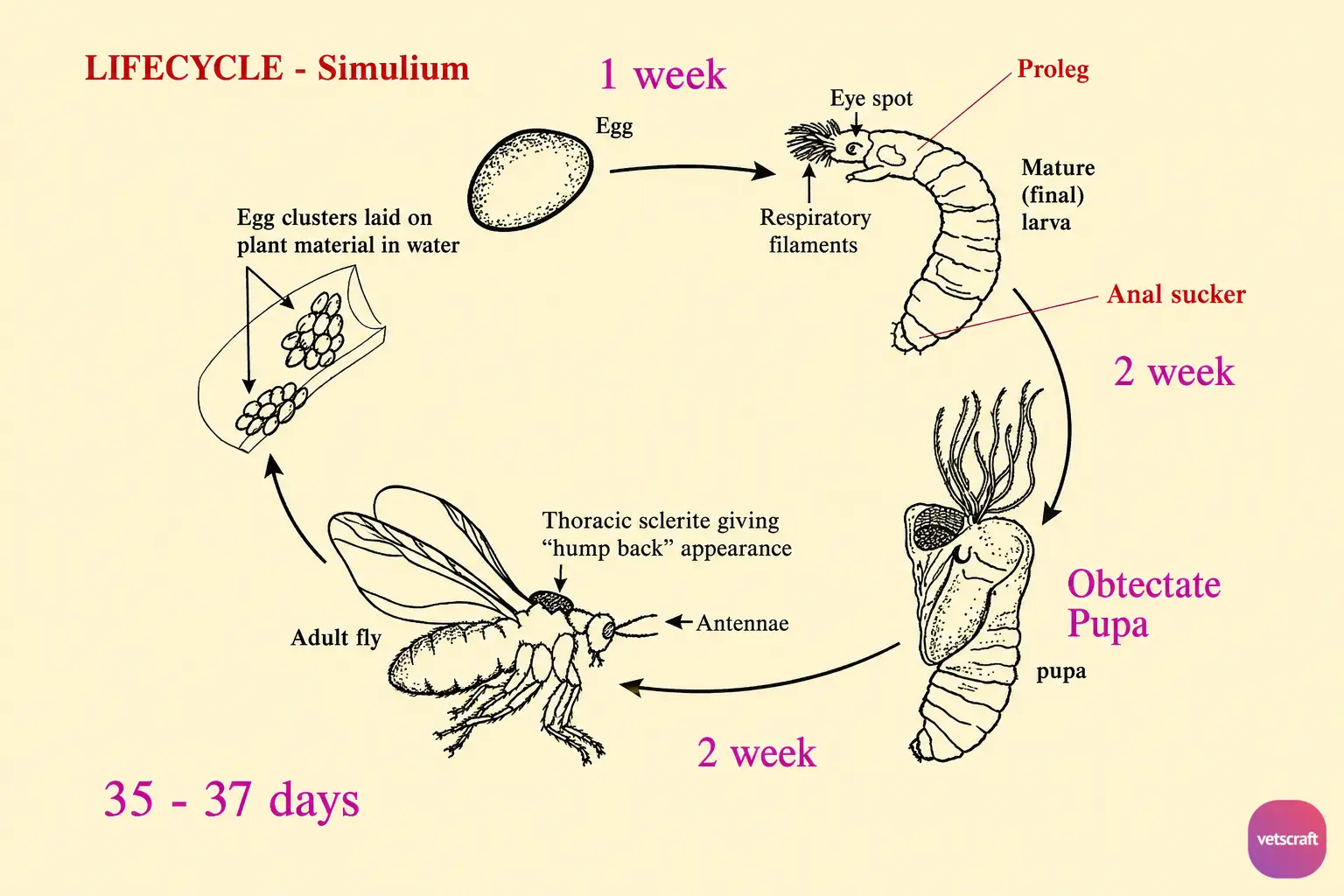
- Eggs are laid in batches (300–500) on stones or plants just below the water surface of running streams.
- Females lay several hundred eggs, which hatch in 4–12 days.
- Eggs are triangular, cream-colored when laid, and turn brown within 24 hours.
Larva
- There are six larval stages, lasting about 15 days. Larvae are carnivorous and predacious on aquatic organisms.
- Larvae are cylindrical or club-shaped and yellowish-brown in color.
- They have a small head with a pair of eyes, mouthparts, and a pair of brush-like organs.
- The prothorax bears an arm-like appendage called the proleg, which has a circlet of hooks.
- The abdomen is narrow anteriorly and bulbous posteriorly.
- The terminal abdominal segment has an anal sucker armed with hooks for attachment to rocks or vegetation.
- Larvae cling to plants or rocks using their anal suckers. They can also attach themselves to fast-moving objects or invertebrates such as crabs and are transported in this manner.
Pupa
- The pupa is obtect and lasts for about one week.
- The sixth larval stage spins a triangular cocoon using salivary secretions, which remains submerged in water.
- A tuft of 6–8 respiratory filaments is attached to the thoracic region.
- The pupa is attached to plants and rocks. Adult emergence takes place underwater.
Pathogenesis
Simulium indicum (Black Fly) causes annoyance and irritation and may produce an acute disease characterized by petechial hemorrhages on areas of thin skin and edema of the throat and abdomen. They commonly bite the legs, abdomen, head, and ears.
The bites give rise to vesicles that may rupture or develop into wart-like papules. These papules are commonly seen on the teats of cows and take about one week to heal. Some species inject toxins that are lethal to animals. In poultry, they can cause anemia.
Vector Potentiality
- Simulium indicum (Black Fly) acts as an intermediate host for filarial nematodes, including Onchocerca gutturosa of cattle and Onchocerca volvulus in humans, which causes river blindness. It also transmits tularemia.
- It transmits viruses such as Eastern equine encephalitis virus and vesicular stomatitis virus in cattle.
- It also acts as a vector for Leucocytozoon smithi of turkeys, Leucocytozoon simondi of ducks, and Leucocytozoon caulleryi in fowl.