TABLE OF CONTENTS
Culicoides fulvithorax (Biting Midges): Morphology, Life Cycle, Pathogenesis & Vector Potential
Culicoides fulvithorax, commonly known as the biting midge or no-see-um, is a tiny hematophagous fly of veterinary importance belonging to the family Ceratopogonidae. Female biting midges feed on the blood of animals and humans, causing painful bites and transmitting a variety of pathogens. They also serve as intermediate hosts for certain filarid nematodes and vectors of several important viral and protozoal diseases affecting livestock and poultry.
This article covers the morphology, feeding habits, life cycle, pathogenesis, and vector potential of Culicoides fulvithorax for veterinary students and professionals.
- Family: Ceratopogonidae
- “Cera” means: antenna (horn)
- “Pogonos” means: beard-like antenna
- Genus: Culicoides
- Species: Culicoides fulvithorax
- Common Names: No-see-ums, biting midges, punkies
Morphological Characters
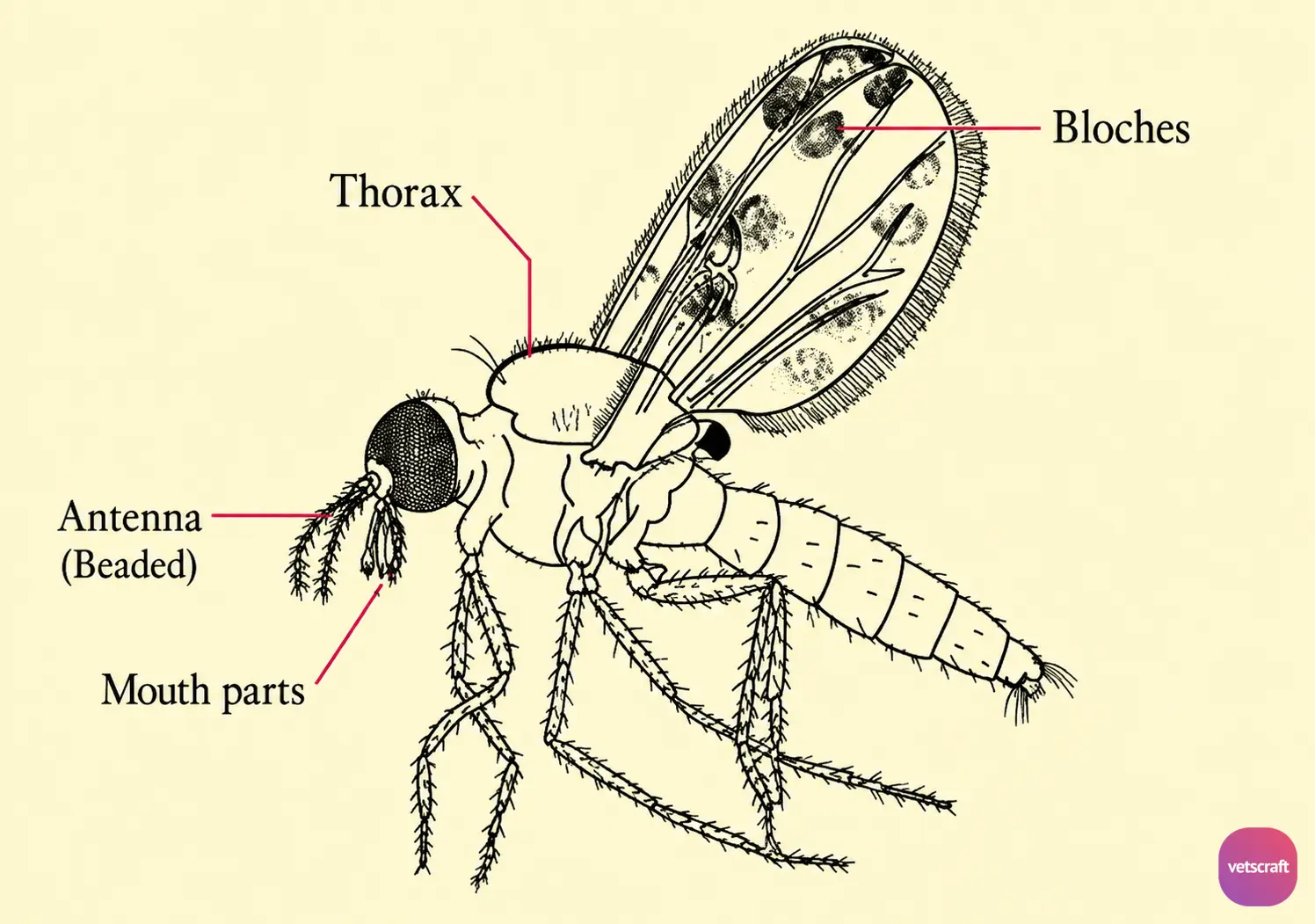
- They are black or brown in color and are very minute insects.
- The body is short and stout with short legs (especially the forelegs).
- Sexual dimorphism is observed only in the antennae, which are plumose in males and pilose in females.
- The antennae are long, with 13–15 segments. The thorax is humped over a small head.
- Mouthparts: Piercing and sucking type. The proboscis is short and stumpy, with stylet/scissor-like mouthparts.
- Wings: Typical, hairy wings. The costal region has dark patches due to pigmentation. The wings are folded like scissors.
- Wing Venation: The anterior vein is shorter than the posterior vein, enclosing two small areas in the radial region, i.e., the 1st and 2nd radial cells. The median vein is forked (M₁, M₂).
Feeding Habits
- Adults are painful biters and are crepuscular in activity.
- They are exophilic and exophagic (feed outdoors).
- Females are blood-sucking and feed on humans and animals.
- Males feed on plant juices.
- Feeding lasts for 3–10 minutes, facilitating the transmission of diseases.
Life Cycle
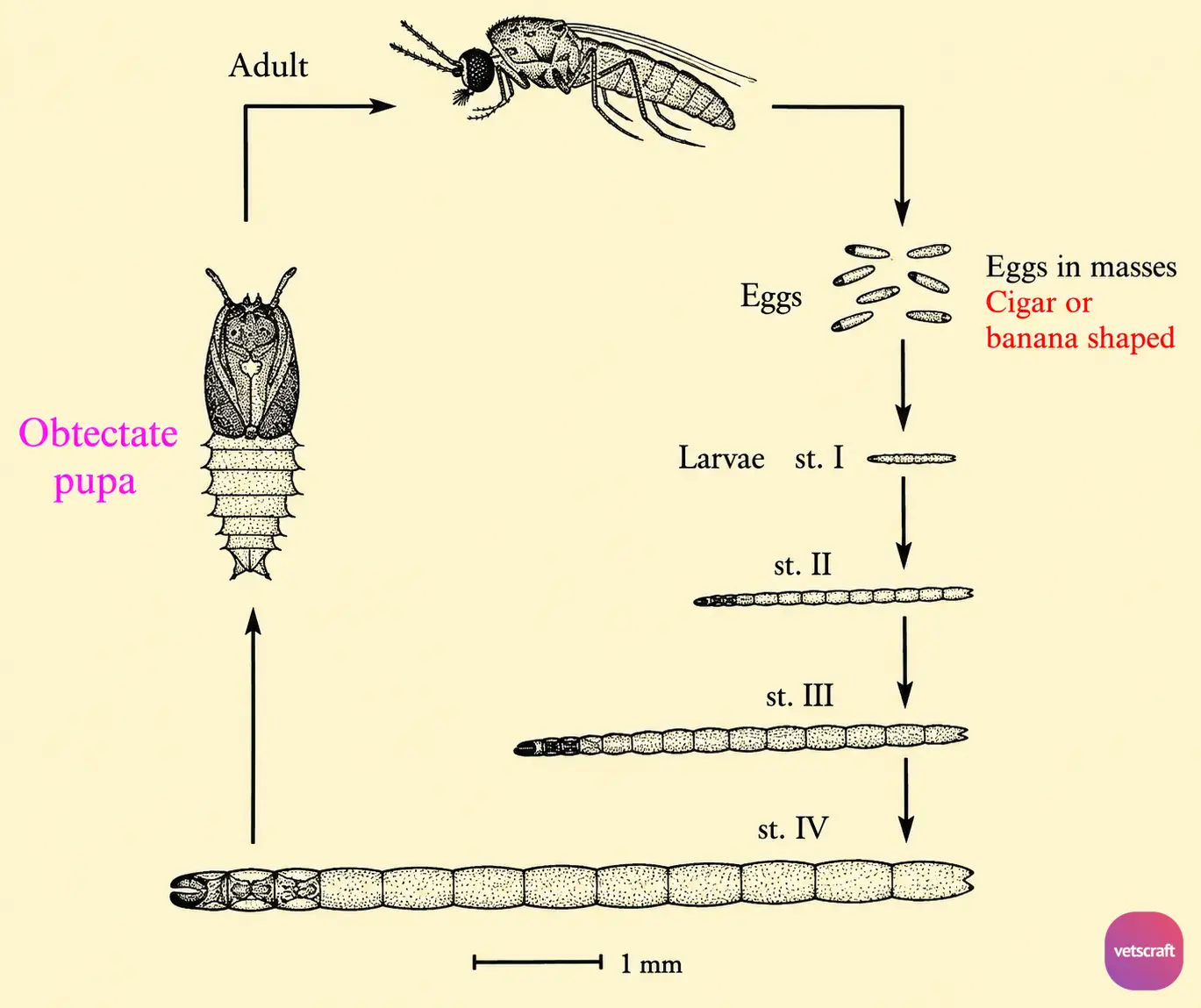
Egg
Eggs are laid in water as well as in moist or marshy areas containing decaying vegetation. They are banana- or cigar-shaped.
Larva
Larvae are aquatic, worm-like, and have a smooth body. They have a small head, three thoracic segments, and nine abdominal segments. The terminal abdominal segment has two four-lobed retractile papillae.
Pupa
The pupa is obtect, brown in color, and inactive. A pair of breathing trumpets is present on the cephalothorax. The pupa is covered with spines along the sides of the abdomen. The last abdominal segment bears a pair of horn-like processes.
Pathogenesis
In horses in Australia, it causes allergic dermatitis, commonly known as sweet itch (also called summer dermatitis). C. robertsi causes allergic dermatitis in horses in Queensland, commonly referred to as Queensland itch.
Vector Potentiality
Culicoides fulvithorax (biting midges) acts as an intermediate host for the filarid nematodes Onchocerca cervicalis in horses and O. gibsoni in cattle. Culicoides variipennis acts as a vector for the bluetongue virus in sheep. It also transmits viral diseases, including African horse sickness, bovine ephemeral fever, Eastern equine encephalitis, and Venezuelan equine encephalitis.
Culicoides fulvithorax (biting midges) also acts as a vector for Leucocytozoon caulleryi in poultry.