TABLE OF CONTENTS
Phlebotomus (Sand Fly): Morphology, Life Cycle, Vector Potential & Control
Phlebotomus (sand fly) is a medically and veterinary important blood-feeding dipteran belonging to the family Psychodidae. Several species act as biological vectors of pathogens, including Leishmania spp., which cause cutaneous and visceral leishmaniasis in humans and animals. In this article, learn about the taxonomy, morphology, life cycle, vector potential, and control measures of Phlebotomus, with a focus on the important species Phlebotomus argentipes and Phlebotomus sergenti.
Members of this family are called “owl midges” because they have very large compound eyes that resemble those of an owl. They are also called “sand flies” because their larval stages develop in sandy habitats, and “moth flies” because they are weak fliers and cannot fly for long distances.
Taxonomical Classification
- Kingdom: Animalia
- Phylum: Arthropoda
- Class: Insecta
- Order: Diptera
- Suborder: Nematocera
- Family: Psychodidae
- Subfamily: Phlebotominae
- Genus: Phlebotomus
- Important Species: Phlebotomus argentipes, Phlebotomus sergenti
Morphology of Phlebotomus sergenti (Sand Fly)
- Occurs in tropical, subtropical, and temperate regions.
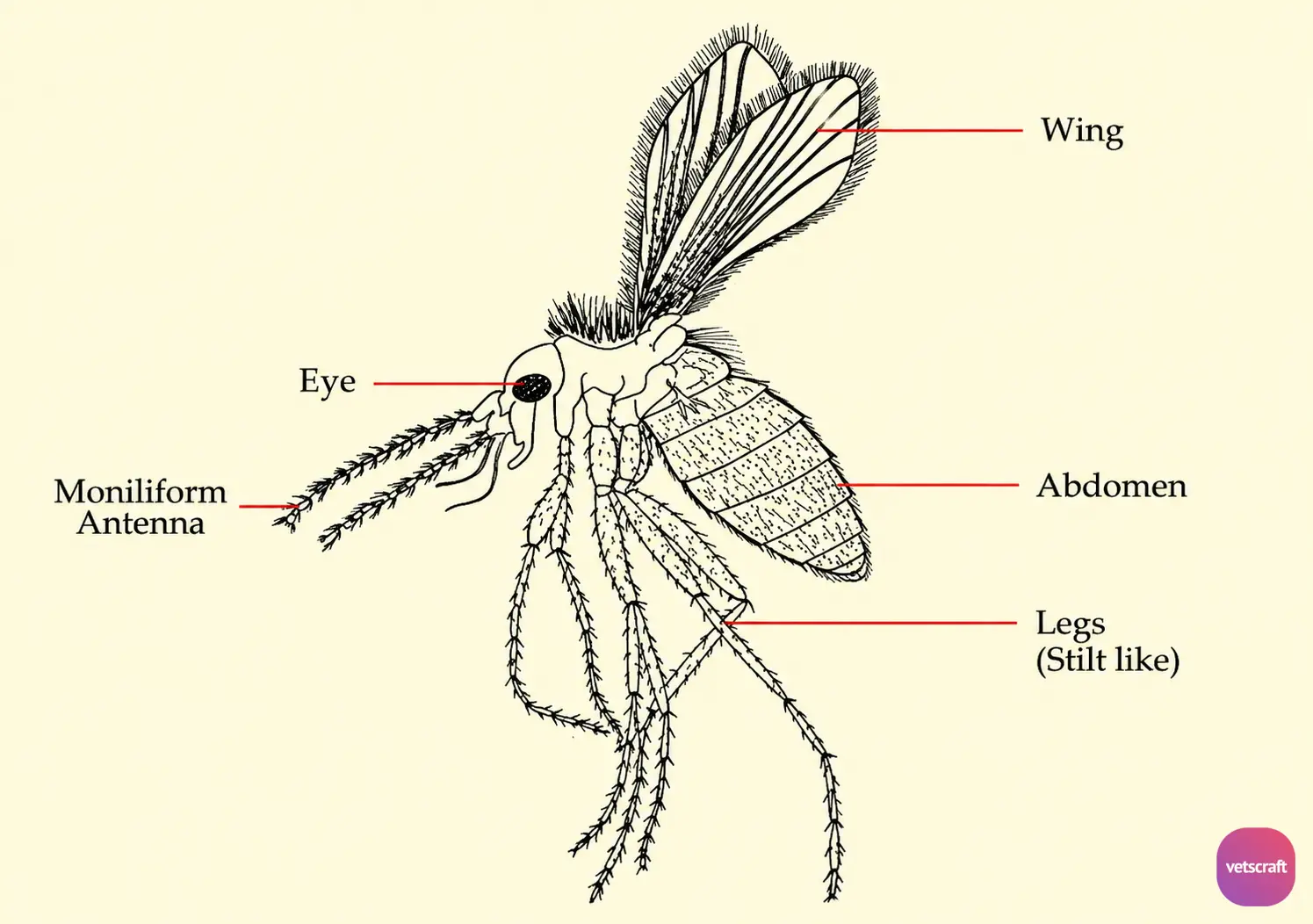
- Small, hairy fly.
- Brownish to yellow in color with a narrow body.
- Eyes are very large and dichoptic in both sexes.
- Mouthparts are of the piercing and sucking type. Males do not feed on blood, whereas females are hematophagous (blood-feeding).
- Maxillary palps are five-segmented, hairy, and have recurved tips.
- Antennae are long, 16-segmented, bead-like in appearance, and pilose in both sexes.
- Wings are lanceolate (tapering) and are held erect (roof-like) over the abdomen during rest.
- The thorax is hunchbacked, and the wings are hairy.
- Three pairs of very long, stilt-like legs in proportion to the body length.
- Scales are present over the entire body.
- Males feed on available plant materials and may also feed on human sweat.
- Females sometimes feed on cold-blooded animals and are primarily active at night.
Life Cycle
Egg
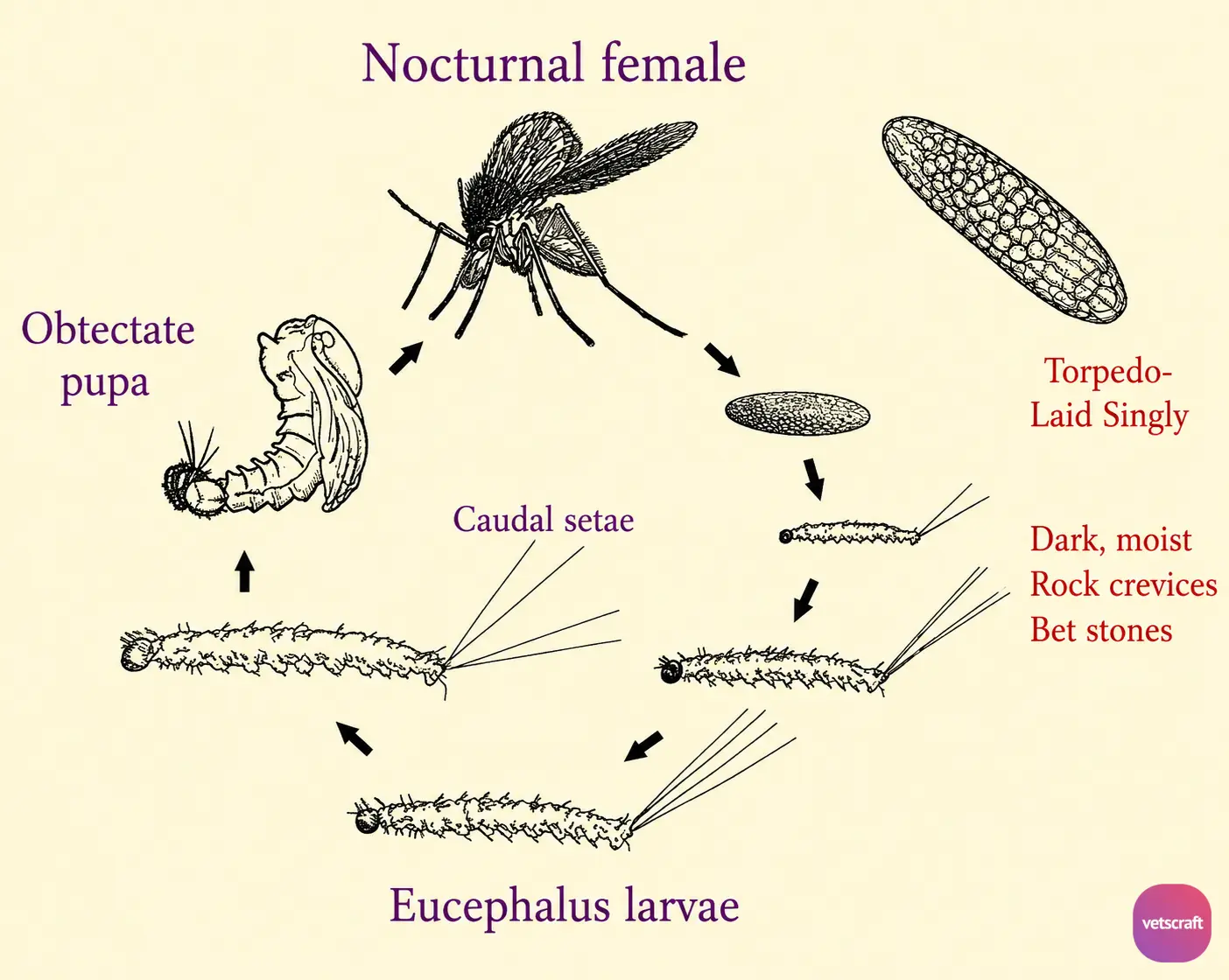
Breeding sites are non-aquatic. Eggs are laid between stones, in crevices, or in mud walls. They are laid singly, usually 40–80 eggs at a time. Freshly laid eggs are white, torpedo-shaped, and have a reticulated surface. They become dark within a few hours.
Larva
Larvae hatch from the eggs and pass through four larval instars over approximately four weeks. They resemble small caterpillars (eucephalous) and feed on the feces of lizards, bats, and other animals, as well as dried leaves.
The head is prominent, highly chitinized, and lacks eyes. Conspicuous thick bristles with feathered stems, known as matchstick hairs, are present on the head and body.
The thorax is three-segmented, and the abdomen is nine-segmented. The last abdominal segment bears long and short bristles and has two pairs of caudal setae.
Pupa
The pupa emerges from the larva and is obtect. The pupal head is triangular and curved, resembling a miniature ram’s head, while the antennal sheaths resemble the horns of a ram.
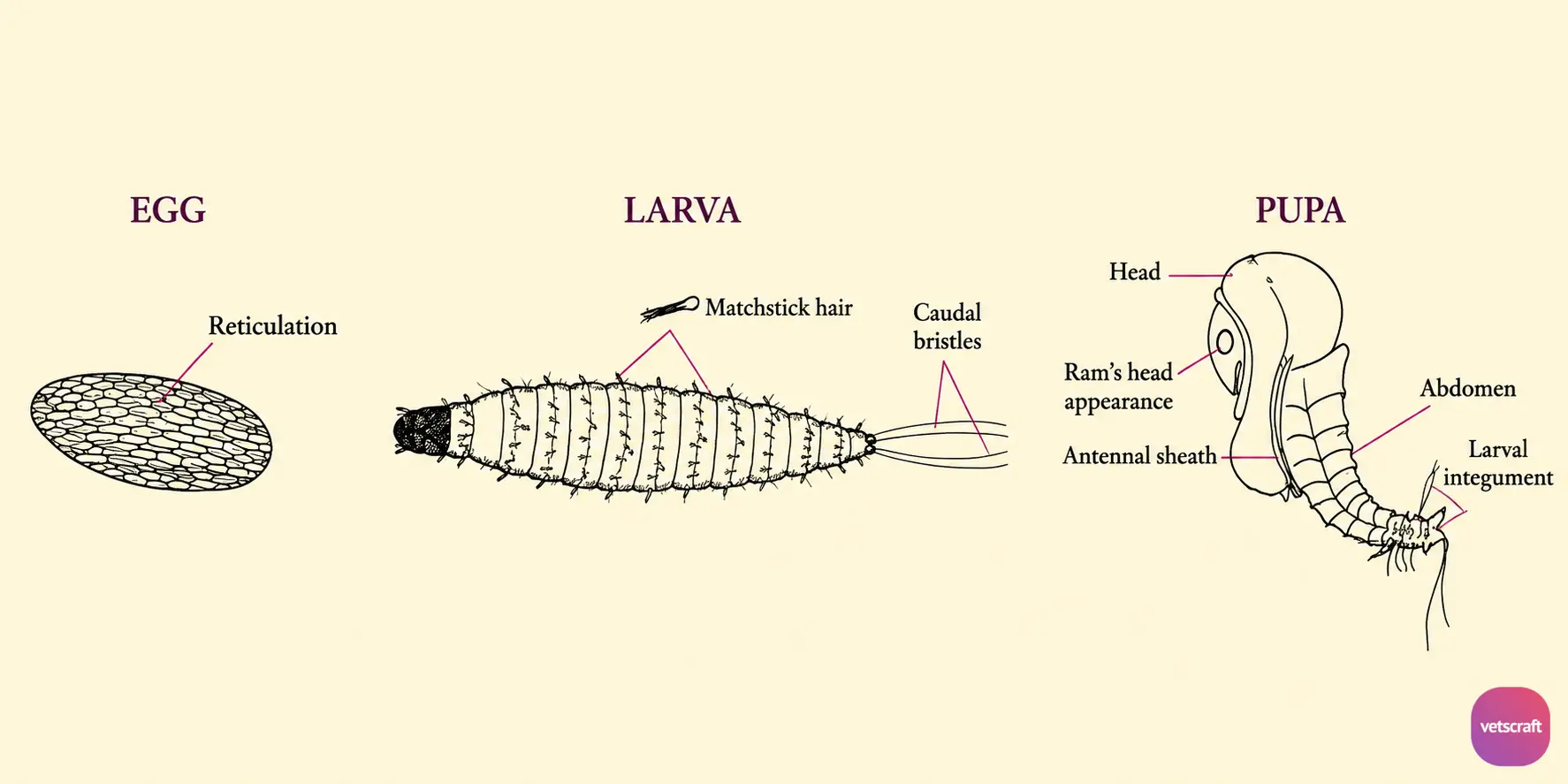
The last larval skin remains attached to the pupa; therefore, the larval caudal setae remain visible. The life cycle is completed in approximately 45 days.
Adult
Adults are nocturnal. They can pass through mosquito nets because of their small size. They are weak fliers and are primarily found in tropical regions. The adult life cycle lasts approximately 37 days.
Vector Potential
Phlebotomus sergenti transmits Leishmania tropica, the causative agent of cutaneous leishmaniasis (also known as Delhi boil or tropical ulcer), to humans and dogs.
Phlebotomus argentipes transmits Leishmania donovani, the causative agent of visceral leishmaniasis (also known as kala-azar or Dum Dum fever), to humans. It also transmits Bartonella bacilliformis, sand fly fever virus (Papatasi fever), the agent of Carrion’s disease (Oroya fever), and Vesicular stomatitis virus.
Control Measures
- Control is difficult; however, mosquito control measures may also be effective against sand flies.
- Remove dense vegetation around human and animal dwellings.
- Apply DDT around human and animal dwellings at a rate of 1–3 g/m².
- Biological control is not feasible because the larvae are non-aquatic.
- Repellents such as dimethyl phthalate may be used.