TABLE OF CONTENTS
Musca: Morphology, Life Cycle, Disease Transmission & Control Measures
Musca is a genus of non-biting flies in the family Muscidae and includes several species of veterinary and public health importance, such as the common house fly (Musca domestica). Although these flies do not bite, they are important mechanical vectors of numerous bacterial, viral, protozoal, and parasitic diseases affecting both humans and animals. Understanding the morphology, life cycle, feeding behavior, disease transmission, and control measures of Musca is essential in veterinary parasitology for effective fly management and disease prevention.
The genus Musca includes the following important species:
- Musca domestica: House fly
- Musca vetustissima: Bush fly
- Musca autumnalis: Face fly
- Musca sorbens: Bazaar fly
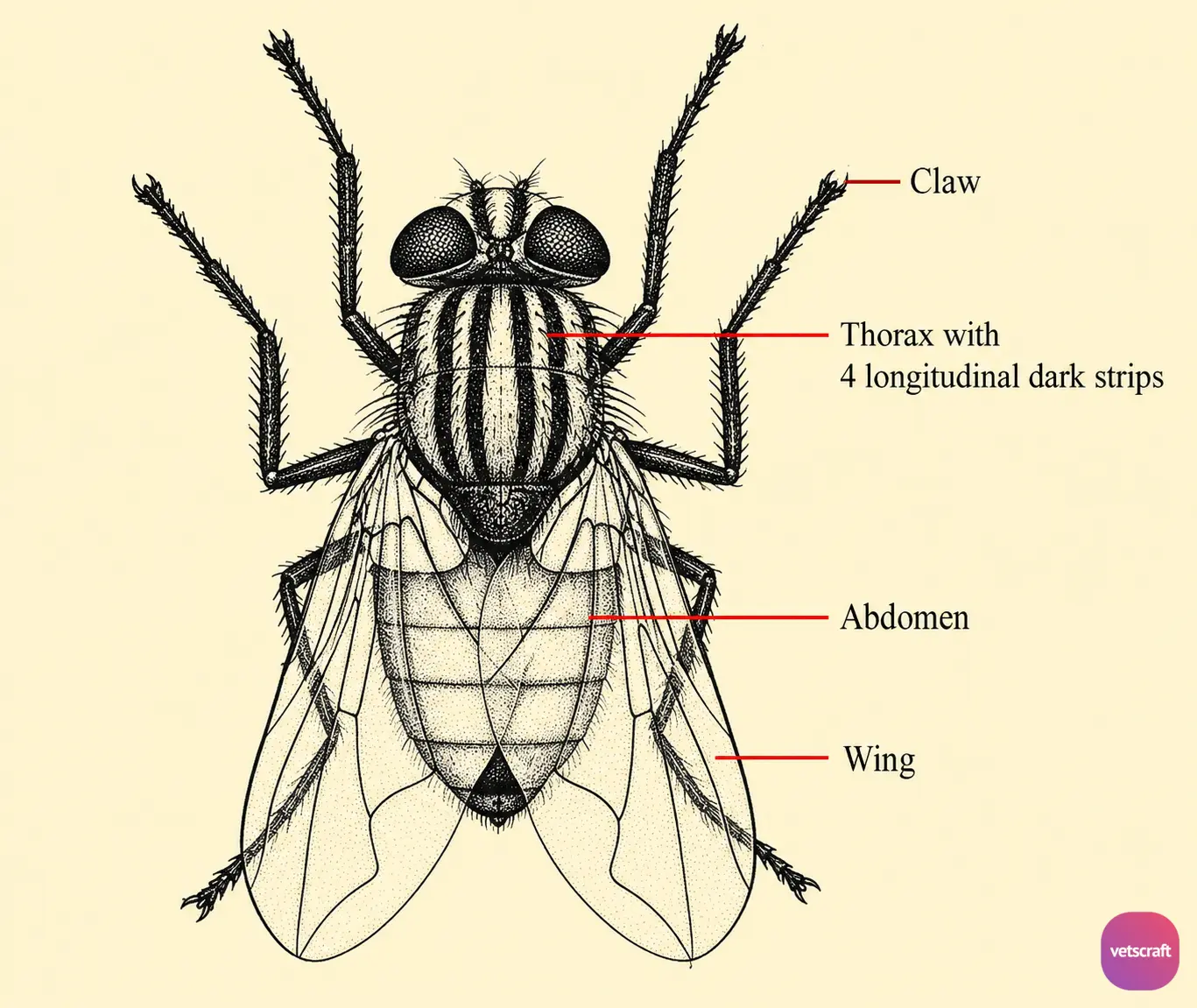
Musca flies are medium-sized and gray in color. They have large compound eyes, which are holoptic in males and dichoptic in females.
Morphology
Antenna
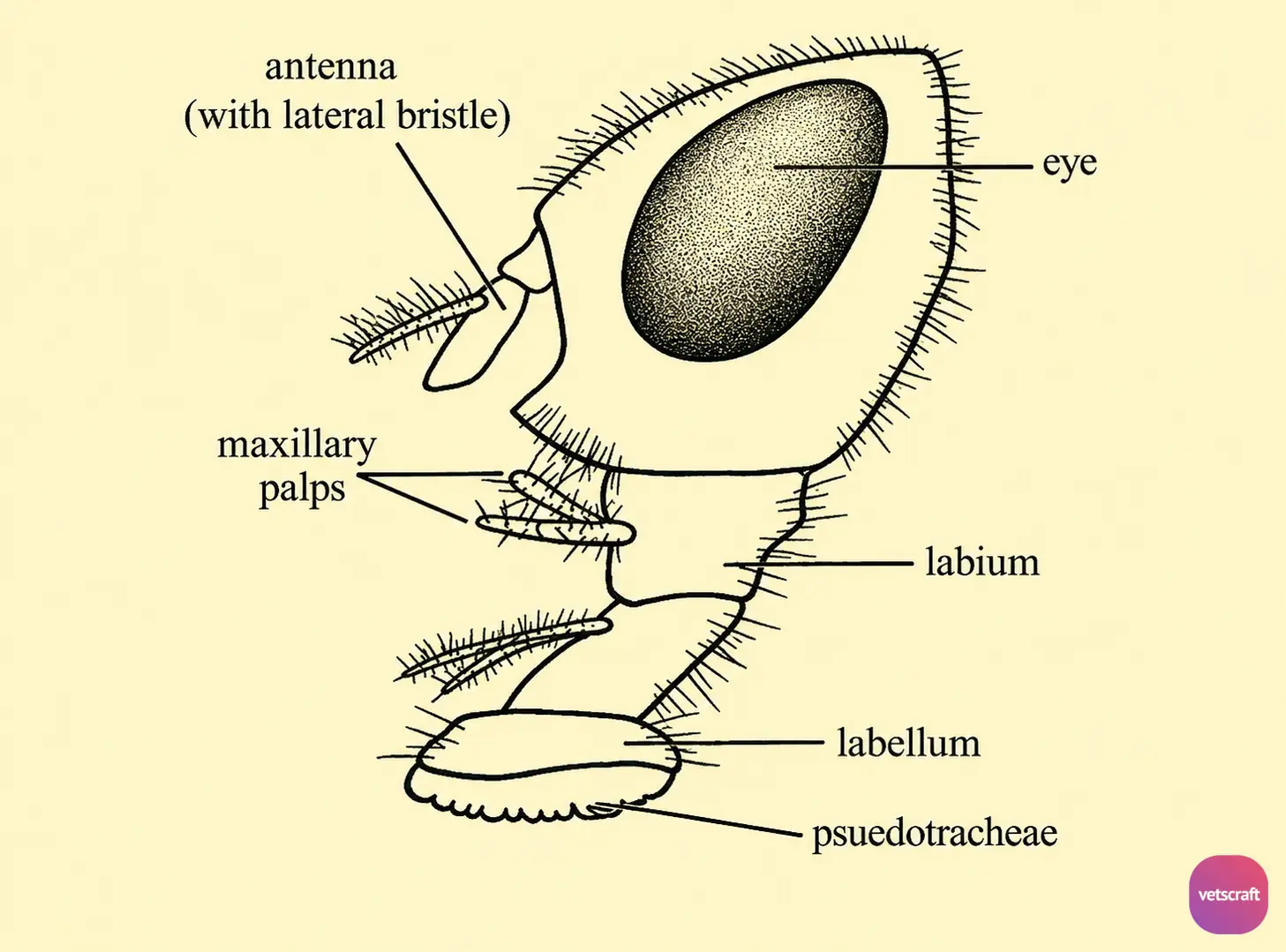
- Three-segmented; the last segment bears a bilaterally plumose arista.
- Mandibles and maxillae are absent.
Mouthparts
The mouthparts are adapted for sucking/imbibing liquid food and consist of three parts:
- Rostrum: Located behind the clypeus and contains a chitinized structure called the fulcrum and a single-segmented maxillary palp.
- Haustellum: Consists of the labrum-epipharynx, hypopharynx, and labium. The labrum-epipharynx is connected to the rostrum by a chitinized bar called the labral apodemes.
- Labella: The labium is expanded distally into two labella, which are connected to the labrum by means of a dorsal sclerite. These are capable of expansion during feeding. The median wall of the labella is covered with a pseudotracheal membrane.
Wing
- The 4th longitudinal vein bends upward about the middle of its course and joins the 3rd vein to form a closed apical cell.
- The thorax is yellowish-gray to dark gray and has four longitudinal stripes of equal width that extend to the posterior border of the scutum.
- The abdomen has five segments, of which only four are visible.
- A median black longitudinal stripe becomes diffuse on the 4th abdominal segment in males.
- The abdomen of the female is marked on either side with a diffuse dark band.
Life Cycle
Eggs
Eggs are laid by the female on decomposing organic matter, dung, poultry manure, and kitchen waste but do not develop in cow manure. About 100–150 eggs are laid at a time. These eggs are elongate, cream-colored, about 1 mm long, and have two rib-like thickenings on the dorsal surface. The eggs hatch within 12–24 hours.
Larva
- There are three larval stages. The larval period lasts 3–7 days.
- Larvae are long, maggot-like, white in color, and 12-segmented. They lack hairs and are therefore called smooth larvae. They are acephalous and apodous. The larva is about 1.5 cm long, with a pointed anterior end and a broad posterior end.
- The head bears two unequal, chitinized black oral hooks that are connected to the cephalopharyngeal skeleton. The oral hooks are used for movement and for tearing the substrate.
- The anterior spiracle is situated at the level of the 1st or 2nd thoracic segment and has 5–8 papillae.
- The posterior spiracles are situated at the posterior end of the larva. They are D-shaped, located close to each other, and each has three sinuous M-shaped stigmatic slits with a central button. The outer wall is called the peritreme.
- Larvae feed on bacteria and organic matter (saprophagous). After about 3 days, the larva stops feeding and pupates. It moves out of the dung and pupates in nearby sand.
Pupa
- The pupa is coarctate, brown in color, and oval-shaped. The pupal stage lasts about 3 days but may last up to 26 days under adverse conditions.
- The entire life cycle takes about 7–12 days.
Adult
The adult emerges from the pupa and begins laying eggs within 4 days after fertilization. It is diurnal in habit, synanthropic, and is associated with humans throughout the world.
Method of Feeding
Liquefiable solid food, such as sugar, may be converted into a liquid before being ingested by the ejection of saliva and crop fluid. These fluid droplets are called “vomit drops” and are important in the disease-transmitting capacity of the fly.
The fly regurgitates or vomits at frequent intervals to aid feeding, and while feeding, it defecates indiscriminately. The pulvilli at the end of the tarsal claws are densely covered with hairs. These activities are responsible for the mechanical transmission of diseases through contamination of food.
Disease Transmission
- Transmits bacterial diseases including anthrax, cholera, typhoid, paratyphoid, tuberculosis (TB), salmonellosis, bacillary dysentery, bacillary diarrhea, leprosy, and Moraxella bovis, which causes pink eye in cattle.
- Also transmits viral diseases such as poliomyelitis and infectious hepatitis.
- Transmits protozoan parasites that cause amoebic dysentery and giardiasis.
- Acts as an intermediate host for Habronema muscae, Draschia megastoma, Thelazia rhodesii, Raillietina tetragona, R. cesticillus, Choanotaenia infundibulum, and Parafilaria bovicola.
- Mechanically carries the eggs of Taenia solium, Toxocara spp., Parascaris spp., Hymenolepis spp., Dipylidium caninum, Dibothriocephalus latus (Diphyllobothrium latum), and Heterakis gallinae.
- Musca sorbens acts as a vector for Chlamydia trachomatis, which causes trachoma in Africa.
- Musca larvae do not cause true myiasis. The larvae feed on carcasses containing toxins of Clostridium botulinum. When birds consume these larvae, they may develop botulism (“Limberneck”).
Control
- Manure should be removed regularly, especially during colder months when flies are less active.
- Manure should be stacked in large, compact heaps. Fermentation produces heat that kills maggots and eggs. The sides of the heaps may be treated with insecticides (5% DDT, 1% diazinon).
- Mechanically remove pupae from the manure and burn them.
- Use Hodge’s garbage can trap or UV light trap.
- Use pyrethrins with synergists (piperonyl butoxide) as a mist or space spray.
- Apply 1% dimethoate or 1% fenchlorphos as a wall spray.
- Use organophosphate (OP) liquid or dry baits formulated with sugar as an attractant (e.g., DDVP, diazinon, malathion, and Neguvon).
- Use resin strips impregnated with DDVP.
- Apply diazinon or dimethoate as a 1–2% spray to breeding areas at weekly intervals to control larval stages.
- Use back rubbers or self-applying dust bags containing insecticides.
- Apply deltamethrin (Butox) as a 2–4% spray.
Insect Growth Regulators (IGRs)
Insect growth regulators (IGRs) are substances that interfere with various aspects of arthropod growth and development, acting principally on embryonic, larval, and nymphal development, thereby disrupting metamorphosis and reproduction.
IGRs can be divided into three categories:
- Juvenile hormone analogs (e.g., methoprene).
- Chitin synthesis inhibitors (e.g., diflubenzuron).
- Other insect growth regulators (e.g., cyromazine).
Sterile Insect Approach
Apholate is added to feed at a concentration of 1%. When consumed by flies, it induces sterility in the adults.
- Cyromazine: Prevents house fly larval development in poultry manure beneath caged laying hens. It is mixed with feed as a 1% premix (500 g per metric ton of feed) for 4–6 weeks or until the fly population is controlled. Cyromazine interferes with molting and pupation without directly affecting chitin synthesis. It passes through the chicken into the manure, preventing the emergence of house flies.
- Muscalure: A synthetic pheromone that attracts house flies. Sugar baits containing 0.25% Muscalure mixed with 1% methomyl are used to control house flies.
Biological Control
- Predatory beetle: Carcinops pumilio, which is abundant in poultry manure and readily feeds on fly larvae.
- Spalangia endius (Hymenopteran wasp): Parasitizes the pupae of house flies.
- Spores of Bacillus thuringiensis: Used as a larvicide.
- Ophyra aenescens: Cannibalistic on fly eggs and larvae.
- Nasonia vitripennis: Parasitic wasp.
- Muscidifurax raptor: Parasitic wasp.
- Steinernema spp.: Entomopathogenic (killer) nematodes.
- Predatory mite: Macrocheles muscae domesticae, which feeds on the eggs and first-stage (L₁) larvae of Musca spp.