TABLE OF CONTENTS
Stomoxys calcitrans (Stable Fly): Morphology, Life Cycle & Veterinary Significance
Stomoxys calcitrans, commonly known as the stable fly, is a blood-feeding fly of major veterinary importance that affects livestock and other animals worldwide. Unlike the common house fly, both male and female stable flies feed on blood, causing painful bites, blood loss, reduced productivity, and significant economic losses. In addition to its direct effects, Stomoxys calcitrans also serves as a mechanical vector for several important pathogens. This article covers the morphology, life cycle, feeding behavior, and veterinary significance of Stomoxys calcitrans.
Parasite Overview
- Genus: Stomoxys
- Species: Stomoxys calcitrans
- Common Name: Stable fly, Biting house fly
Stomoxys calcitrans is known as the stable fly because it prefers to lay eggs on the bedding material of horses.
Morphology
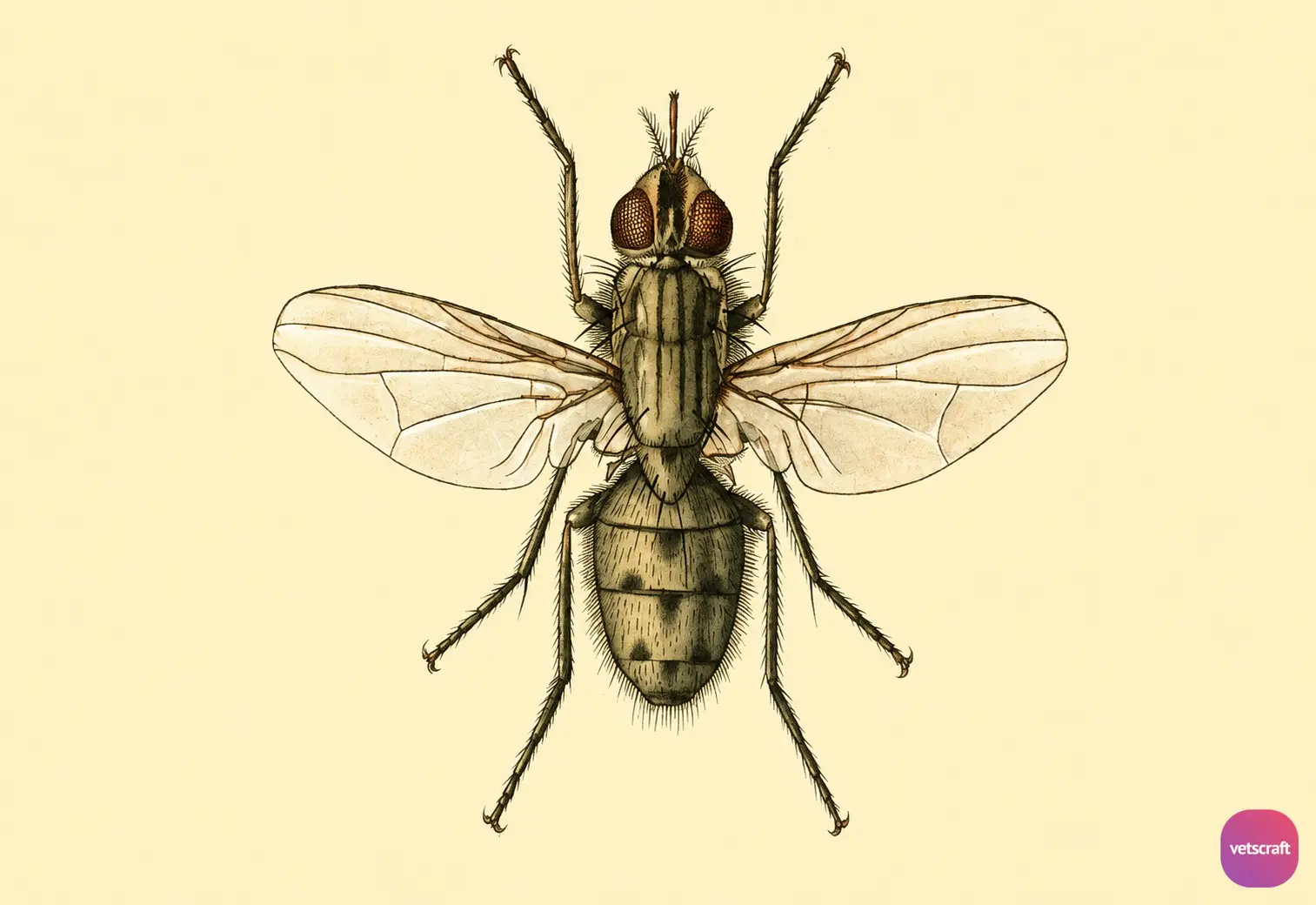
- The flies are medium-sized, grey in color, and resemble Musca.
- Non-retractile, forwardly directed, baton-like proboscis. The proboscis contains a bulbous labium and ends in prestomal teeth.
- The maxillary palp is short, one-third the length of the proboscis, and single-segmented.
- The arista is dorsally plumose and contains 8–10 bristles; the last bristle is shorter than the bare tip.
- The thorax has four longitudinal stripes, of which the lateral pair are narrow and do not reach the end of the scutum.
- The abdomen is short and broad. The 2nd and 3rd segments have three dark spots.
- The wings are held at a divergent angle, and the apical cell is open.
Life Cycle
Eggs are laid by the female on fresh horse manure, straw, and other waste materials contaminated with urine. About 40–50 eggs are laid at a time. These eggs are white in color and have one groove. The eggs hatch in 5–10 days.
Larva
- The larvae feed on bacteria and organic matter (saprophagous). They are described as acephalous and apodous. There are three larval stages. The larval period lasts for 20 days. The larva is about 1 cm long.
- The posterior spiracle is situated at the posterior end of the larva, is triangular in shape, and has three “S”-shaped stigmatic slits that are far apart from each other.
Pupa
The pupa of Stomoxys calcitrans (stable fly) is coarctate, brown in color, and lasts for about 8 days. The whole life cycle takes about 4 weeks.
Adult
Both sexes are blood feeders. They are fast fliers but do not travel long distances and inflict a painful bite. It is one of the most annoying and destructive fly pests of cattle. They are diurnal and are mostly seen during summer. They prefer bright sunlight.
They bite intermittently like Tabanus. They also attack humans, mostly in the ankle region. They mainly attack the legs and flanks and feed more than once a day.
Veterinary Significance
- Stomoxys calcitrans (stable fly) causes blood loss, anorexia, and reduced milk yield. The bite of the fly has an immunosuppressive effect.
- These flies act as mechanical vectors for Trypanosoma evansi in cattle.
- They also transmit bacterial diseases, including anthrax, tetanus, swine erysipelas and brucellosis, as well as viral diseases including rinderpest, equine infectious anemia, African horse sickness, fowlpox, and poliomyelitis.
- They also transmit Dermatophilus congolensis.
- They act as intermediate hosts for Habronema majus and Hymenolepis carioca.