TABLE OF CONTENTS
Lucilia (Blow Fly): Morphology, Life Cycle, Pathogenesis & Veterinary Importance
Lucilia is a genus of blow flies of major veterinary importance, particularly as primary producers of myiasis in livestock. Species such as Lucilia cuprina and Lucilia sericata infest wounds and damaged skin, where their larvae feed on host tissues, leading to significant economic losses and animal welfare concerns. Understanding the morphology, life cycle, pathogenesis, and veterinary importance of Lucilia is essential for the diagnosis, prevention, and control of blowfly strike in domestic animals.
The Lucilia genus includes the following two important flies:
- Lucilia cuprina (Green bottle blow fly, Copper bottle blow fly)
- Lucilia sericata (Sheep blow fly)
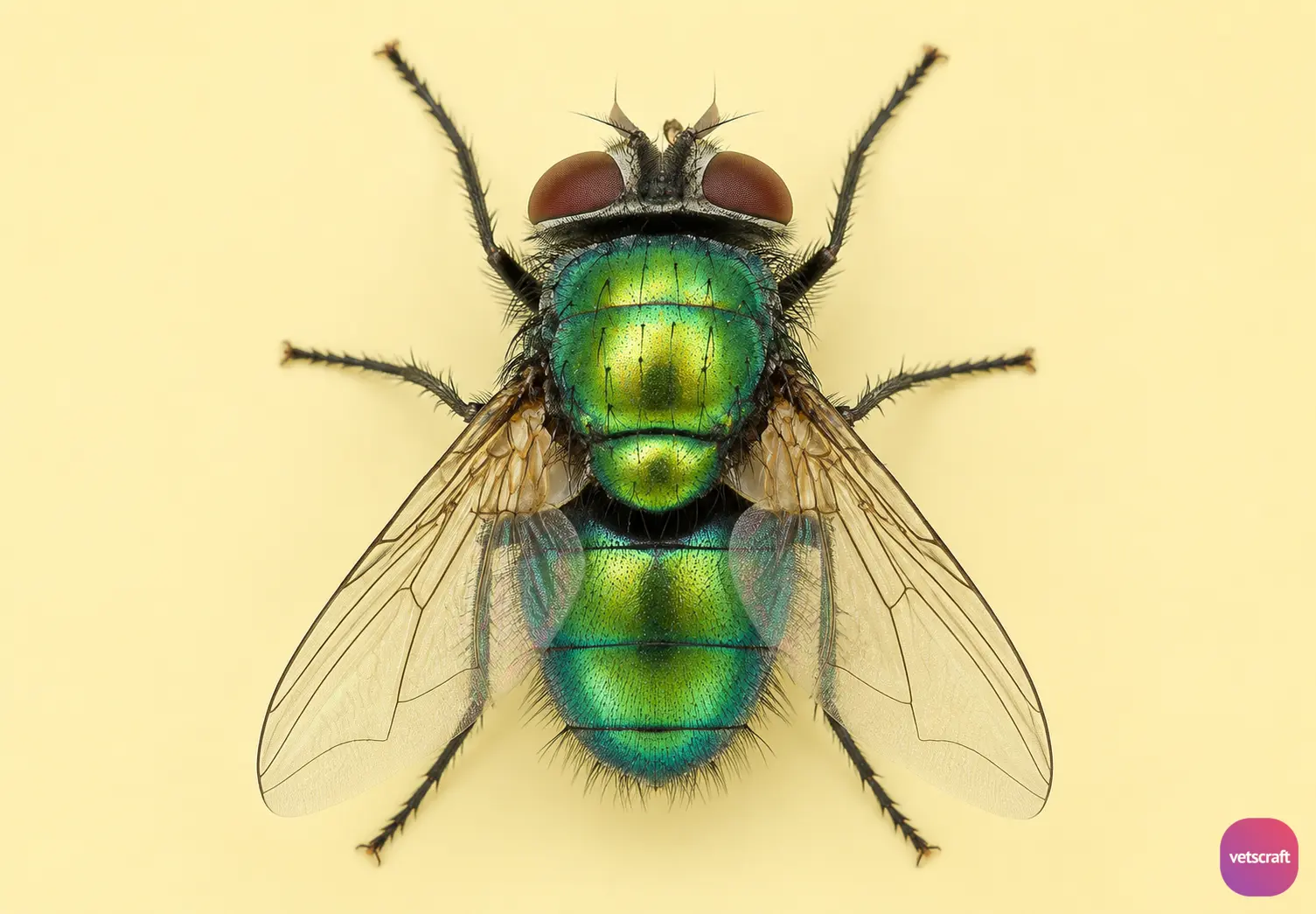
Lucilia is a facultative ectoparasite and a primary producer of myiasis.
Morphology
- The body is metallic green.
- The thorax has two faint dark stripes and is characterized by the presence of bare squamae.
- The thorax has three pairs of postsutural dorsocentral bristles.
- Both males and females are free-living, and the larvae are flesh feeders.
Life Cycle
Female flies are anautogenous and require a protein meal for egg maturation. About 225–250 eggs are laid at a time. The eggs hatch within 12–18 hours, releasing the larvae. Eggs are laid by the female on carcasses or foul-smelling wounds.
Larva
- There are three larval stages. The L₁ larvae migrate to the wound or moist tissue and feed superficially on the epidermis, lymphatic exudates, or necrotic tissue. As they aggregate, they begin to feed on healthy tissue.
- When fully developed, the third-stage larvae leave the wound, drop to the ground, and pupate in the soil for about 12 days.
- The posterior spiracle is circular in shape. The outer wall has a complete peritreme. It has three longitudinal slits directed toward the button with an inward projection.
Pupa
The pupa of Lucilia is coarctate, brown in color, and oval-shaped. The pupal stage lasts for about 4 days. The entire life cycle takes approximately 4–6 weeks.
Adult
Lucilia adults are diurnal, and both males and females are free-living.
Pathology
Blowfly strike occurs in the perineal and inner thigh regions and is associated with fecal soiling.
Body strike occurs in the shoulder and back regions and is associated with bacterial dermatophilosis caused by Dermatophilus congolensis.
Body strike is also associated with bacterial fleece rot caused by Pseudomonas aeruginosa on the skin, resulting in a matted band of discolored fleece.
They cause increased body temperature and respiratory rate, weight loss, and anorexia. The animals become anemic and suffer from toxemia, with both the kidneys and heart affected.
The feeding activity of the larvae may cause extensive tissue damage which, in combination with the proteases produced by the larvae, results in the development of inflamed, abraded, or undermined areas of skin. This leads to reduced fertility and, if left untreated, may result in death due to toxemia.