TABLE OF CONTENTS
Hypoderma lineatum (Ox Warble Fly) in Cattle: Life Cycle, Pathogenesis & Treatment
Hypoderma lineatum, also known as the heel fly, ox warble fly, common cattle grub fly, gad fly, or bomb fly, is an important parasitic fly of cattle that causes hypodermosis through the migration of its larvae within the host’s tissues. The migrating larvae produce characteristic warbles on the back, reduce hide quality, decrease productivity, and can result in significant economic losses to the cattle industry. This article covers the morphology, life cycle, pathogenesis, clinical signs, treatment, prevention, and economic importance of Hypoderma lineatum in cattle.
The larval stages of Hypoderma lineatum (“ox warbles”) are common parasites of cattle and, less commonly, of humans and horses. A warble or grub is the larval stage of these flies, and the term warble is also used to describe the skin nodule caused by the larvae.
The Hypoderma genus includes the following species in addition to Hypoderma lineatum:
- Hypoderma bovis (also known as the northern cattle grub)
- Hypoderma crossi (in goats)
- Hypoderma diana (in deer)
Morphology
Hypoderma lineatum (ox warble fly) is a hairy fly that resembles a bee in appearance. The hairs on the head and anterior part of the thorax are yellowish-white in color.
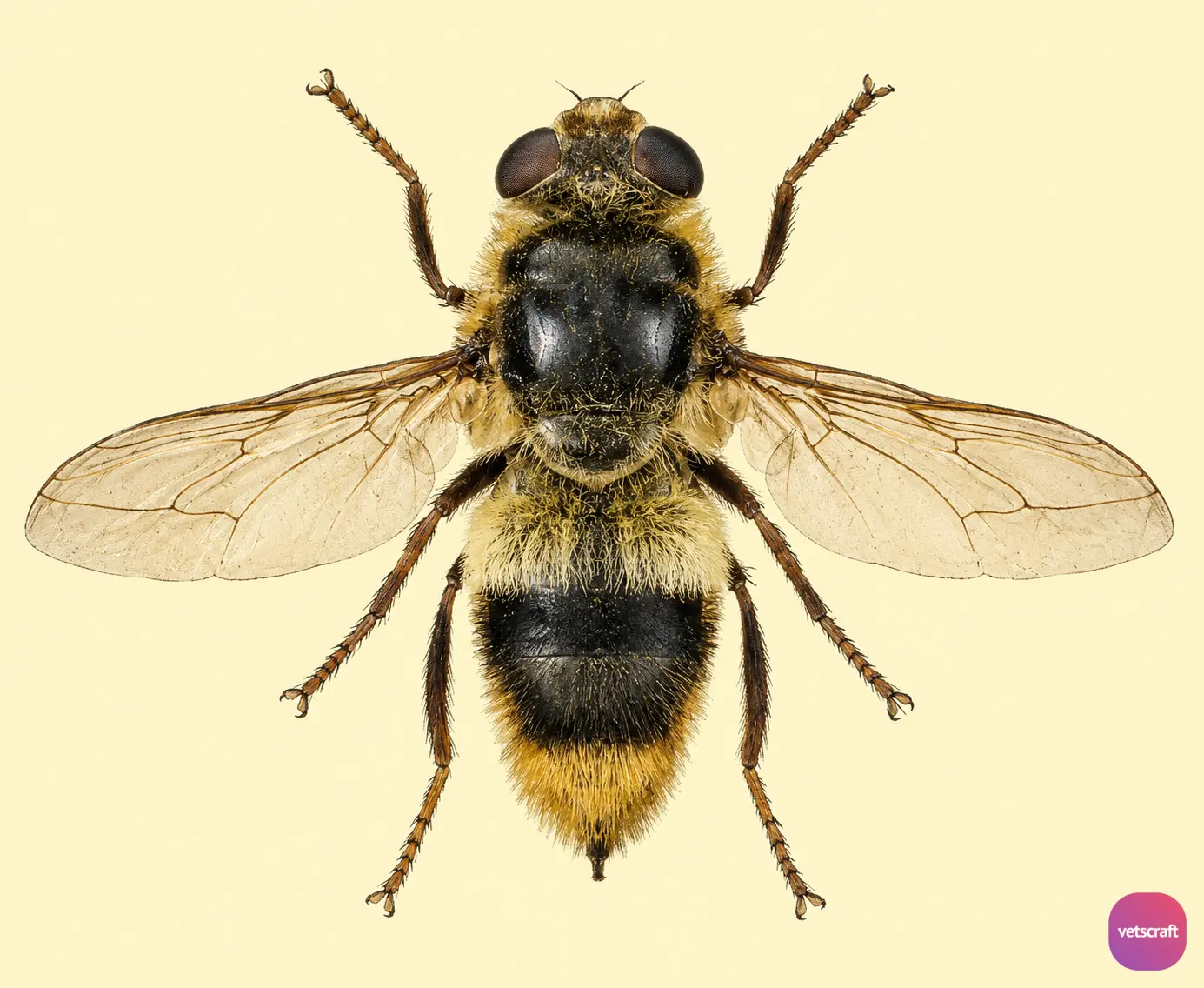
The anterior portion of the abdomen is covered with light yellow hairs, followed by a band of dark hairs, while the posterior portion bears orange-yellow hairs. The mouthparts are non-functional and lack palps.
Life Cycle
Adults are active during the summer. They live for only a few days to 2 weeks but can lay hundreds of eggs. The female oviposits while walking on the animal.
They deposit a row of 6–20 eggs on a hair below the hock and around the lower region of the legs, whereas H. bovis lays a single egg on a hair on the lower part of the body above the hock region.
- H. lineatum: Lays 6–20 eggs below the hock region.
- H. bovis: Lays a single egg above the hock region.
The eggs hatch in 3–4 days. The first-stage larvae crawl down the hair and begin to burrow through the skin. They then begin an extensive migration through the tissues of the body, moving through the intermuscular connective tissues and over the surfaces of internal organs.
Most larvae congregate in the tissues of the esophagus after about 4 months. They spend 3 months or more in the submucosal connective tissues of the esophageal wall, which is referred to as the winter resting site of the first-stage larvae.
The second-stage larvae then migrate toward the dorsal aspect of the body and reach the subcutaneous tissues of the back, where they develop into the third stage. This is the spring resting site of the third-stage larvae. When the larvae reach the skin of the back, swellings begin to form, measuring approximately 3 cm in diameter.
The skin over each swelling becomes perforated, and the larva lies with its posterior spiracular plate directed toward the pore for respiration. This is the warble stage of infection and lasts for about 30 days.
The fully grown third-stage larva is about 25 mm long. Each segment bears numerous flat tubercles and small spines except the last segment.
The posterior spiracle is kidney-shaped and has numerous radiating spiracular openings. The spiracular plate surrounding the button has a broad channel, whereas in H. bovis, it has a narrow funnel-like channel.
The mature larva wriggles out of its cyst, falls to the ground, and pupates. The pupal case is black, and the adult fly emerges after 35–36 days by pushing open an operculum at the anterior end. The entire life cycle requires approximately 1 year.
Pathogenesis and Economic Importance
First-stage larvae of H. lineatum migrate through the connective tissues and produce yellow or greenish, gelatinous, edematous areas with marked eosinophilic infiltration. These lesions are described as “butcher’s jelly” or “licked beef”, requiring affected tissues to be trimmed from the carcass.
Young animals appear to be more susceptible to infestation than older animals. The characteristic noise and persistent oviposition behavior of the adult flies are recognized by cattle, resulting in a dramatic avoidance behavior known as gadding.
This behavior may result in self-inflicted wounds, spontaneous abortion, reduced growth, loss of body condition, and decreased milk yield. H. lineatum approaches cattle through a series of silent hops along the ground, hence the common name heel fly.
The death of H. lineatum larvae in the esophageal wall may cause bloat due to esophageal stricture, leading to impaired regurgitation. If H. bovis larvae die in the spinal canal, they release a proteolytic toxin that may cause paraplegia.
The major economic losses caused by Hypoderma result from the breathing holes created by the larvae, which greatly reduce the value of the hide. Occasionally, edema and inflammation occur at the site of entry of the first-stage larvae. The exit holes created by the third-stage larvae may also become infected and can attract other myiasis-producing flies.
Clinical Signs
Except for poor growth in severe cases and decreased milk yield, affected animals show no appreciable clinical signs until the larvae appear along the back, where the swellings become visible and palpable. The larvae lie within cysts that also contain yellow purulent fluid.
Treatment
- Mechanical Removal of Larvae: Mature larvae may be gently squeezed out of the warble swelling. Rupture of the larva during extraction may lead to localized inflammation and abscess formation.
- Systemic Insecticides: Organophosphorus compounds may be administered parenterally or dermally. Pour-on formulations are the most widely accepted method.
- Ivermectin: 0.2 mg/kg body weight, subcutaneous (SC) route.
Prevention
Hypodermin A is a potential vaccine candidate for the prevention and control of Hypoderma lineatum.