Taenia multiceps: Morphology, Life Cycle, Pathogenesis, Diagnosis & Treatment
Taenia multiceps is a cyclophyllidean tapeworm of dogs and other wild carnivores that causes coenurosis (gid) in sheep, goats, and other intermediate hosts. The larval stage, Coenurus cerebralis, develops primarily in the brain and spinal cord, producing severe neurological signs and significant economic losses in small ruminants. This article covers the morphology, taxonomy, life cycle, pathogenesis, diagnosis, and treatment of Taenia multiceps.
Parasite Overview
- Host: Dogs and wild carnivores
- Location: Small intestine
- Intermediate Host: Sheep and goats
- Metacestode Stage: Coenurus cerebralis
- Disease Caused: Coenurosis (Gid)
Taxonomical Classification
- Kingdom: Animalia
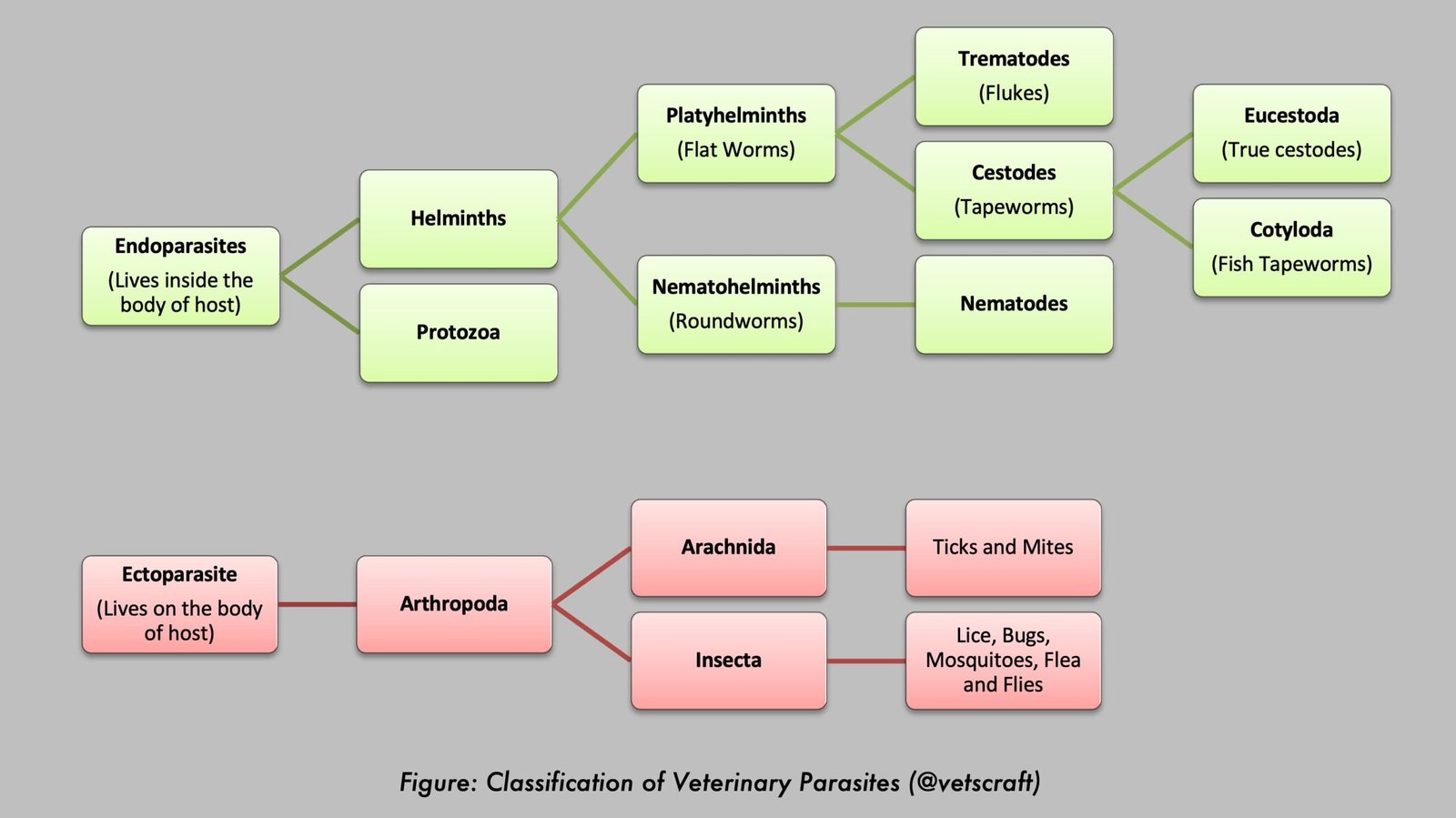
- Phylum: Platyhelminthes
- Class: Cestoda
- Subclass: Eucestoda
- Order: Cyclophyllidea
- Family: Taeniidae
- Genus: Taenia
- Species: Taenia multiceps
- Common Name: Coenurus tapeworm, Gid tapeworm
Morphology
- The adults are up to 40–100 cm in length. In the gravid segments, the uterus has 14–20 lateral branches.
- The metacestode stage occurs in the brain and spinal cord. In goats, it may also occur in the subcutaneous tissue. The metacestode occurring in goats has been considered a separate species, Taenia gaigeri.
Life Cycle
- The eggs are ingested by the intermediate host (I/H) and hatch in the small intestine. The oncospheres penetrate the intestinal wall and reach the brain and spinal cord via the bloodstream.
- The developing larval stages migrate through the brain and spinal cord, leaving tortuous yellowish-gray to reddish streaks.
- The larval stage matures in approximately 8 months. The coenurus is a large, fluid-filled bladder containing numerous invaginated protoscolices attached to its wall.
- The definitive host acquires infection by ingesting the brain or spinal cord of infected intermediate hosts containing viable coenuri.
Pathogenesis
- Adult worms are not pathogenic in the definitive host (D/H; dog), but the larval stage is highly pathogenic in the intermediate host (I/H; sheep). In lambs, the migrating larval stage causes acute meningoencephalitis, whereas the chronic form is associated with one or two coenuri. The developing coenurus produces a high degree of brain tissue damage, resulting in neurological signs referred to as gid, staggers, or sturdy. The neurological signs depend on the location of the cyst within the CNS.
- If the cyst is located in one of the cerebral hemispheres, the animal holds its head to one side and walks in circles toward the affected side. The eye on the opposite side may be blind.
- If the cyst is situated in the anterior part of the brain, the animal holds its head against the chest and takes high-stepping strides, or it may walk in a straight line until it encounters an obstacle and then remain motionless.
- If the cyst is present in the ventricle, the animal may move backward.
- If the cyst is present in the cerebellum, the animal may exhibit hyperesthesia, incoordination, a jerky or staggering gait, and may also remain motionless.
- If the cyst is present on the surface of the brain, the skull may undergo pressure atrophy, and perforation of the skull may also occur.
Diagnosis
- Clinical history and characteristic neurological signs in sheep or goats.
- Radiography (X-ray) or advanced imaging (CT/MRI) in valuable animals.
- Postmortem examination demonstrating Coenurus cerebralis in the brain or spinal cord.
Treatment
- Treatment is generally considered uneconomical in food-producing animals because neurological damage is often irreversible.
- Surgical removal of the coenurus cyst (trephination) may be attempted in valuable animals when the cyst is superficial and accurately localized.
- The prognosis depends on the location, size, and number of cysts, as well as the severity of neurological damage.
- Control is primarily based on preventing dogs and wild carnivores from consuming infected sheep or goat tissues, along with regular deworming of dogs and other definitive hosts using appropriate anthelmintics.