Family Strongylidae (Palisade Worms): Classification, Characteristics & Caudal Bursa
The family Strongylidae is an important group of parasitic nematodes that infect the gastrointestinal tract of domestic and wild animals. These parasites are of major veterinary importance because they can cause enteritis, anemia, weight loss, poor growth, and reduced productivity, particularly in herbivorous animals. Members of this family are distinguished by their well-developed buccal capsule and characteristic copulatory bursa in males.
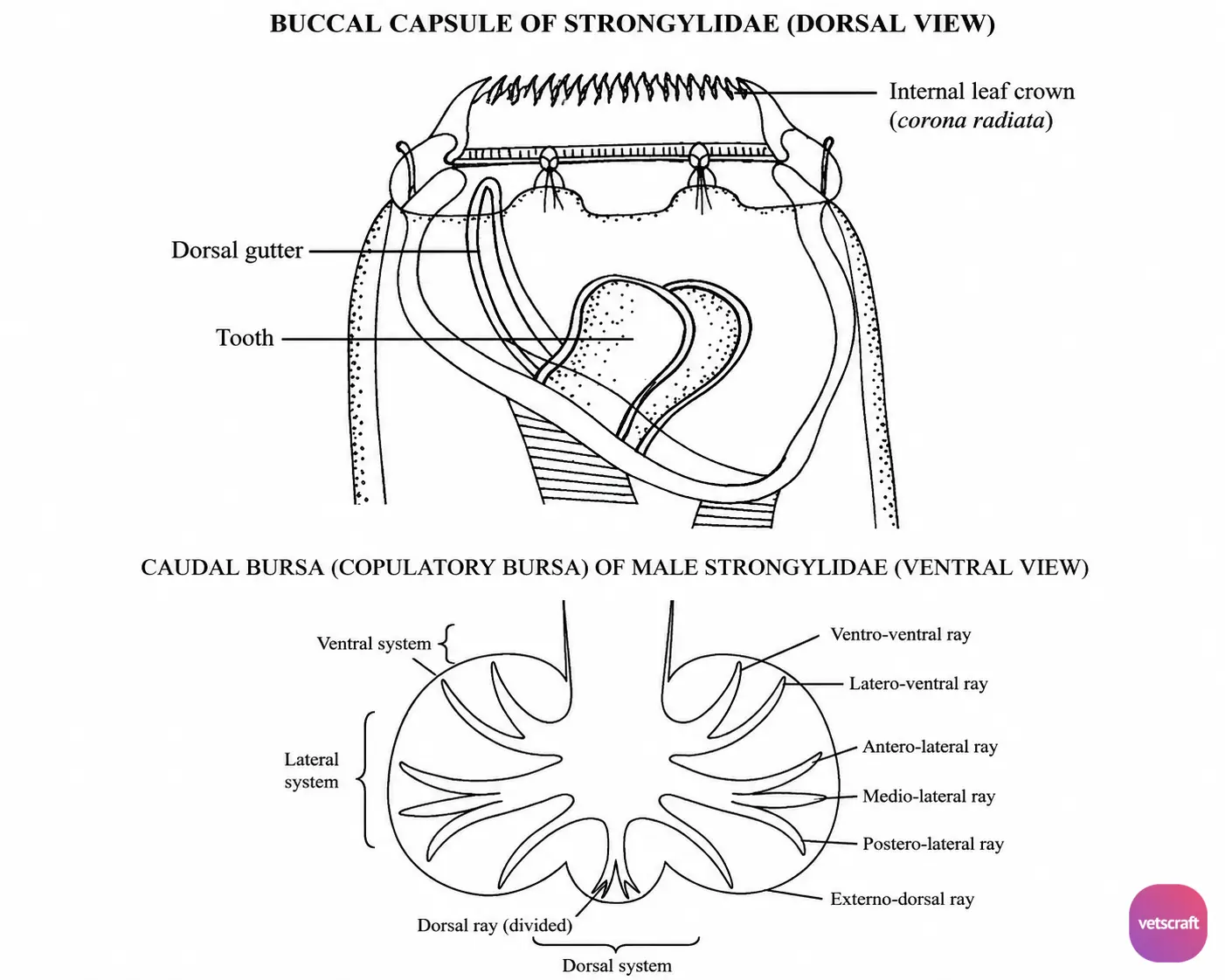
Members of the family Strongylidae are commonly known as bursate nematodes, red worms, or palisade worms. They are characterized by the presence of both external and internal leaf crowns (corona radiata), which resemble a palisade, giving rise to the common name “palisade worms.”
Taxonomical Classification of Family Strongylidae
- Kingdom: Animalia
- Phylum: Nematoda
- Class: Chromadorea
- Order: Strongylida
- Superfamily: Strongyloidea
- Family: Strongylidae
Characters of the Family Strongylidae
- It has a well-developed buccal capsule.
- A median thickening in the buccal capsule is known as the dorsal gutter.
- It possesses both external and internal leaf crowns, known as the “corona radiata.”
- The leaf crowns resemble a palisade; therefore, they are commonly called palisade worms.
- Teeth or cutting plates may be present.
Structure of Caudal Bursa (Copulatory Bursa)
- In males, the bursa is well developed. The bursal lobes are supported by modified caudal papillae, known as bursal rays. There are three lobes: one dorsal and two lateral.
- A definite set of rays is present: two ventral rays (ventro-ventral and latero-ventral).
- Three lateral rays are present in each lateral lobe (antero-lateral or externo-lateral, medio-lateral, and postero-lateral).
- The dorsal lobe contains a single externo-dorsal ray and a divided dorsal ray.
- A genital cone with the cloaca is present.
- Two equal spicules are present.