Syngamus trachea (Gapeworm of Poultry): Morphology, Life Cycle, Pathogenesis & Treatment
Syngamus trachea, commonly known as the gapeworm of poultry, is a blood-feeding nematode that parasitizes the trachea of chickens, turkeys, and several other avian species. The parasite derives its common name from the characteristic “gaping” respiratory movements exhibited by infected birds due to airway obstruction.
Gapeworm infection can cause significant respiratory disease, particularly in young birds, leading to poor growth, reduced productivity, and, in severe cases, death.
This article provides a comprehensive overview of Syngamus trachea, including its taxonomical classification, morphology, life cycle, pathogenesis, clinical signs, postmortem lesions, diagnosis, treatment, and control measures.
Parasite Overview
- Common Name: Gapeworm of poultry, red worm, or forked worm
- Host: Chickens and turkeys
- Predilection Site: Trachea
- Distribution: Worldwide
Taxonomical Classification of Syngamus trachea
- Kingdom: Animalia
- Phylum: Nematoda
- Class: Secernentea (Phasmidia)
- Order: Strongylida
- Superfamily: Strongyloidea
- Family: Syngamidae
- Genus: Syngamus
- Species: Syngamus trachea
- Common Name: Gapeworm
Morphology
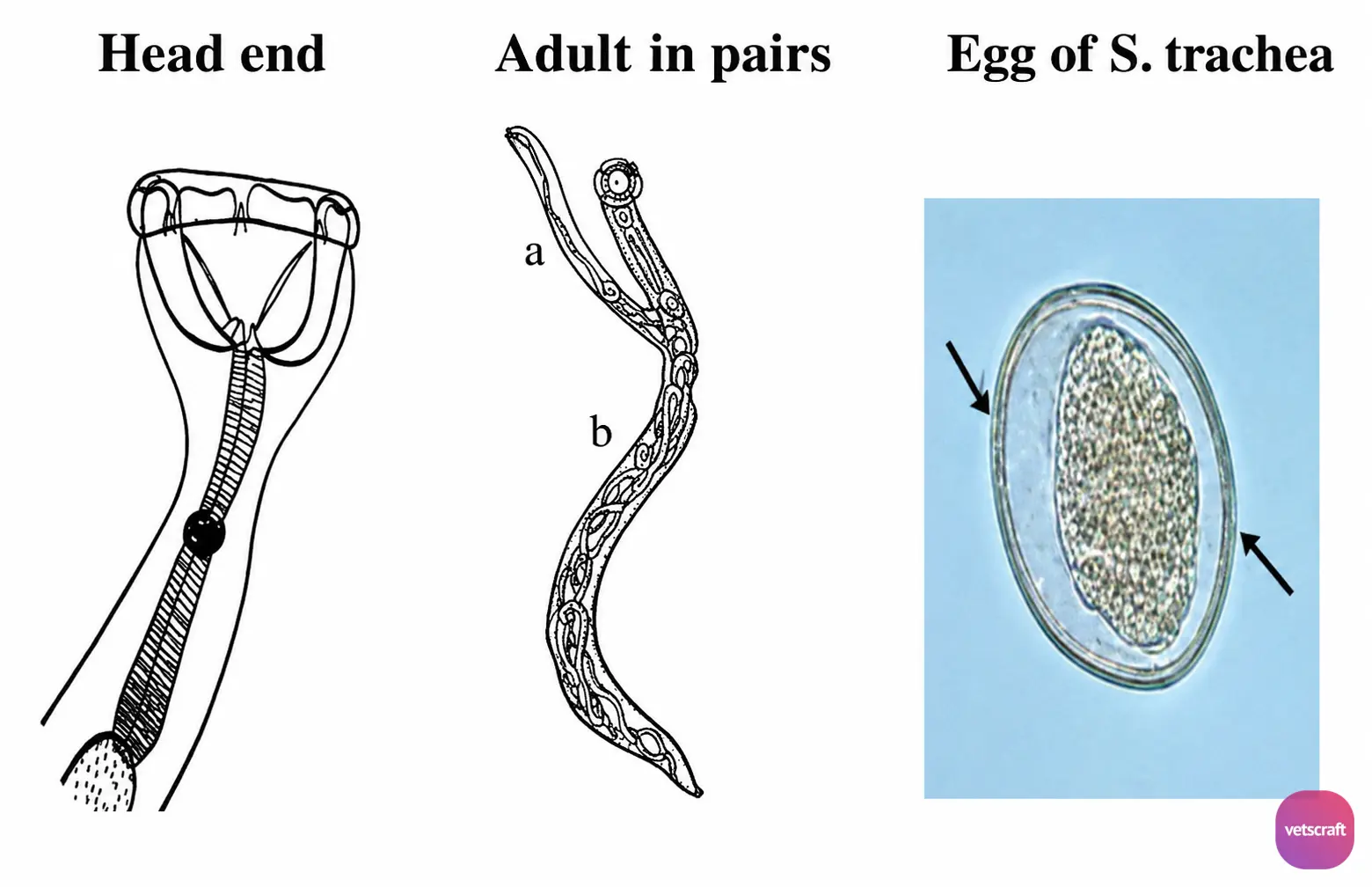
- The parasites are bright red when fresh, and the sexes remain permanently in copulation, giving them a “Y”-shaped appearance.
- It has a cup-shaped buccal capsule.
- Leaf crowns are absent. There are 6 to 10 teeth at the base of the buccal capsule.
- Eggs are ellipsoidal, thick-shelled, and operculated at both ends. They contain the 16-celled (yolk) stage.
Life Cycle
- Eggs are usually coughed up, swallowed by the birds, and passed in the droppings.
- Under optimal conditions, the infective stage (L3) is reached in about 3 days. The L3 larva develops inside the egg.
- The infective larvae hatch from the egg and soon become inactive. The infective stage may be ingested by transport hosts such as earthworms, snails, slugs, Musca, green bottle flies, and beetles.
- Inside the transport host, the larvae become encysted and remain viable for several months to years. Sometimes, the eggs may not hatch in the environment or outside the host.
Infection of the definitive host occurs in three ways:
- Ingestion of embryonated eggs containing the L3 stage
- Ingestion of L3 larvae along with feed
- Ingestion of infected transport hosts
After ingestion, the L3 stage penetrates the intestinal mucosa, enters the bloodstream, and is carried to the lungs within about 6 hours. In the lungs, the L3 stage is found in the alveoli, where it undergoes two additional molts (L4 and L5) within 3 days of infection. The young worms then migrate to the larger bronchi, where copulation occurs, and reach the trachea by approximately the 7th day after infection. The prepatent period is 17 to 20 days.
Pathogenesis
- Heavy infections cause ecchymoses, edema, and lobar pneumonia due to the migration of large numbers of larvae.
- Adult worms attach to the tracheal wall and suck blood, causing catarrhal tracheitis. Excess mucus secretion results in blockage of the air passages and difficulty breathing.
- Male worms are deeply embedded in the tracheal wall, causing nodular formation.
Clinical Signs
- In chickens, young birds are primarily affected. They develop dyspnea, asphyxia, and spasms due to the accumulation of mucus.
- The bird shakes and tosses its head and may cough or extend its neck. Birds may keep their mouths open and gasp for breath or perform gaping movements, hence the name “gapeworm.” Emaciation, anemia, weakness, and death due to asphyxia may occur.
- When birds are handled, gurgling or a “tracheal rattle” can often be heard, which may be confused with a respiratory infection.
Postmortem Lesions
The carcass is emaciated and anemic, and worms are found in the posterior part of the trachea, attached to the mucosa and surrounded by blood-streaked mucus.
Diagnosis
Clinical signs and fecal examination for eggs.
Treatment
- Mebendazole and Fenbendazole: 0.01% in feed for 1 to 2 weeks
- Thiabendazole: 0.3 to 1.5 g/kg in feed
- Levamisole: 0.04% for 2 days
Control
- Birds should not be kept in moist areas.
- Chickens and turkeys should not be kept in the same pen or on the same ground.
- Young chicks should not be reared with adults.
- In turkeys, all age groups may be affected, and they may act as carriers of the disease.