Subphylum Sarcodina (Amoebae): Classification, Characteristics, and Genus Entamoeba
Subphylum Sarcodina (Amoebae) comprises protozoan organisms that move by means of pseudopodia and are widely distributed in aquatic, terrestrial, and host-associated environments. While most sarcodines are free-living and nonpathogenic, some species are important parasites of humans and animals, particularly those belonging to the genus Entamoeba.
This article provides an overview of the classification, general characteristics, and important taxonomic groups within the subphylum Sarcodina, with special emphasis on the Family Endamoebidae and the Genus Entamoeba.
Members of this subphylum move by means of pseudopodia, as they have no cilia or flagella. The sarcodines are holozoic, ingesting preformed solid food materials through a temporary mouth.
The cytoplasm is usually divided into the endoplasm and the relatively clear ectoplasm. The former contains food vacuoles, a contractile vacuole, and the nucleus. Reproduction is asexual by binary fission or, rarely, by multiple fission, budding, or plasmotomy, and a cyst is usually produced.
Most species of amoebae are free-living and nonpathogenic, but a few species are parasites of arthropods and vertebrates.
Family: Endamoebidae
The members of this family live as parasites or commensals in the digestive tract of arthropods and vertebrates. Based on the structure of the nucleus, the members are classified into three genera: Entamoeba, Endolimax, and Iodamoeba. Among these, only species belonging to the genus Entamoeba are known to affect humans and animals.
Genus: Entamoeba
The members have a vesicular nucleus with a small endosome located at or near the center. The chromatin granules are arranged around the periphery of the nucleus; however, in some species, granules are also seen around the endosome. The cytoplasm contains a variety of food vacuoles and ingested food particles, usually bacteria and starch grains.
The members of this genus are found in the digestive tract of domestic animals and humans. They can be divided into four groups on the basis of trophozoite and cyst morphology.
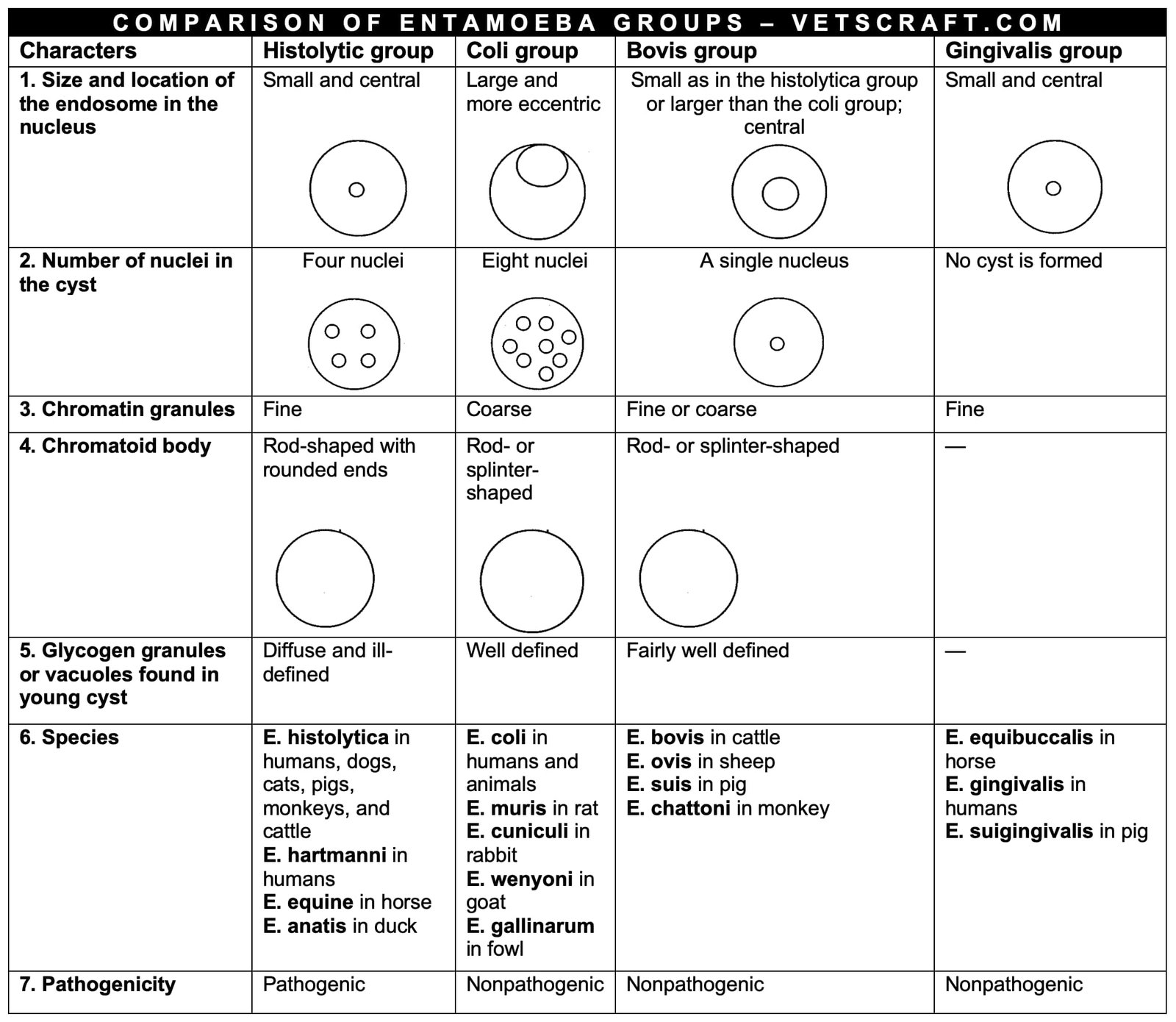
The genus Entamoeba includes several species that differ in morphology, host range, cyst characteristics, and pathogenicity. Understanding these distinguishing features is essential for accurate identification and diagnosis in veterinary parasitology.