Trichomonas gallinae: Morphology, Epidemiology, Pathogenesis, Clinical Signs, Diagnosis, Treatment & Control
Trichomonas gallinae is a flagellated protozoan parasite that primarily infects the upper digestive tract of birds, especially domestic pigeons. It is the causative agent of avian trichomonosis (canker), a disease characterized by caseous lesions in the oral cavity, esophagus, and crop. Although pigeons serve as the primary reservoir, the parasite can also infect turkeys, chickens, and a variety of wild birds, including raptors.
The parasite is transmitted mainly through crop milk, contaminated drinking water, or by predation on infected birds. Young birds are the most susceptible and may develop severe disease with high mortality, whereas adult birds often remain asymptomatic carriers.
Parasite Overview
- Host: The domestic pigeon is the primary host, but it also occurs in turkeys, chickens, and wild birds such as hawks, falcons, and eagles.
- Predilection Site: Upper digestive tract.
- Disease: Avian trichomonosis, upper digestive tract trichomonosis, and canker.
Taxonomical Classification
- Kingdom: Protista
- Phylum: Metamonada
- Class: Parabasalia
- Order: Trichomonadida
- Family: Trichomonadidae
- Genus: Trichomonas
- Species: Trichomonas gallinae
Morphology
Trichomonas gallinae is pyriform in shape. There are four anterior flagella that arise from the blepharoplast.
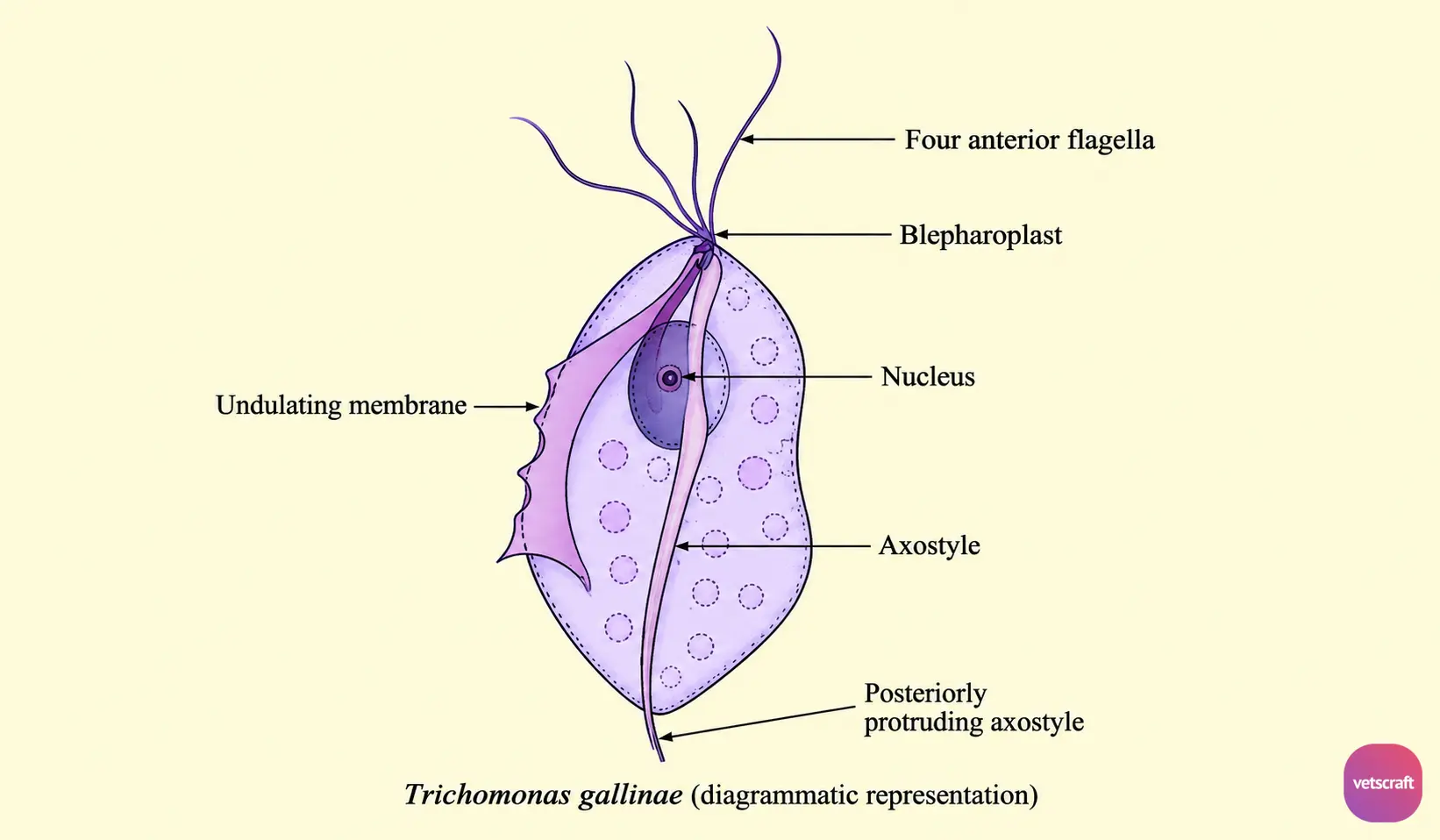
The axostyle is narrow and protrudes a short distance posteriorly from the body. The undulating membrane extends for 2/3rd to 3/4th of the body length, and a free flagellum is absent.
Epidemiology
In pigeons, Trichomonas gallinae is normally transmitted from adult carrier birds to squabs through crop milk or crop fluid.
Wild birds become infected by feeding on infected pigeons, turkeys, and chickens. Trichomonas gallinae has no cyst stage and is highly sensitive to drying.
Pathogenesis
Avian trichomonosis is primarily a disease of young birds. Approximately 80–90% of adult birds are infected but show no clinical signs, whereas squabs may die within 10 days of infection. Pathogenicity depends on the virulence of the strain. The most virulent strain is the Jones’ Barn (JB) strain.
Initially, lesions appear as small, yellowish, circumscribed areas in the oral cavity, especially on the soft palate. These lesions increase in number and size and extend to the esophagus, crop, and proventriculus.
In the digestive tract, the lesions do not extend beyond the proventriculus but may spread to the liver, lungs, serosal surface of the intestine, pancreas, and heart.
At a later stage, lesions in the pharynx, esophagus, and crop become small, whitish to yellowish caseous nodules. These may remain circumscribed or coalesce to form thick caseous necrotic masses that may obstruct the lumen. These circumscribed, disc-shaped lesions are often described as “yellow buttons.”
Clinical Signs
Infected birds initially show depression with ruffled feathers and later become weak and emaciated. There is an accumulation of greenish fluid or cheesy material in the mouth and crop, which may exude from the beak.
In turkey poults and chickens, clinical signs include drowsiness, a pendulous crop, and a foul odor from the mouth.
Postmortem Lesions
- Yellowish to grayish necrotic lesions in the mouth, crop, and esophagus.
- Lesions may also be found in the skull bones, liver, and other organs.
- Numerous organisms are present in the contents of the mouth and crop.
Immunity
Recovered birds are immune to reinfection but remain asymptomatic carriers. Infection with a non-virulent strain produces immunity against more virulent strains.
Diagnosis
- Observation of lesions in the upper digestive tract.
- Demonstration of organisms in fluid collected from the mouth using a cotton swab.
Differential Diagnosis
It should be differentiated from fowl pox and vitamin A deficiency.
Treatment
- Enheptin (2-amino-5-nitrothiazole): 30 mg/kg in drinking water for 7–14 days.
- Furazolidone: 25–30 mg/day for 7 days.
Control
- Treat infected pigeons.
- Trichomonosis in turkeys and chickens can be controlled by preventing wild birds from accessing the drinking water of poultry.