TABLE OF CONTENTS
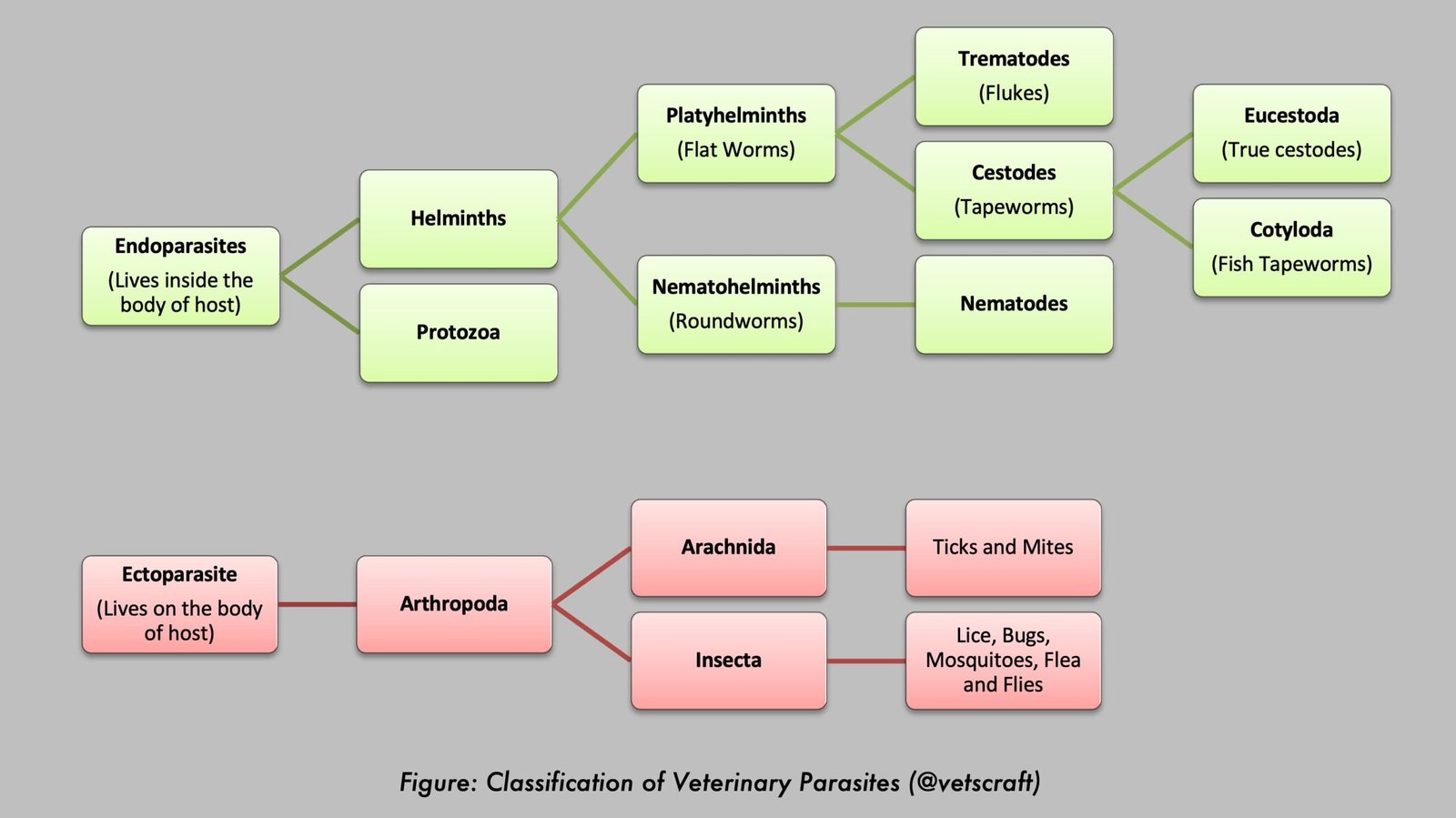
Class Cestoda (Tapeworms): Morphology, Life Cycle, and Differences Between Eucestoda and Cotyloda
Class Cestoda comprises tapeworms, a group of parasitic helminths characterized by a segmented body, the absence of a digestive system, and a complex life cycle involving one or more intermediate hosts.
The term Cestoda is derived from the word ‘cestus’, which means a tape-like structure. Tapeworms are hermaphroditic parasites.
They are endoparasites and are elongate and dorsoventrally flattened in nature. Their length may range from a few millimeters to several centimeters.
The body cavity and the digestive, respiratory, and circulatory systems are absent. Parasites belonging to Class Cestoda exhibit saprozoic nutrition.
Morphology of Tapeworms (Class Cestoda)
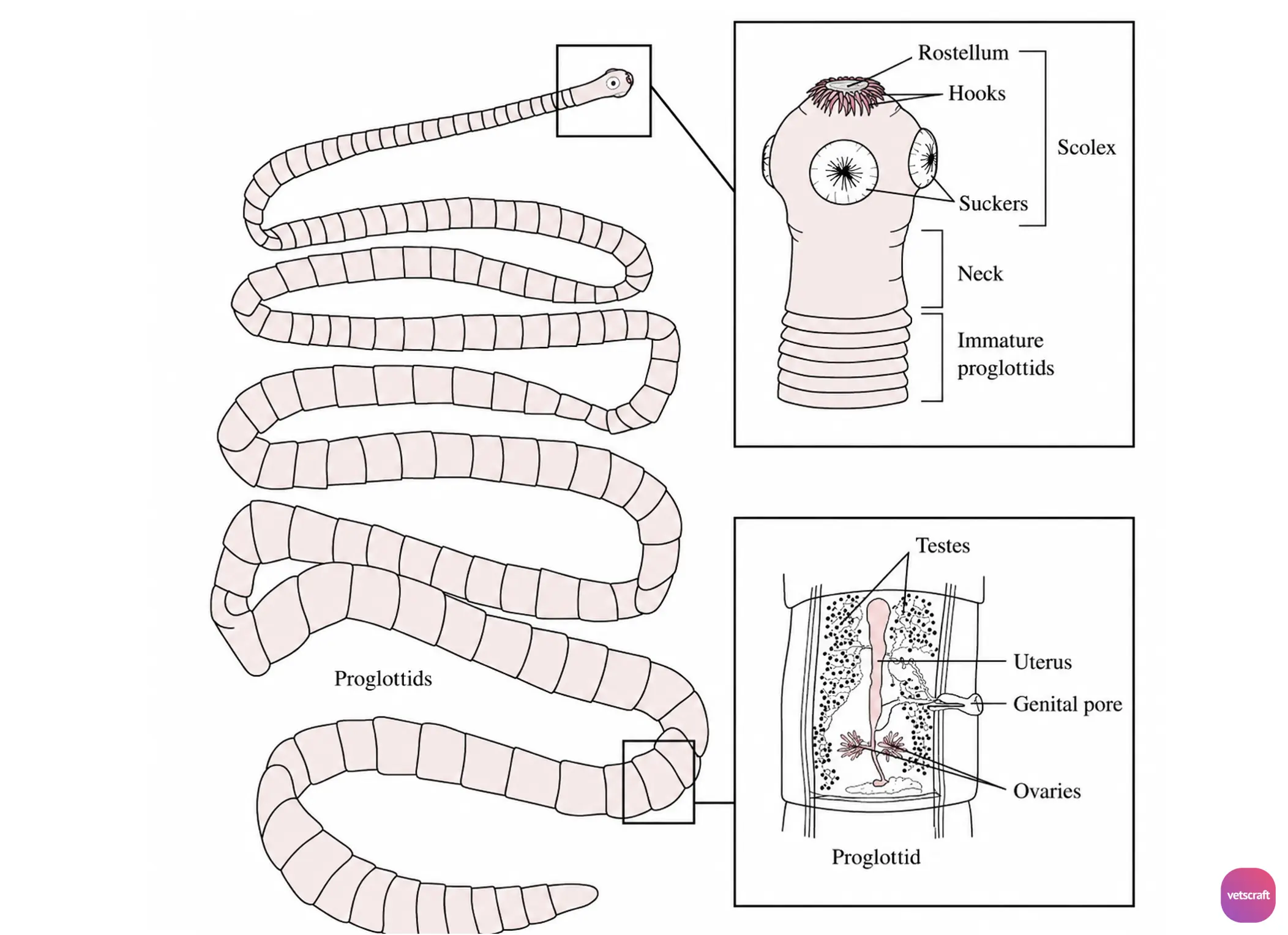
Tapeworms have three important parts:
- Head or scolex
- Neck
- Body or strobila
1. Scolex
The scolex is globular in shape and bears holdfast or adhesive organs. These organs are called suckers in Eucestoda, whereas in Cotyloda they are known as ‘bothria’. Suckers are cup-like structures, while bothria are longitudinal groove-like structures.
The scolex may have a platform-like structure called the rostellum. It may or may not bear hooks. A rostellum bearing hooks is known as an ‘armed rostellum’. In some species, the suckers also bear hooks and are referred to as armed suckers.
2. Neck
The unsegmented portion immediately posterior to the head is called the neck.
3. Body
The portion behind the neck region is called the body or strobila. The strobila consists of numerous segments called proglottids, which are separated by transverse constrictions.
The genital organs are poorly developed in the first few segments, which are known as immature segments. Mature segments contain fully developed and functional genital organs.
Each segment contains one or two sets of genital organs:
- Raillietina spp. – Single set of genital organs.
- Cotugnia digonopora – Double set of genital organs.
Generally, the genital pore opens on the lateral aspect in Eucestoda, whereas in Cotyloda it is situated on the ventral aspect. The posterior segments become packed with eggs and are known as gravid segments. Only cotylodan tapeworms possess a separate uterine pore and therefore lay eggs individually. In contrast, in Eucestoda, gravid segments detach and are passed in the feces of the host. The eggs are released following disintegration of the gravid segments, a process known as ‘apolysis’.
In some species, the gravid segments continue to move on the surface of feces, bedding material, or the floor after being voided. This phenomenon is known as “euapolysis”.
Nervous System
The central part of the nervous system is situated in the scolex, from which nerve cords extend posteriorly.
Life Cycle of Cestodes
Eggs may be embryonated or unembryonated when laid. Embryonated eggs contain an oncosphere or hexacanth embryo. The oncosphere is bilaterally symmetrical and possesses three pairs of hooks.
Cestode eggs have four layers:
- Outer capsule
- Outer envelope
- Inner envelope
- Oncosphere membrane
In Eucestoda, the eggs hatch only after ingestion by the intermediate host (I/H) and develop into larval stages. In contrast, in Cotyloda, the eggs hatch in water and release a larval stage known as the “coracidium”.
The larval stage of a tapeworm is known as the metacestode or bladder worm stage.
Differences Between Eucestoda and Cotyloda
| Eucestoda | Cotyloda |
|---|---|
| The holdfast organ is known as a sucker. Suckers may be armed or unarmed and are usually four in number. | The holdfast organ is known as a bothrium, consisting of two longitudinal weak muscular grooves. |
| Segmentation is present. | Segmentation is absent. |
| The genital pore is present on the lateral aspect. | The genital pore is present on the ventral aspect. |
| Eggs are embryonated when laid and hatch within the intermediate host (I/H). | Eggs are unembryonated, operculated, and hatch in water. |
| Only one intermediate host is required. | Two intermediate hosts are required. |
| Apolysis is present. | Apolysis is absent. |