Types of Parasitic Infection: Definitions and Examples
Parasitic infections may occur in different forms depending upon the mode of transmission, host-parasite relationship, and epidemiological factors. Understanding these types of infections is important in veterinary parasitology for proper diagnosis, prevention, and control of parasitic diseases in animals and humans.
Auto Infection
Auto infection is reinfection of the host by the parasite that is already present in its body. In this type of infection, the parasite completes part of its life cycle within the same host, resulting in repeated infection without exposure to an external source.
Examples include Strongyloides stercoralis and Taenia solium.
A man who harbours Taenia solium infection may get infected repeatedly by the hexacanth embryos that hatch out in the intestine, leading to internal reinfection.
Auto infection is clinically important because it may increase the severity and persistence of parasitic infection in the host.
Congenital Infection
Congenital infection is transmission of parasites from mother to offspring either during pregnancy or shortly before birth. Examples include Toxoplasma gondii in humans and Toxocara canis in dogs.
Congenital infections are important because they may lead to weakness, developmental abnormalities, or even death of the foetus or newborn offspring.
Prenatal Infection
Prenatal infection is a type of congenital infection in which the parasite is transmitted from mother to foetus through placental circulation before birth.
Examples include Toxocara canis in dogs and Toxocara vitulorum in calves.
Prenatal transmission plays an important role in maintaining parasitic infection in young animals even before they are exposed to the external environment.
Transcolostral or Transmammary infection
Transcolostral or transmammary infection is transmission of parasites from dam to offspring through colostrum or milk during nursing.
An example is transmission of Toxocara vitulorum in calves.
This type of transmission is commonly observed in nematode infections and is responsible for early infection in neonates.
Transovarian Transmission
Transovarian transmission is transmission of parasites from an infected female tick to its offspring through the ova.
An example is transmission of babesiosis by Boophilus spp. ticks.
In this type of transmission, the parasite passes from one tick generation to the next generation.
Transtadial Transmission
Transtadial transmission is transmission of a parasite from one developmental stage of a tick to the next stage.
An example is transmission of theileriosis (Theileria annulata) by Hyalomma spp. ticks.
For example, a parasite acquired during the larval stage may persist through the nymphal and adult stages of the vector.
Zoonoses
Zoonoses refers to diseases or infections that are naturally transmitted between animals and humans.
Zoonotic parasitic diseases are of major public health importance because humans may acquire infection directly or indirectly from animals.
Anthroponoses
Anthroponoses (Anthropozoonosis) refers to transmission of disease from animals to humans. Examples include cysticercosis and trichinellosis.
Zooanthroponoses
Zooanthroponoses denotes transmission of disease from humans to animals. An example is amoebiasis.
Epidemiology
Epidemiology (Epizootiology in animals) is the study of the distribution, occurrence, and determinants of diseases in a population. It helps in understanding disease outbreaks, transmission patterns, and preventive measures.
Endemic (Enzootic)
Endemic (Enzootic) refers to the constant presence or usual occurrence of a disease within a particular geographical area or animal population. The disease usually affects a moderate number of individuals at regular intervals.
Epidemic (Epizootic)
Epidemic (Epizootic) refers to a sudden outbreak of a disease affecting a large number of individuals within a short period of time. The disease spreads rapidly among the susceptible population.
Sporadic
Sporadic refers to the occasional occurrence of a disease at irregular intervals. Only a few individuals are affected, and cases occur here and there without any predictable pattern.
Pandemic
Pandemic refers to an outbreak of a disease that spreads across several countries or continents and affects a very large population.
Incubation Period
Incubation period is the period between the time of infection and the appearance of clinical signs or symptoms.
The duration of the incubation period varies depending upon the parasite, host immunity, and severity of infection.
Prepatent Period (Biological Incubation)
Prepatent period (biological incubation period) is the period between the time of infection and the first demonstration of parasitic stages such as eggs, larvae, or parasites in blood, faeces, or other body fluids.
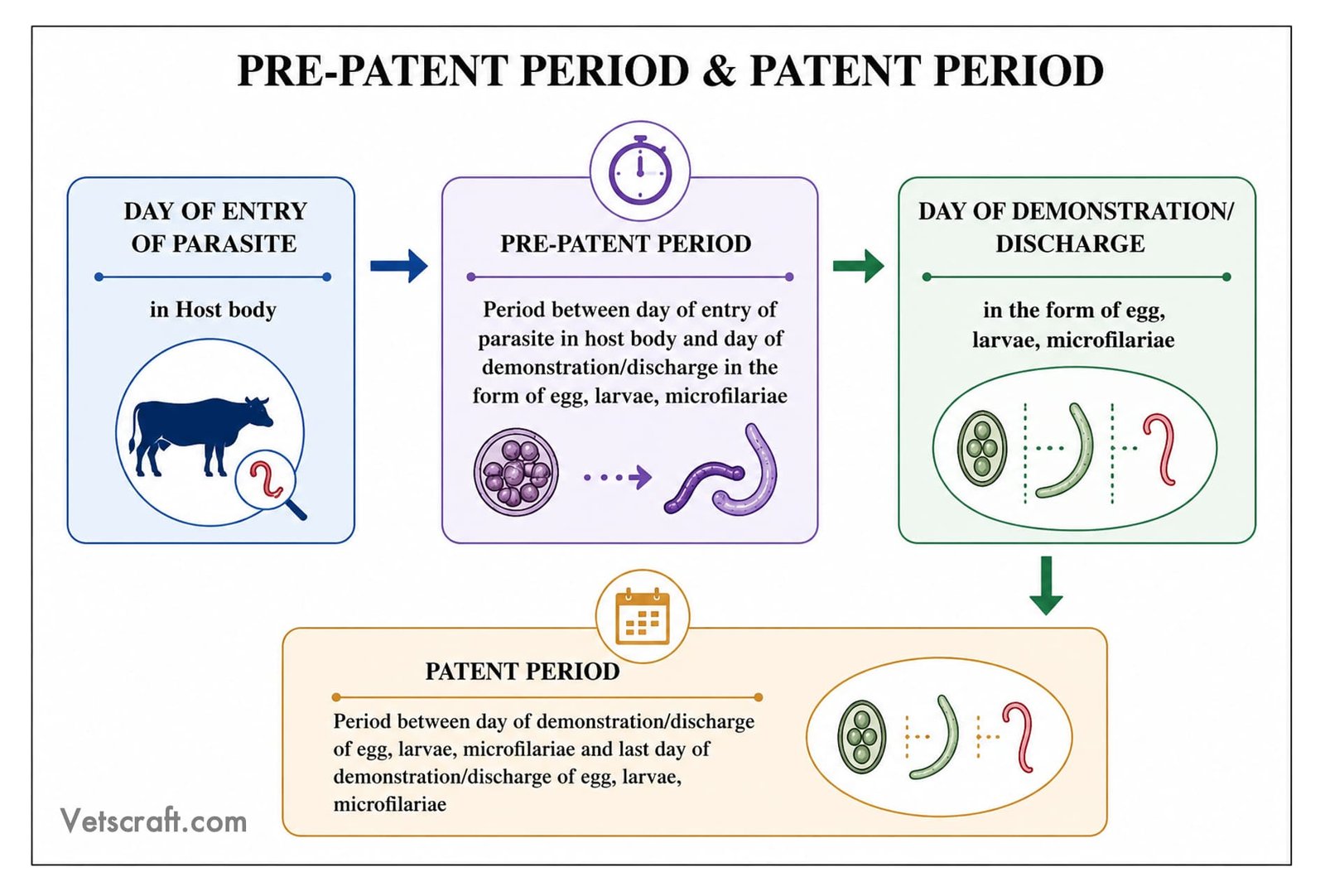
It is an important diagnostic parameter in parasitology.
Threshold Value
Threshold value refers to the number of parasites that can be harboured by the host without producing clinical signs. When the parasite burden exceeds the threshold value, clinical disease may develop.
Parasitiasis
Parasitiasis is a term used to denote a parasitic infection that does not produce any noticeable clinical signs in the host. The host may appear clinically healthy despite harbouring parasites.
Parasitosis
Parasitosis is a term used to denote a parasitic infection that produces clinical signs and pathological changes in the host.
Clinical manifestations may vary from mild illness to severe disease depending upon the type and burden of parasites.