Nutrition in Parasites: Types, Modes, and Importance
Nutrition is essential for the survival, growth, reproduction, and pathogenicity of parasites. Different groups of parasites have evolved specialized feeding mechanisms to obtain nutrients from their hosts.
The mode of nutrition in protozoa may be holozoic, saprozoic, or pinocytosis. Different protozoan parasites obtain nutrients from the host by different methods depending upon their structure and habitat.
The mode of nutrition in parasites are:
- Holozoic Nutrition
- Pinocytosis Nutrition
- Saprozoic Nutrition
1. Holozoic Nutrition
Holozoic nutrition is the engulfing or ingestion of preformed solid food material through a temporary or permanent mouth. In amoebae, the food particles are ingested through temporary projections called pseudopodia that form a temporary mouth whenever needed. In ciliates, a permanent mouth called the cytostome (cell mouth) is present through which food particles are engulfed and passed into food vacuoles in the cytoplasm where digestion occurs.
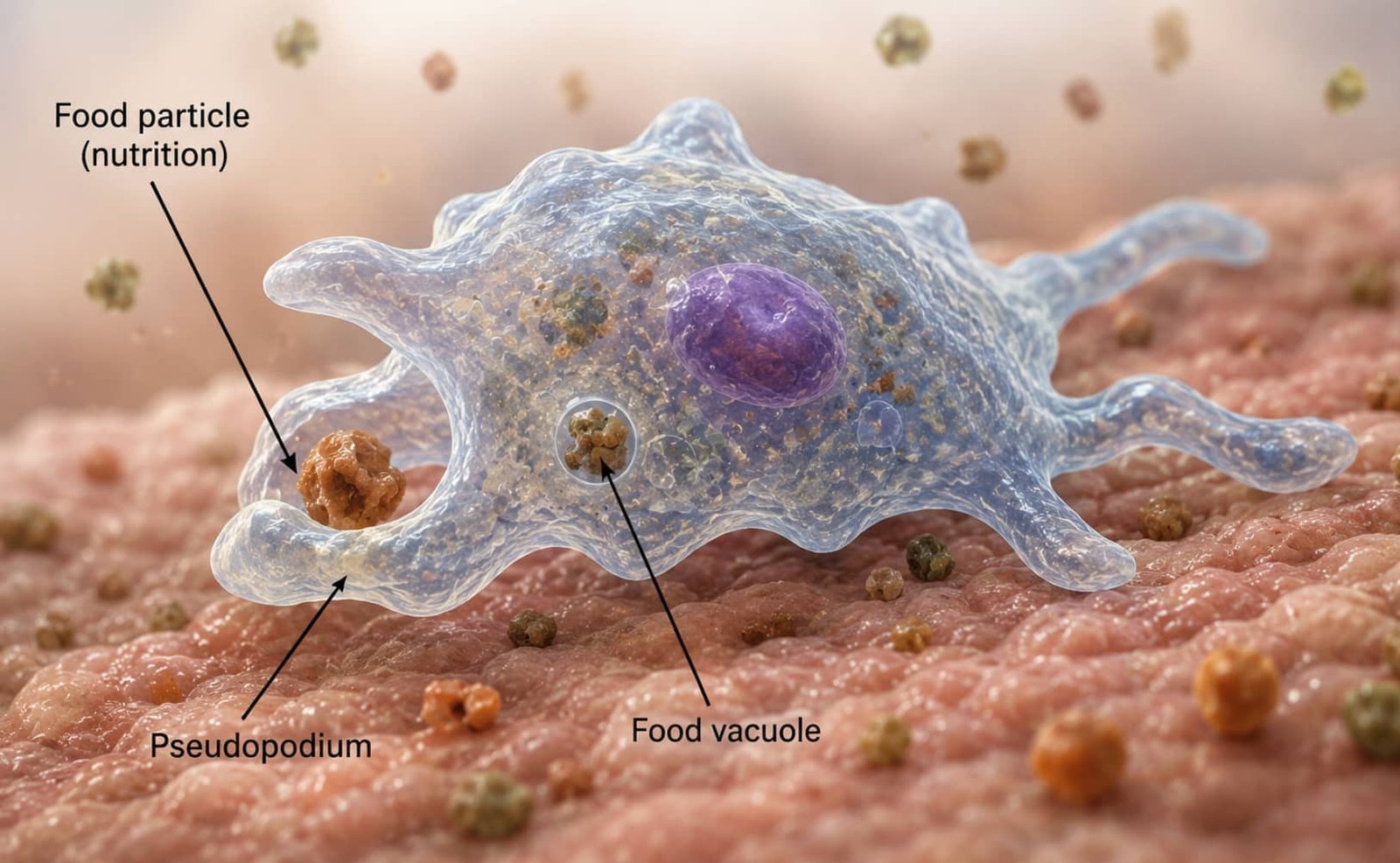
After digestion, the undigested materials are extruded from the body through a temporary opening or through a permanent anal pore called the cytopyge (cell anus). This type of nutrition is commonly seen in amoebae and ciliates.
2. Pinocytosis
Pinocytosis, also known as “cell drinking,” is the ingestion of liquid food materials through minute temporary channels formed on the cell surface. These channels pinch off internally to form small vacuoles called pinosomes.
This mode of nutrition enables parasites to absorb dissolved nutrients directly from the surrounding medium. Pinocytosis is commonly observed in trypanosomes and some other flagellates.
3. Saprozoic Nutrition
Saprozoic nutrition is a mode of nutrition in which dissolved nutrients are absorbed directly through the body surface or plasma membrane. In this method, no specialized organelles for ingestion are required.
The parasites absorb predigested nutrients from the host body fluids or intestinal contents. This type of nutrition is found in many protozoa, tapeworms (cestodes), and Acanthocephala.
Difference Between Holozoic, Pinocytotic, & Saprozoic Nutrition
| Type of Nutrition | Method of Feeding | Food Material | Examples |
|---|---|---|---|
| Holozoic | Engulfment through cytostome or pseudopodia | Solid food particles | Amoebae, ciliates |
| Pinocytosis | Ingestion through temporary channels | Liquid food materials | Trypanosomes |
| Saprozoic | Direct absorption through body surface | Dissolved nutrients | Cestodes, Acanthocephala |
Importance of Nutrition in Parasites
The mode of nutrition plays an important role in the survival, growth, multiplication, and pathogenicity of parasites. Adaptations in feeding mechanisms help parasites efficiently utilize nutrients from the host and survive in different environments within the host body.