Ctenocephalides (Dog and Cat Fleas): Pathogenesis, Disease Transmission, Treatment & Control
Ctenocephalides is a genus of fleas in the family Pulicidae that includes important flea species affecting dogs and cats. Ctenocephalides felis (cat flea) and Ctenocephalides canis (dog flea) are associated with flea allergy dermatitis, pruritus, anemia in heavily infested animals, and transmission of certain parasites. This article covers the identification, pathogenesis, disease transmission, treatment, and control of Ctenocephalides fleas.
There are two important species in the genus Ctenocephalides:
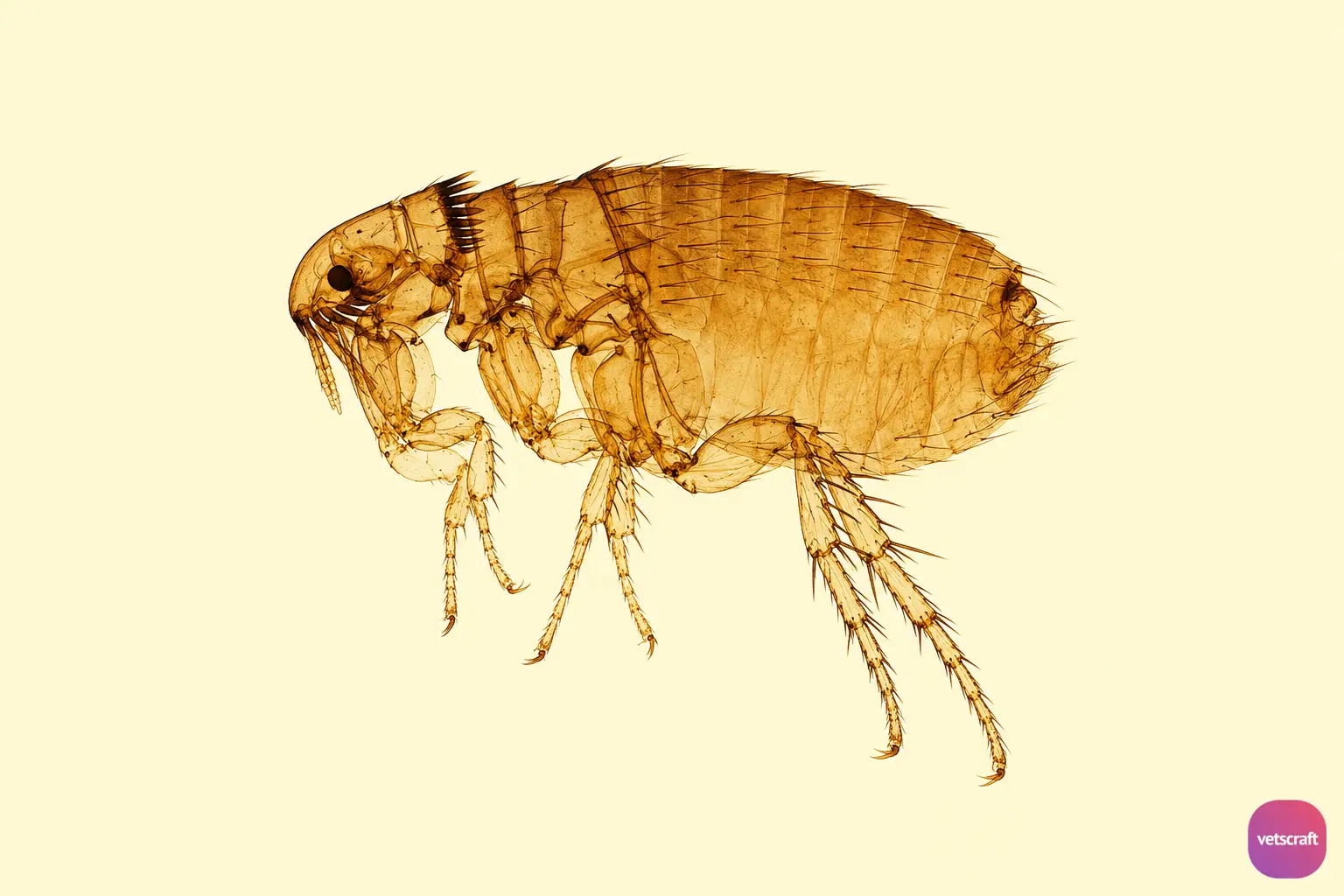
- Ctenocephalides canis (Dog Flea): The head is rounder, and the first spine is shorter than the rest. It has both genal (7–8 spines) and pronotal combs (16 spines).
- Ctenocephalides felis (Cat Flea): The head is elongated. It has both genal (7–8 spines) and pronotal combs (16 spines), and the spines are equal in length.
Pathogenesis
Flea Allergy Dermatitis (FAD)
Animals with flea allergy dermatitis (FAD) become restless, lose condition, and spoil their coats by biting and scratching. The reaction to a flea bite is determined by the stage of sensitization of the animal to flea saliva.
A hapten in the saliva becomes immunogenic by fixation to skin collagen and forms a complete allergen (an incomplete antigen). When feeding, fleas inject saliva that contains a variety of histamine-like compounds, enzymes, polypeptides, and amino acids and induces Type I, Type IV, and basophil hypersensitivity.
Flea-naive dogs exposed intermittently to flea bites develop either immediate (15 minutes) or delayed (24–48 hours) reactions, or both, and detectable levels of both circulating IgE and IgG antiflea antibodies.
Dogs exposed continuously to flea bites have low levels of these circulating antibodies and either do not develop skin reactions or develop them later and to a considerably reduced degree. This could indicate that immunologic tolerance may develop naturally in dogs continuously exposed to flea bites.
Animals vary greatly in their sensitivity to flea bites. For example, dogs and cats that do not become hypersensitive to flea saliva show, at most, mild pruritus that often goes unnoticed. In animals that respond, moderate to severe pruritic reactions occur in the lumbosacral area, abdomen, hind legs, and neck.
Lesions vary from painful areas of moist dermatitis (wet eczema), which may become secondarily infected by bacteria, to discrete papules with scaling. Acanthosis, alopecia, severe seborrhea, hyperkeratosis, and hyperpigmentation are features of long-standing cases.
Miliary Dermatitis and Feline Symmetrical Alopecia
In cats, two distinct clinical manifestations are associated with flea allergy, viz., miliary dermatitis and feline symmetrical alopecia, which is caused by self-trauma. The skin appears normal, but microscopic examination of distal hair tips shows that they have fractured due to excessive grooming.
However, in miliary dermatitis, the skin, especially across the dorsum and trunk, is covered in crusted papules with variable degrees of hair loss. This miliary dermatitis is typically found on the back, neck, and face.
The lesions are not actual flea bites but a manifestation of a systemic allergic reaction that leads to generalized pruritus and an eczematous rash. Pruritus may be severe, evidenced by repeated licking, scratching, and chewing. Cats with FAD can have alopecia, facial dermatitis, exfoliative dermatitis, and “racing stripe” or dorsal dermatitis.
Although blood meal size is small, repeated feedings and high infestation can cause significant blood loss, and heavy infestations may cause fatal iron deficiency anemia in very young animals. The animal will bite that area and pull out the fur and swallow the hairs, leading to hairballs in the stomach.
Fleas in the genus Ctenocephalides have been reported to produce anemia in poultry, dogs, cats, goats, cattle, and sheep.
Disease Transmission
They transmit Dipylidium caninum (tapeworm of dogs). Larval fleas ingest eggs of Dipylidium caninum. The cysticercoids develop in adult fleas. Dogs are infected by swallowing adult fleas. They also transmit Acanthocheilonema reconditum.
Treatment
- Isoxazolines: Afoxolaner, fluralaner, sarolaner, and lotilaner are highly effective modern flea treatments.
- Selamectin: A topical macrocyclic lactone used in dogs and cats for flea control and prevention of reinfestation.
- Fipronil: A topical phenylpyrazole insecticide available as spot-on and spray formulations.
- Imidacloprid: A topical neonicotinoid effective against adult fleas and available alone or in combination with other antiparasitic agents.
- Dinotefuran: A topical neonicotinoid used for flea control available in combination products with insect growth regulators or other ectoparasiticides.
- Indoxacarb: A topical oxadiazine insecticide.
- Nitenpyram: A rapidly acting oral neonicotinoid that provides rapid reduction of adult fleas and can be useful when immediate flea killing is required.
- Spinosad: An oral insecticide that provides effective control of adult fleas and is administered at regular intervals.
- Insect Growth Regulators (IGRs): Lufenuron, methoprene, and pyriproxyfen interfere with flea development and may be used alone or in combination with adulticides to help break the flea life cycle.
Control
- Year-round flea prevention: Consistent use of an effective flea-control product in dogs and cats is recommended to prevent infestation and reinfestation. All susceptible animals in the household should be treated simultaneously.
- Environmental control: Environmental control should be performed along with treatment of the animals. Premise sprays containing appropriate adulticides and/or insect growth regulators (IGRs) can be used in areas with established infestations.
- Vacuuming: Floors, carpets, rugs, upholstery, furniture, cracks, crevices, and other areas where pets spend time should be thoroughly and regularly vacuumed. Particular attention should be given to areas where animals rest.
- Cleaning bedding: Pet bedding, blankets, and other washable materials should be regularly washed. Heavily infested bedding or materials that cannot be adequately cleaned may need to be discarded.
- Treatment of all animals: Every dog and cat in the household should receive an appropriate flea-control treatment, even if fleas are not currently visible on every animal.
- Insect growth regulators: Products containing insect growth regulators such as methoprene or pyriproxyfen can help interrupt the flea life cycle by preventing the development of immature flea stages.
- Entomopathogenic nematodes: Entomopathogenic nematodes that parasitize flea larvae and pupae may be used in suitable outdoor areas to help reduce environmental flea populations.
Flea Collars
Flea collars are another option for flea control. Their efficacy and duration of protection vary according to the active ingredients and specific product. Some modern flea collars provide several months of continuous protection.
Flea collars should be used only in the species for which they are specifically labeled. A dog flea collar should not be used on a cat unless the product is specifically labeled for cats. Some insecticides used in dog products, particularly certain pyrethroids such as permethrin, can be highly toxic to cats.
Contact dermatitis or other adverse reactions may occasionally occur with flea collars. The collar should be fitted according to the manufacturer’s instructions, and the product label should be followed regarding age, health status, duration of use, bathing, and concurrent use of other ectoparasiticides.