Xenopsylla cheopis (Oriental Rat Flea): Morphology & Disease Transmission
Xenopsylla cheopis (Oriental Rat Flea) is an important flea species associated primarily with rats and is well known for its role in the transmission of several pathogens. It is a major vector of Yersinia pestis, the causative agent of plague, and can also serve as an intermediate host for Hymenolepis diminuta and H. nana. Its distinctive morphological features and medical and veterinary importance make it an important species in veterinary parasitology and public health.
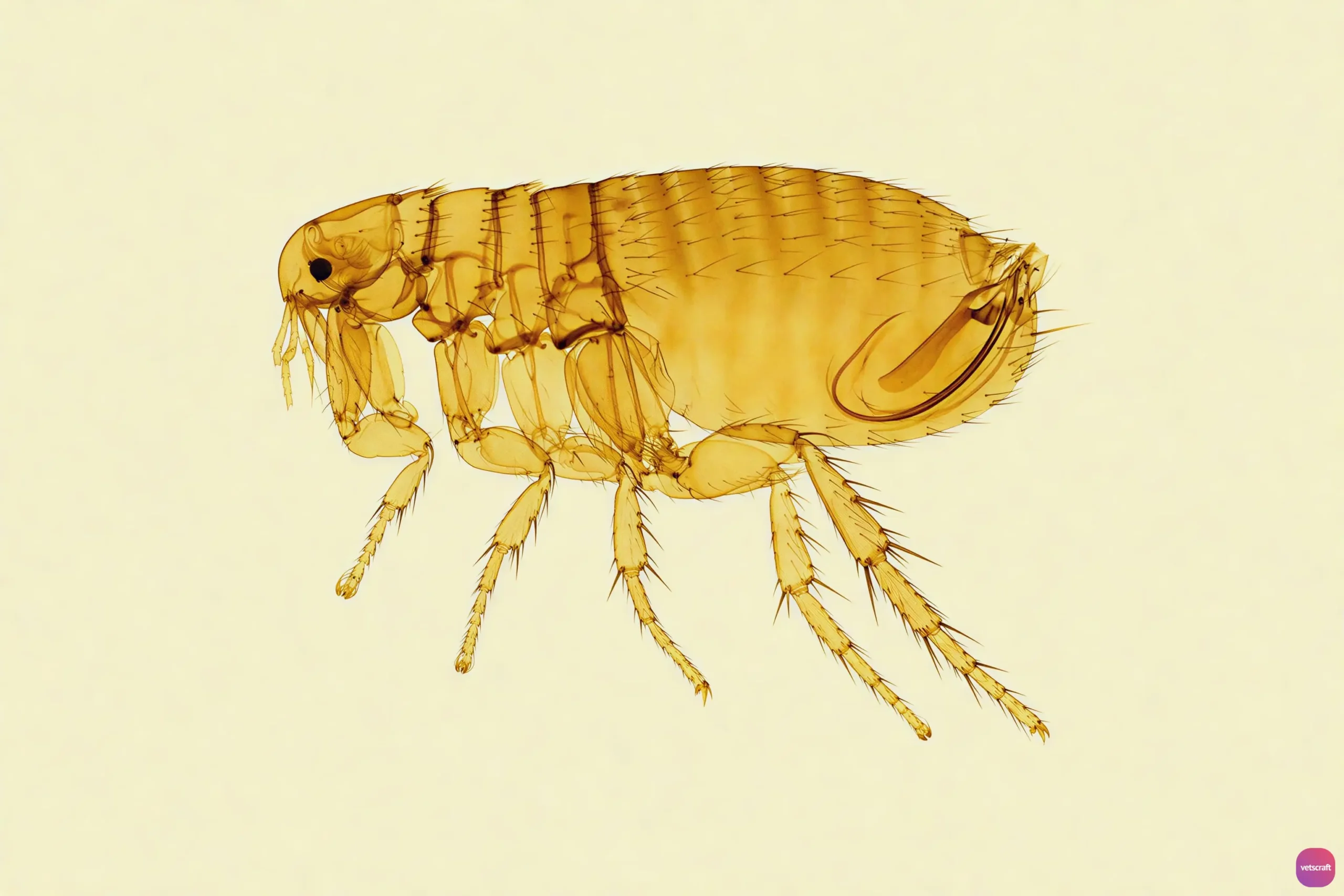
Morphology
- Head is rounded anteriorly.
- Both genal and pronotal combs are absent.
- Eyes are present.
- The segments of the thorax appear relatively large, and a pleural ridge is present in the mesopleuron of the thorax.
- A row of bristles is present along the posterior margin of the head, along with a stout ocular bristle in front of the eye.
Disease Transmission
Xenopsylla cheopis (Oriental Rat Flea) transmits Yersinia pestis, the causative agent of bubonic plague. An important factor in plague transmission is the blockage of the proventriculus by a biofilm formed by Yersinia pestis. A blocked flea is unable to fill the midgut with blood and wanders from host to host, attempting to feed, thereby contaminating new hosts with bacilli.
Xenopsylla cheopis also acts as an intermediate host of Hymenolepis diminuta and H. nana in humans.
Endemic or murine exanthematous typhus (Rickettsia mooseri) is transmitted by rat fleas to humans. It is a mild to severe febrile disease characterized by headache, chills, and skin rashes, with infrequent involvement of the kidneys and central nervous system (CNS). The rickettsiae multiply in the flea gut and are excreted in the feces of fleas.
Tularemia (Francisella tularensis) is transmitted mechanically by fleas.