TABLE OF CONTENTS
Internal Anatomy and Physiology of Insects: Digestive, Respiratory, Circulatory, and Reproductive Systems
The internal anatomy and physiology of insects are highly specialized to support their survival, growth, reproduction, and adaptation to diverse environments. Unlike vertebrates, insects possess an open circulatory system, a tracheal respiratory system, and Malpighian tubules for excretion. Their body systems work together efficiently to perform essential physiological functions.
This article provides a comprehensive overview of the internal anatomy and physiology of insects, including the digestive, respiratory, circulatory, nervous, excretory, and reproductive systems.
Integumentary System
The exoskeleton is the outer covering that provides support and protection to the living tissues of arthropods and is non-cellular. Instead, it is composed of a number of layers of cuticle, which are secreted by a single outer cell layer of the body known as the epidermis.
The outer layer of the cuticle is the waxy layer. The next two layers are the outer exocuticle and inner endocuticle. Both are composed of a protein and a polysaccharide called chitin, which has long, fibrous molecules containing nitrogen. These are bound together into a stable glycoprotein complex.
Alimentary Canal (Digestive System)
The alimentary canal is divided into three regions:
- Foregut (stomodeum)
- Midgut (Mesenteron): Digestion and absorption occur here.
- Hindgut (Proctodeum): Water absorption and waste elimination occur here.
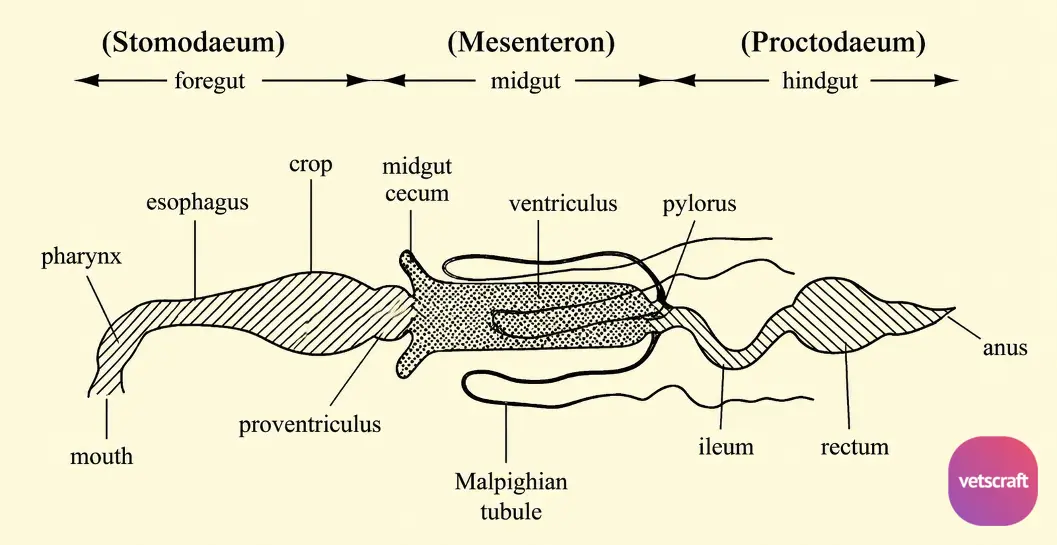
The alimentary canal consists of the mouth, which leads to the oesophagus, followed by a small sac known as the crop. The crop is followed by the proventriculus and then by the true stomach, known as the midgut. On both sides of the midgut, two small tubes known as the Malpighian tubules are attached. These are followed by the ileum, colon, and finally the rectum, which are collectively known as the hindgut.
The Malpighian tubules are the excretory organs of insects. They absorb nitrogenous waste materials from the haemolymph and excrete them. The foregut and hindgut arise from ectodermal invaginations, and both are shed and renewed during each moult. The true mouth is absent in insects. The crop serves as a food reservoir.
The gizzard, or proventriculus, is located behind the crop and has a thick muscular wall lined with chitin. In some insects, small tooth-like structures are present. The midgut is the main digestive organ.
Salivary glands are paired and have long ducts that join to form a common duct, which opens at the base of the hypopharynx. At the posterior end of the mesenteron, a ring of Malpighian tubules (finger-like processes) is present.
Respiratory System
The respiratory system consists of tracheal tubes that open externally through spiracles or stigmata located along the lateral sides of the body. Spiracles are present on the mesothorax, metathorax, and abdominal segments.
Circulatory System
The circulatory system consists of a dorsally situated heart, an aorta, and a general body cavity or haemocoel. The heart is a tube surrounded by pericardial cells, and its lumen is divided into a number of compartments or chambers by valves, which allow the blood to pass forward only.
Each compartment opens into the haemocoel through a pair of openings known as ostia. Anteriorly, there is an aorta that carries the blood to the head, where it enters the haemocoel and bathes all the organs. The dorsal aspect of the body is connected by veins.
The blood of insects is called haemolymph, which does not clot readily. It is a viscid fluid containing few cells and is gray, amber, or sometimes greenish in color.
Nervous System
The nervous system is located ventrally in insects. It consists of the circumoesophageal commissure with ganglia and a double ventral nerve cord of ganglia from which nerves arise.
Each thoracic and abdominal segment has one ganglion (i.e., 3 thoracic and 11 abdominal ganglia).
Excretory System
The excretory function is carried out by the Malpighian tubules, which are evaginations of the anterior part of the hindgut.
Reproductive System
Male insects have two testes, each connected to a vas deferens. Distally, the vasa deferentia enlarge to form seminal vesicles before fusing into a common ejaculatory duct. Sperm is stored in the seminal vesicles, and the common duct opens into the aedeagus, which transfers sperm to the female during copulation.
Accessory sex glands are present on either side of the ejaculatory duct and secrete fluid that forms the spermatophore and lubricates the aedeagus. The external genitalia consist of the aedeagus, which is provided with claspers.
The female reproductive system consists of two ovaries, each composed of a group of ovarian tubules arising from an apical filament. The oviducts unite to form a common duct, which bears the receptaculum seminis and terminates in the ovipositor.
Accessory glands are usually present, and their secretions help attach the eggs to the hair of the host.
Based on their egg-laying habits, insects are classified into:
- Oviparous: Flies that lay eggs only, e.g., houseflies and mosquitoes.
- Larviparous or Viviparous: Flies that lay or deposit larvae, which take a longer time to pupate, e.g., Oestrus spp. and Sarcophaga spp.
- Pupiparous: Flies that lay or deposit larvae that are ready to pupate, e.g., Hippobosca spp.