TABLE OF CONTENTS
Development of Insects: Molting, Metamorphosis, Types of Larvae & Pupae
The development of insects involves a series of growth stages marked by molting and metamorphosis. During development, insects shed their cuticle through molting (ecdysis) and progress through distinct life stages, including larval and pupal forms, before reaching adulthood. Understanding insect development is essential in veterinary parasitology, as the life cycle influences the identification, biology, and control of medically and veterinary important arthropods.
The growth of an insect is accompanied by a series of moults in which the cuticle is shed and renewed. This process is known as moulting (or) ecdysis. The shed cuticle or cast cuticular skin is known as the exuviae.
The number of moults varies from 4–8. The form of an insect between two moults is known as an instar, and the interval between two moults is known as a stadium. The change in the form of an insect during development is called metamorphosis. The larval stages are known as bots, maggots, instars, and grubs. The immature adult is known as the imago.
Metamorphosis
The change in the form of an insect during development is known as metamorphosis.
Complete Metamorphosis (Holometabolous)
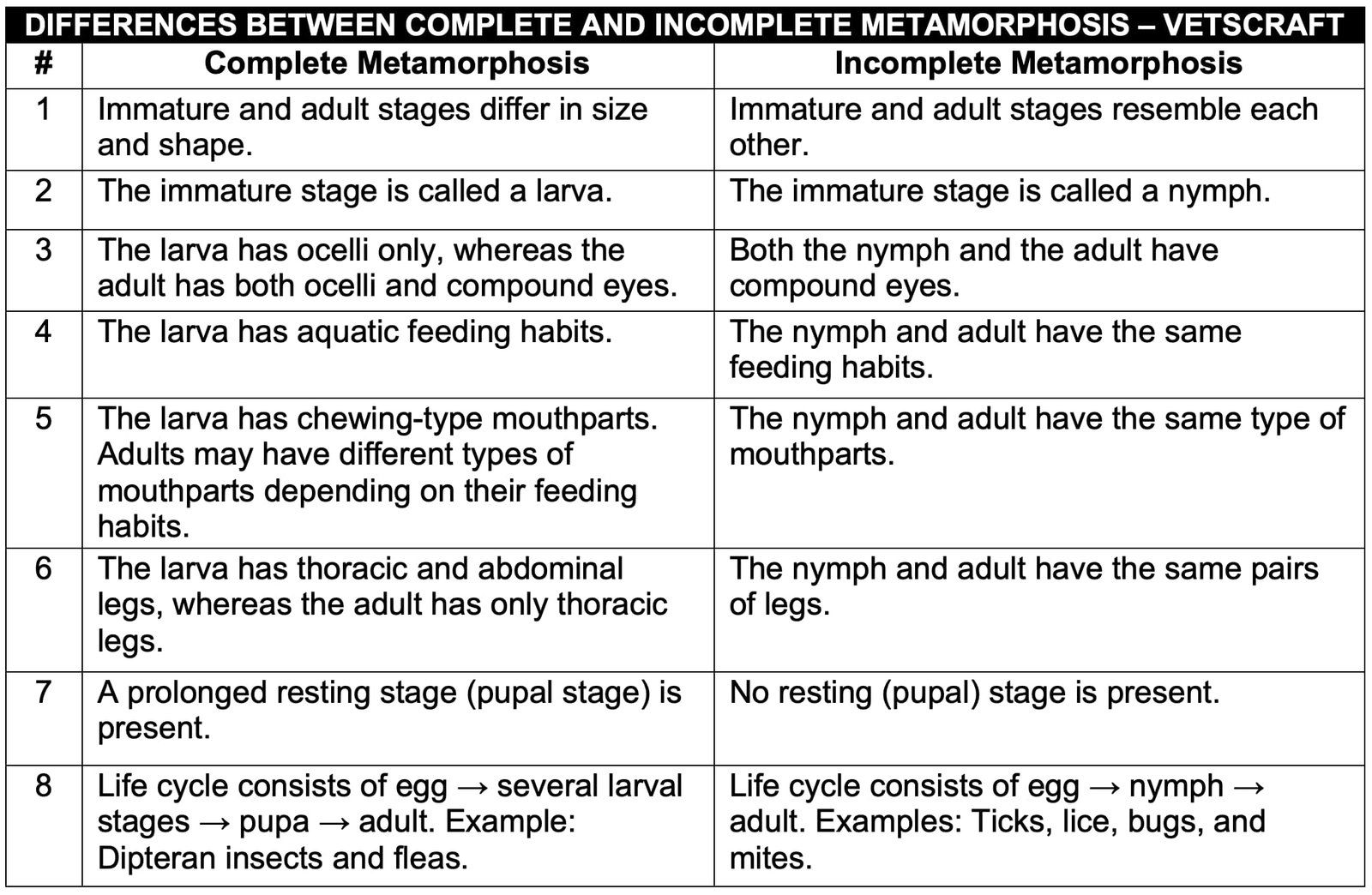
The immature stage (i.e., the young form) and the adult differ from each other in their morphological form and structure. The habitats of the immature stage and the adult also differ. E.g. all dipteran insects and fleas.
Egg → Larva → Pupa → Adult
Incomplete Metamorphosis
The immature stage (i.e., the young form) and the adult resemble each other in their morphological form and structure. The habitats of the immature stage and the adult are also the same. E.g. ticks, lice, bugs, and mites.
Egg → Nymph → Adult (Lice and bugs)
Egg → Larva → Nymph → Adult (Ticks and mites)
Differences Between Complete and Incomplete Metamorphosis
Types of Larvae
- Eucephalous: Larvae with a distinct head and thorax. E.g. mosquito larva.
- Acephalous: Larvae with a reduced or absent head. E.g. house fly.
- Apodous Larvae: Larvae with no legs. E.g. house fly and blow fly.
- Polypod Larvae: Larvae with a well-developed head and thorax, in which each thoracic segment bears a pair of legs, and an abdomen of ten segments bearing five pairs of hooked prolegs. E.g. caterpillars and butterfly larvae.
- Oligopod Larvae: Larvae with a well-developed head and thorax, in which each thoracic segment bears a pair of legs, and an abdomen of ten segments without any legs. E.g. beetles.
Types of Pupae
The pupa is a quiescent stage during which the imago is formed.
Pupae are classified into three types:
- Exarate (Free) Pupa: The pupa remains uncovered. The wings and legs of the adult insect are free from the rest of the body and are visible externally. E.g. beetles.
- Obtect Pupa: The pupa is immobile. The legs and wings are bound to the body by the moulting fluid but remain visible externally. The adult emerges from the pupal case through a T-shaped slit on the dorsal surface. E.g. mosquitoes.
- Coarctate Pupa: The pupa is immobile. The last larval skin is not shed but forms a puparium, so the insect cannot be seen externally. The adult emerges by making a circular opening in the puparium. E.g. house fly.
Pharate adult: An adult present within the pupal case after the completion of pupation.