TABLE OF CONTENTS
Thorax and Abdomen of Insects: Structure, Wings, Legs & Anatomy
The thorax and abdomen are the two major body regions of insects responsible for locomotion, respiration, reproduction, and other essential functions. The thorax bears the legs and wings, enabling movement and flight, while the abdomen contains the respiratory openings, reproductive organs, and other internal structures.
Thorax
The thorax is made up of three parts: the prothorax (anterior), mesothorax (middle), and metathorax (posterior). The hardened plate on the dorsal aspect is called the tergite, while the hardened plate on the ventral aspect is called the sternite.
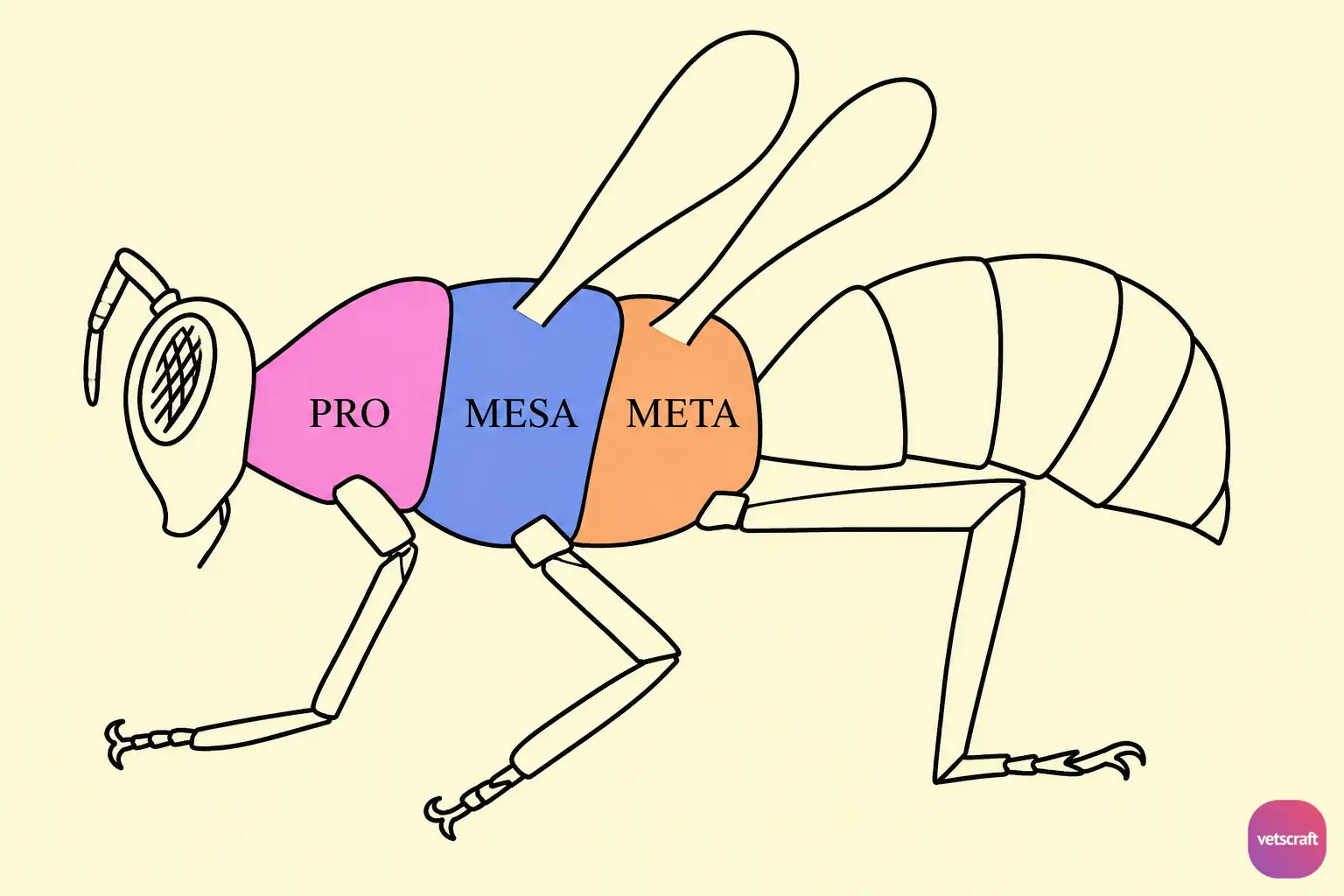
The hardened plate on the lateral aspect is called the pleurite and is connected by means of sutures. Each thoracic segment bears a pair of legs. The mesothorax and metathorax each bear a pair of wings.
In the order Diptera, the metathoracic wings are reduced, and only the mesothoracic wings are functional. The lateral walls of the thorax are pierced by the mesothoracic and metathoracic spiracles, which serve as the openings of the respiratory system.
Wings
Wings are outgrowths of the integument. They are strengthened by hollow, chitinized tubes known as veins or nerves. Usually, two pairs of wings are present. Some species lack wings and are referred to as apterous. In Diptera, the mesothoracic wings are well developed, whereas the metathoracic wings are reduced to knob- or button-like structures known as halteres or balancers. These structures help detect changes in direction and maintain balance during flight.
Typically, insect wings are thin, transparent membranes composed of closely adherent upper and lower layers that enclose a series of longitudinal strengthening tubes called veins. These veins are interconnected by crossveins.
The arrangement of veins in a wing is referred to as wing venation and is useful for insect identification. Each wing is usually more or less triangular in shape. The anterior margin is known as the costa, and the outer margin is called the apical region.
The posterior margin is known as the anal region, and the inner margin is called the base. Near the posterior border close to the base, there are a number of constrictions that divide the wing into several lobes.
The lobes arising from the anal region are called the anal lobe, alula, antisquama, and squama. The areas of the wing enclosed by veins are referred to as cells. The cell located along the anterior margin is called the costal cell, while the cell near the apex is called the apical cell.
Locomotor System (Leg)
The leg of an insect consists of seven segments. These include a basal coxa, by which the leg is attached to the thorax, followed by the trochanter, femur, tibia, and tarsus. The tarsus is composed of a number of segments, usually five.
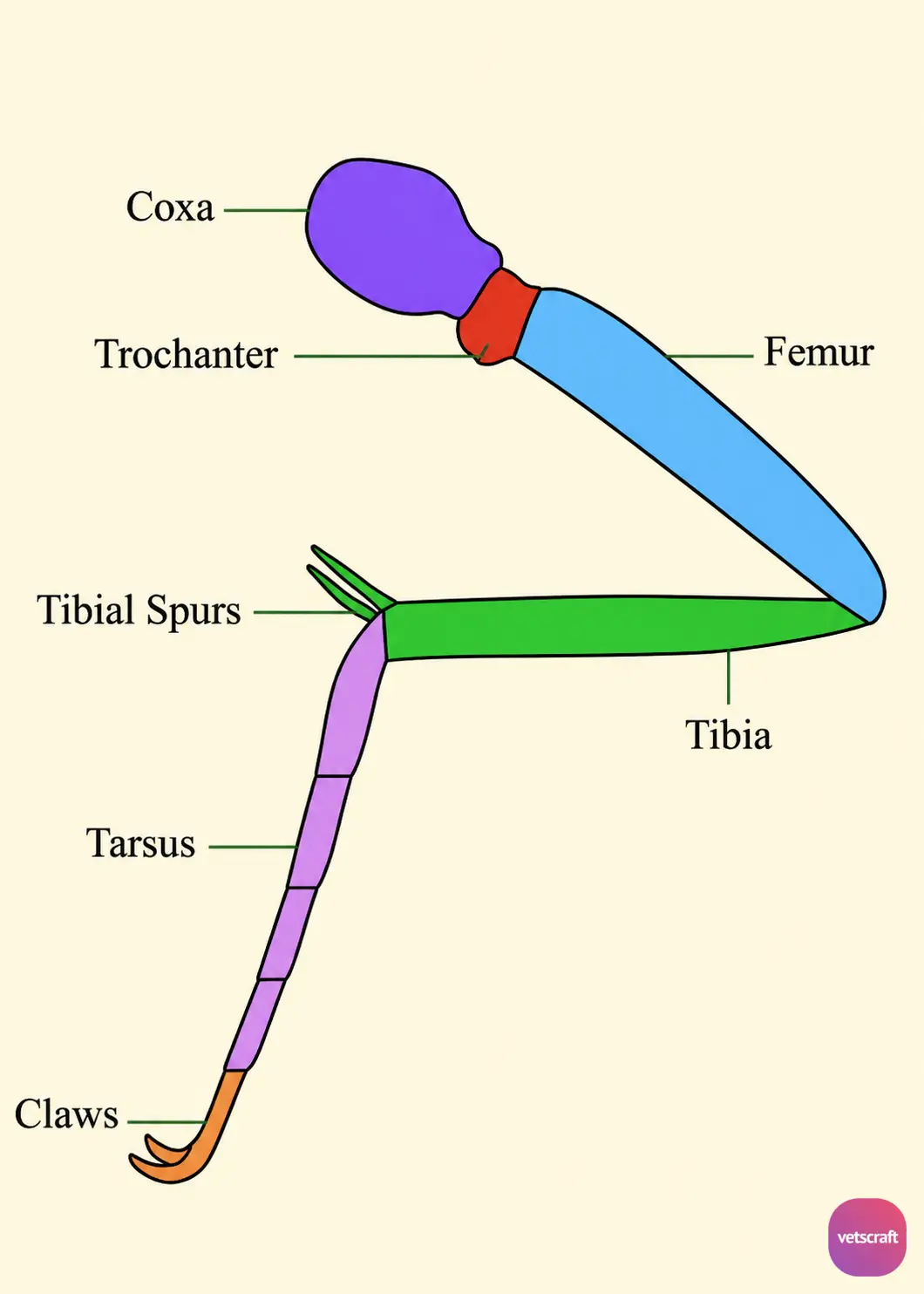
The last tarsal segment is provided with a pair of claws, between which is an empodium consisting of a spine or bristle. A pair of pads called the pulvilli occur below the claws. The pulvilli are cushioning in nature, whereas the empodium has a sensory function.
Abdomen
The abdomen consists of 10–11 segments. In some insects, the anterior and posterior segments may be telescoped into each other (e.g., tubular ovipositors). The first eight segments bear a pair of spiracles on each segment. The terminal segment may bear a pair of long lateral appendages called cerci (singular: cercus).
In males, the gonophore opens on the ventral side of the ninth segment, whereas in females, the gonophore opens at the end of the eighth segment. In males, a pair of copulatory claspers is present on the posterior aspect of the terminal segment.
Females possess a well-developed ovipositor on the posterior aspect of the terminal segment, which is used for laying eggs. In some female insects, the posterior end of the abdomen is pointed, enabling the insect to deposit eggs. This structure is known as the ovipositor. Example: Gasterophilus equi.