Classification and General Characters of Parasitic Phyla: Platyhelminthes, Nematodes, Arthropods & Protozoa
Parasites belong to different phyla with distinct morphological, physiological, and reproductive characteristics. Understanding the general characters of these parasitic phyla is important in veterinary parasitology for identification, classification, diagnosis, and understanding their life cycles.
Members of the phylum Platyhelminthes have a dorsoventrally flattened, bilaterally symmetrical, solid body without a body cavity. The organs are embedded in a specialized tissue known as parenchyma. Since they lack a definite anus, excretion is carried out by specialized organs called flame cells. Respiratory and circulatory systems are absent. Members are usually hermaphroditic, except for Schistosomes. The life cycle is usually indirect, involving one or two intermediate hosts.
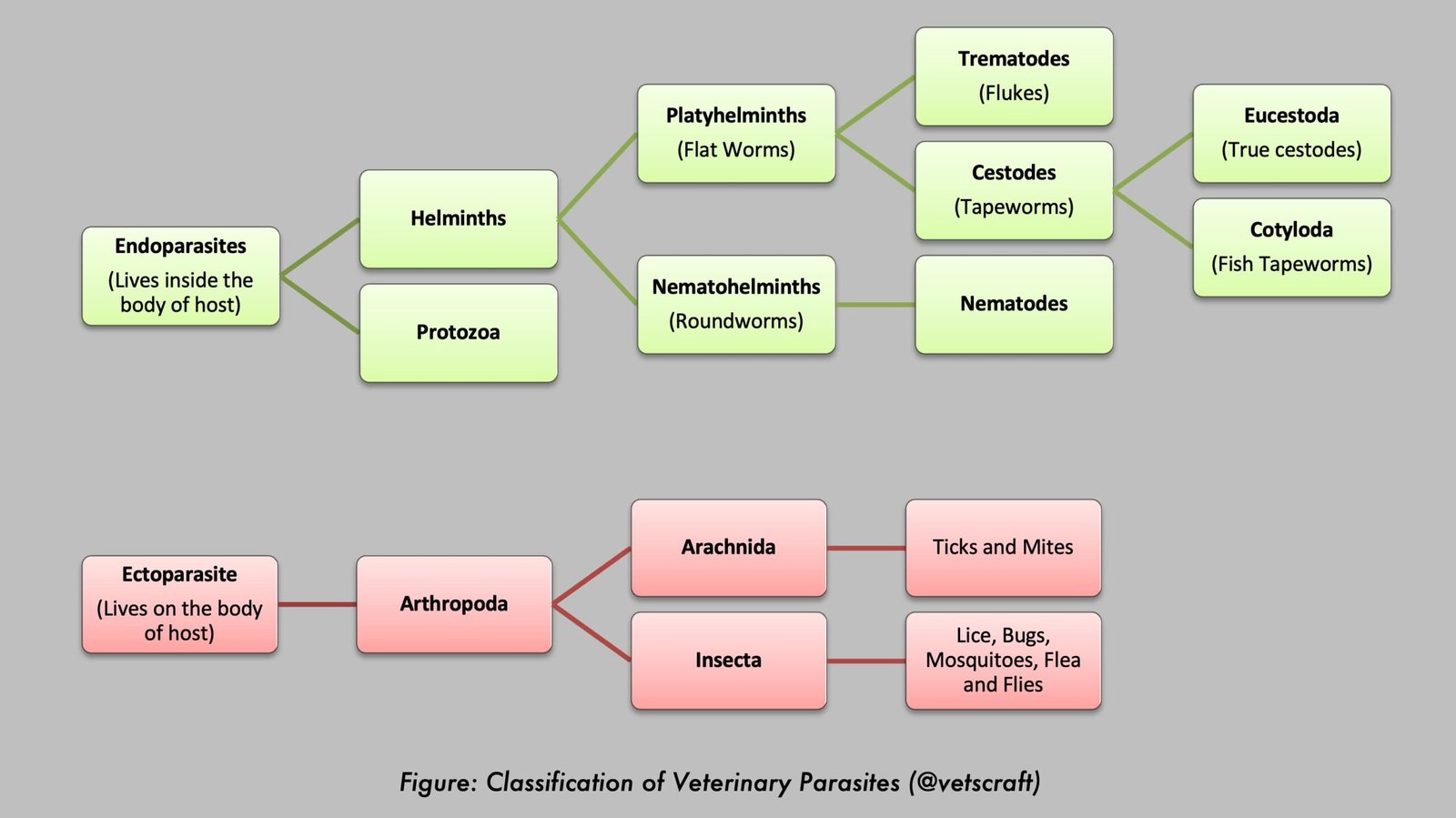
The members of the phylum Platyhelminthes are classified into four classes, and their characteristics are as follows:
- Turbellaria (Eddy worms): Members of this class are non-parasitic in domestic animals.
- Trematoda: Members are parasitic in domestic and wild animals. They have a leaf-shaped, unsegmented body, and the alimentary canal is present. The holdfast organs are called suckers (two in number).
- Eucestoda: Members are parasitic in domestic and wild animals. They have an elongated, tape-like, segmented body, and the alimentary canal is absent (saprozoic nutrition). The holdfast organs are called suckers (four in number).
- Cotyloda: Members are parasitic in domestic and wild animals. The body is elongated and tape-like, with indistinct segmentation, and the alimentary canal is absent (saprozoic nutrition). The holdfast organs are called bothria (two long grooves).
General Characters of Phylum Nemathelminthes
Nematodes are free-living or parasitic. The body is cylindrical, elongated, unsegmented, and tapered at both ends. Members possess a body cavity or coelom, but it is not a true coelom (pseudocoelom). The body is covered by a cuticle, which may be smooth or striated. The alimentary canal is present and consists of a mouth, muscular oesophagus, intestine, and anus.
In ascarids, the mouth is surrounded by three lips, whereas spirurids have two lips, each subdivided into three lobes. Members of the family Strongylidae (e.g., Oesophagostomum spp.) lack lips; instead, they possess a secondary structure known as a leaf crown. The structure of the oesophagus is an important characteristic for the identification of nematode species. It is a strongly muscular organ with a triradiate lumen.
There are two types of oesophagus: rhabditiform and filariform oesophagus.
- Rhabditiform: The rhabditiform oesophagus has a club-shaped anterior portion connected to a pear-shaped posterior bulb by a long neck. This type occurs in the first-stage larvae and adult nematodes of the non-parasitic generation of Rhabditida.
- Filariform Oesophagus: The filariform oesophagus has a club-shaped anterior portion but lacks a posterior bulb. This type occurs in the second- and third-stage larvae of nematodes and also in adults of the parasitic generation of Rhabditida.
In nematodes, excretion is carried out through osmotic regulation. The excretory system consists of a pair of unbranched lateral canals in the body wall that open through an excretory pore.
The nervous system consists of a number of ganglia connected by nerve fibers that form a nerve ring around the oesophagus. From this central nerve ring, six nerve trunks extend into the anterior and posterior parts of the body.
Sexes are usually separate, and sexual dimorphism is present, with males generally smaller than females. The male reproductive system consists of a single testis, vas deferens, seminal vesicle, and ejaculatory duct. The ejaculatory duct opens into the cloaca. Most species possess one or two chitinized and often pigmented structures called spicules, which assist in attachment during copulation.
The female reproductive system consists of a pair of ovaries, oviducts, uteri, and a short vagina that opens at the vulva. Nematodes have a high reproductive capacity and may lay thousands of eggs per day. They may be oviparous, ovoviviparous, or viviparous. The life cycle may be direct or indirect.
General Characters of Phylum Acanthocephala
Members of the phylum Acanthocephala have a cylindrical body covered with a thick cuticle. They possess a retractable proboscis armed with recurved hooks. The digestive system is absent, and nutrition occurs through a saprozoic mode of feeding. The excretory system consists of clusters of flame cells. Sexes are separate, and the members are ovoviviparous. The egg contains an embryo called an acanthor. The life cycle is indirect.
General Characters of Phylum Arthropoda
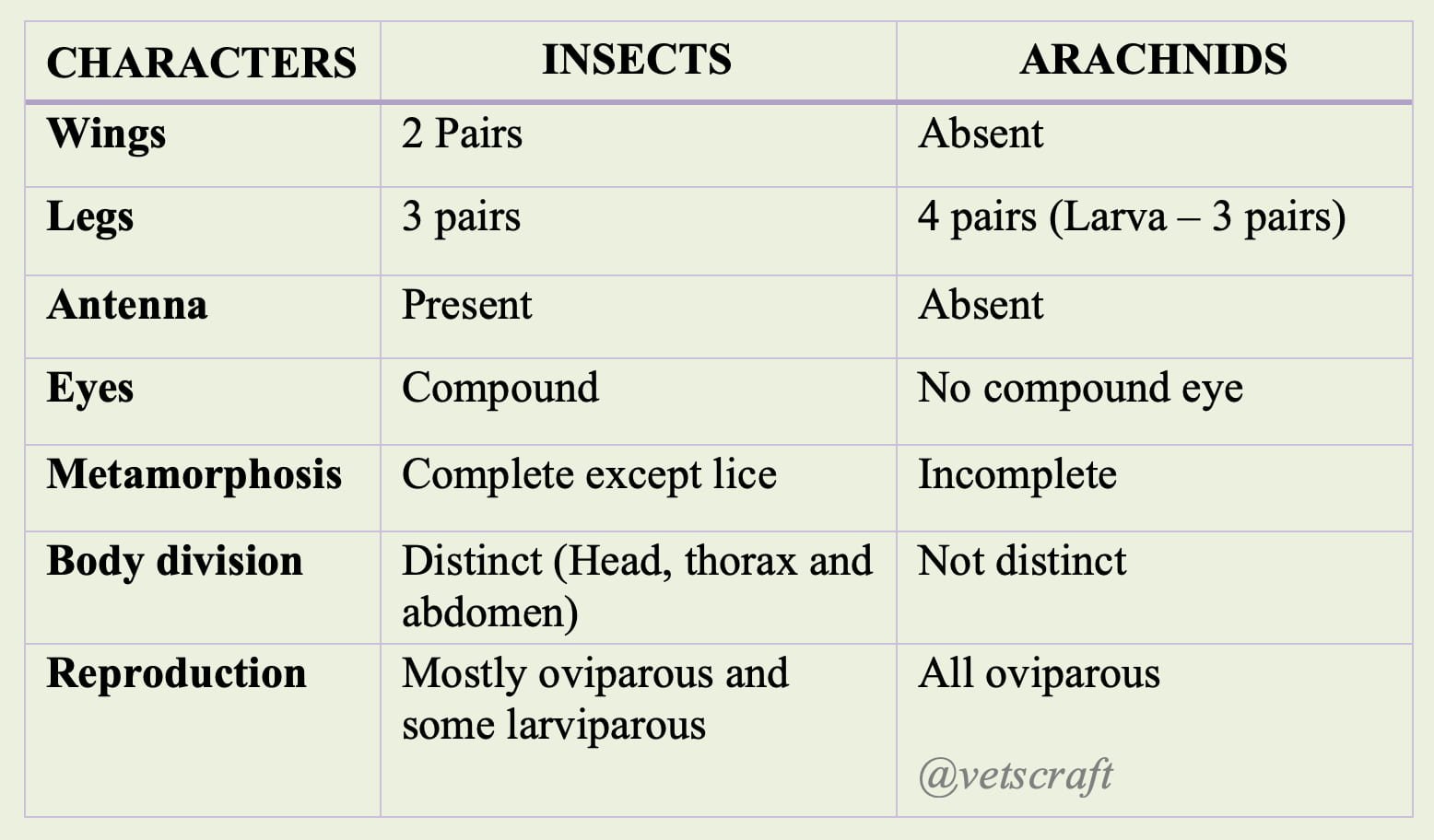
Arthropods possess jointed legs, and their body is bilaterally symmetrical and metamerically segmented. The entire body is enclosed by an exoskeleton composed of chitin. The exoskeleton is present in the form of chitinous plates known as sclerites. The body is divided into the head, thorax, and abdomen. Each segment consists of a dorsal sclerotized plate called the tergum and a similar ventral plate called the sternum. A lateral plate located between the tergum and sternum is called the pleuron. These plates are connected by a more flexible portion of the exoskeleton.
The alimentary canal is present and is divided into three regions: foregut (stomodaeum), midgut (mesenteron), and hindgut (proctodaeum). Excretion is carried out by Malpighian tubules in insects, nephridia in crustaceans, and Malpighian tubules along with coxal glands in arachnids. Respiration occurs through the tracheal system in insects, whereas in arachnids, both tracheae and book lungs serve as respiratory organs. In mites, respiration may also occur through the cuticle.
The circulatory system is located on the dorsal aspect of the body. It consists of a tube-like heart, an aorta, and a general body cavity called the hemocoel. Within the hemocoel, all organs are bathed in blood. The blood of insects is called hemolymph. The nervous system is located on the ventral aspect of the body and consists of a circumesophageal commissure with ganglia and a pair of ventral nerve cords with ganglia.
Sexes are separate. Most arthropods are oviparous (e.g., mosquitoes and Tabanus spp.), some are larviparous (e.g., Oestrus ovis and Sarcophaga spp.), and a few are pupiparous (e.g., Hippobosca spp. and Melophagus ovinus). The life cycle is generally direct, except in the pentastomid Linguatula serrata (tongue worm), which has an indirect life cycle and is therefore considered an aberrant arthropod.
As arthropods grow, the old cuticle (exoskeleton) is periodically shed and replaced by a new one. The shedding of the exoskeleton is called ecdysis or molting. During development, arthropods undergo a series of morphological changes known as metamorphosis.
Example: Egg → Larva → Pupa/Nymph → Adult
Metamorphosis is classified as complete or incomplete. In arthropods with complete metamorphosis, the immature stages and adults are morphologically dissimilar, e.g., Musca domestica (egg → larva → pupa → adult). In arthropods with incomplete metamorphosis, the immature stages and adults are morphologically similar, e.g., ticks and mites (egg → larva → nymph → adult).
General Characters of Phylum Protozoa
Protozoa are unicellular, eukaryotic organisms, and their structures are referred to as organelles rather than organs, since organs are composed of cells. Organelles are specialized portions of a cell.
Protozoa consist of a mass of protoplasm containing one or more nuclei and cytoplasm. Cytoplasm is the extranuclear part of the protozoan cell and is differentiated into an outer ectoplasm and an inner endoplasm. The ectoplasm is involved in protection, locomotion, prehension, excretion, and respiration. In addition, cilia, flagella, and pseudopodia arise from the ectoplasm. The inner granular endoplasm is responsible for nutrition and reproduction. It contains nuclei, food vacuoles, contractile vacuoles, chromatoid bodies, ribosomes, mitochondria, Golgi bodies, lysosomes, pinosomes, etc.
Two types of nuclei, namely vesicular and compact, are found in protozoa. The compact type of nucleus is seen in ciliates, whereas the vesicular type is found in other protozoa. In ciliates, the compact nucleus consists of a micronucleus concerned with reproduction and a macronucleus responsible for vegetative functions.
Protozoa move by means of flagella, cilia, pseudopodia, or gliding movement. Pseudopodia are temporary locomotory organelles formed when required and retracted when not needed. They are found in amoebae.
Flagella are whip-like organelles composed of a central axoneme and an outer sheath. The axoneme arises from a kinetosome, basal granule, or blepharoplast in the cytoplasm and consists of nine peripheral doublet microtubules and two central microtubules. Flagella are seen in Trypanosoma, Leishmania, Giardia, and Tritrichomonas.
Cilia are eyelash-like organelles (short flagella) arising from basal granules embedded in the ectoplasm. Cilia are found in Balantidium coli.
Gliding locomotion refers to smooth movement of the protozoan body without any change in shape. It is seen in Toxoplasma, Sarcocystis, coccidian merozoites, and gregarines.
The mode of nutrition in protozoa may be holozoic or saprozoic or pinocytosis.
Excretion in protozoa occurs through the body wall by diffusion or by means of contractile vacuoles.
Reproduction in protozoa may be either asexual or sexual.
Binary Fission
Binary fission is the most common type of asexual reproduction, in which the nucleus divides first, followed by cytoplasmic division and separation into daughter cells. Longitudinal binary fission occurs in trypanosomes and other flagellates. In transverse binary fission, division occurs along the transverse axis of the parent cell. It occurs in ciliates, e.g., Balantidium coli.
Multiple Fission
Multiple fission (schizogony/merogony) is a type of asexual reproduction found in members of the Apicomplexa (e.g., Eimeria, Toxoplasma, etc.), in which the nucleus divides several times before the cytoplasm divides. Budding is another form of asexual reproduction in which two or more daughter cells are formed from the parent cell.
Syngamy
Syngamy is the fusion of female (♀) and male (♂) gametes resulting in the formation of a zygote. Conjugation is a form of sexual reproduction that occurs in ciliates, e.g., Balantidium coli. In this process, no progeny are produced; instead, there is an exchange of nuclear material between two individuals, a process known as nuclear reorganization.