Muellerius capillaris (Hair Lungworm of Sheep and Goats): Complete Veterinary Guide
Muellerius capillaris, commonly known as the hair lungworm of sheep and goats, is a parasitic nematode that infects the lower respiratory tract of small ruminants. It has an indirect life cycle involving terrestrial snails and slugs as intermediate hosts and is an important cause of chronic lung disease, particularly in goats.
This guide covers the morphology, life cycle, pathogenesis, clinical signs, diagnosis, treatment, and control of Muellerius capillaris for veterinary students and practitioners.
Parasite Overview
- Definitive Hosts: Sheep (primary), goats; occasionally other wild small ruminants
- Intermediate Host: Terrestrial snails and slugs
- Life Cycle: Indirect
- Predilection Site: Terminal bronchioles, alveolar ducts, alveoli, and lung parenchyma (subpleural nodules)
- Infective Stage: Third-stage larva (L3) within the intermediate host (snail or slug)
- Disease Caused: Muelleriosis (verminous pneumonia, nodular lungworm infection)
Taxonomical Classification
- Kingdom: Animalia
- Phylum: Nematoda
- Class: Chromadorea
- Order: Strongylida
- Superfamily: Metastrongyloidea
- Family: Protostrongylidae
- Genus: Muellerius
- Species: Muellerius capillaris
- Common Name: Hair lungworm of sheep and goats
Morphology
- The female measures 1.9–2.3 cm, and the male measures 1.2–1.4 cm in length.
- In the male, the bursa is absent, and the posterior end is coiled.
- The spicules are curved.
- In the female, the vulva is situated near the anus, and a small cuticular swelling is present on its posterior border.
- The eggs are unsegmented when laid.
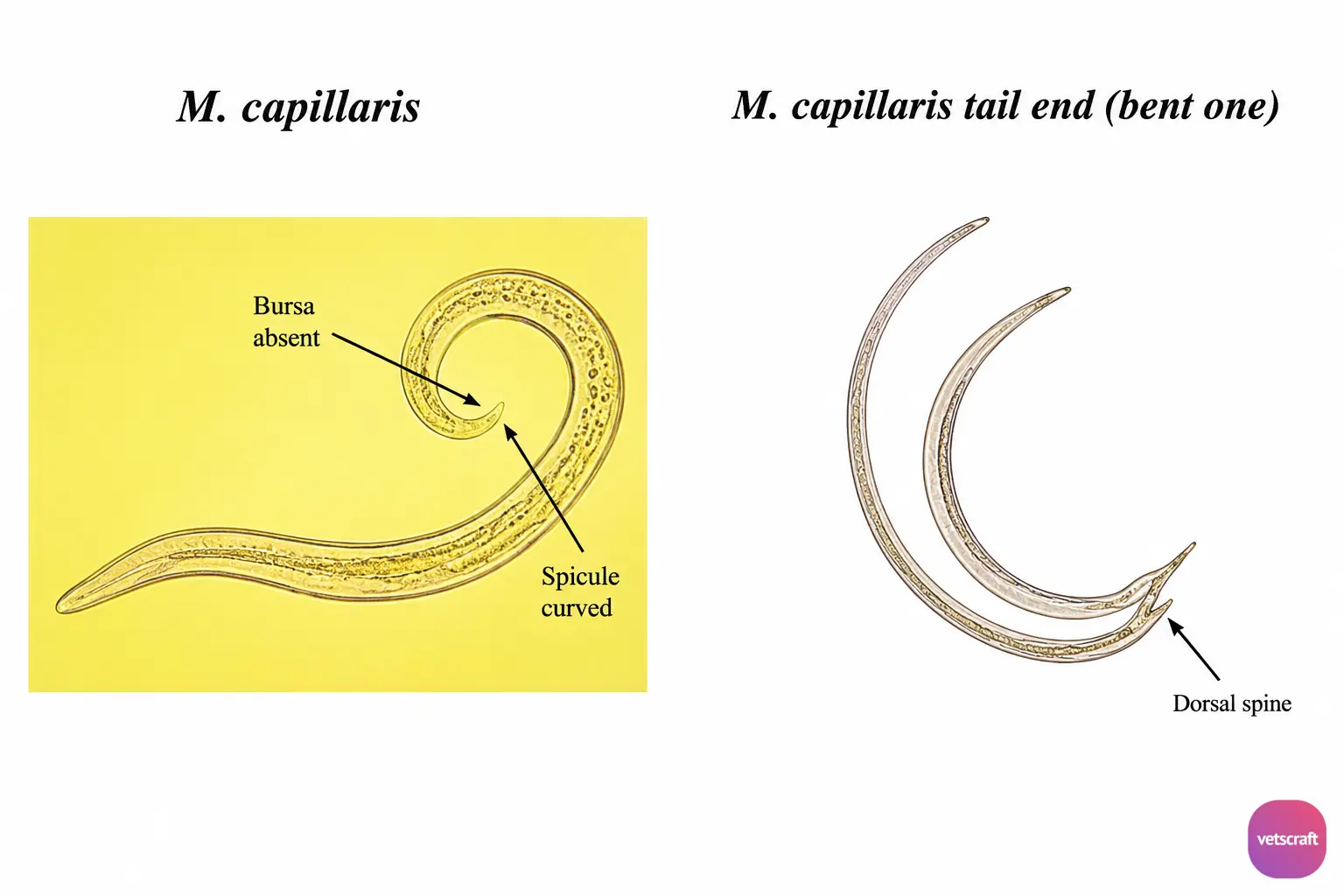
L1 larvae possess a characteristic dorsal spine on the tail, which is the principal diagnostic feature used to identify Muellerius capillaris in fecal examinations.
Life Cycle
Muellerius capillaris is viviparous and has an indirect life cycle.
The eggs are coughed up, swallowed, and the L1 larvae are passed in the feces. Further development occurs only after ingestion by the intermediate host (I/H), namely terrestrial snails or slugs.
Sheep and goats become infected by ingesting infected snails or slugs, or vegetation contaminated with them, containing the infective L3 larvae.
They prefer cold climates and are therefore commonly found in hilly regions. Development within the snail and the sheep is similar to that of Protostrongylus.
Pathogenesis
The worms are generally not found in lambs and kids less than 6 months of age. They inhabit the alveoli and pulmonary parenchyma within the subpleural tissues.
The fine, thin worms are tightly coiled within the lungs. Eggs and larvae are also present. They form grayish brood nodules (shot-like), up to 2 cm in diameter, in the lung parenchyma. These nodules contain pus and may calcify later.
An adenoma-like proliferation may be seen in some cases. In goats, the parasite causes interstitial pneumonia. Heavily infected goats develop moderate to severe clinical signs. The worms are highly pathogenic to goats.
Clinical Signs
Lungworms irritate the lining of the airways. The main clinical sign of lungworm infection in sheep is coughing. At postmortem examination, white, thread-like worms are clearly visible either in the airways or in shot-like nodules beneath the lung surface. Some nodules may contain pus rather than worms.
Usually, animals do not show any clinical signs. However, the infection may affect general health, and in rare cases may cause death. The lungs become susceptible to secondary bacterial infection, and the lesions may coalesce to form septic lesions.
Diagnosis
Diagnosis is primarily based on the detection of first-stage (L1) larvae in feces using the Baermann technique. Characteristic subpleural nodules containing adult worms, eggs, and larvae may also be observed during postmortem examination.
Treatment
- Emetine hydrochloride: 8–9 mg/kg/day for 3 days
- Cyanacethydrazide: 15 mg/kg SC or 17.5 mg/kg orally
- Levamisole: 20 mg/kg body weight, SC
- Fenbendazole: 20–80 mg/kg
- Albendazole: 5 mg/kg
Historically, several anthelmintics have been used for the treatment of Muellerius capillaris infection. In modern veterinary practice, benzimidazoles such as fenbendazole and albendazole are the most commonly used and recommended anthelmintics.
Control
- Remove animals from infected pastures.
- Because larvae are commonly found in moist areas, animals should be allowed to graze on dry pastures.
- Provide clean drinking water.
- Slugs can be controlled by applying lime to pastures.
Avoid grazing animals on pastures heavily contaminated with infected snails and slugs.