TABLE OF CONTENTS
Triatoma (Kissing Bug): Morphology, Veterinary Significance & Disease Transmission
Triatoma (Kissing Bug) is a blood-feeding insect of the family Reduviidae and subfamily Triatominae. It is of veterinary and medical importance primarily because it serves as a vector of Trypanosoma cruzi, the causative agent of Chagas disease, and can also transmit Trypanosoma rangeli.
It is commonly known as the kissing bug because it often bites the lips of sleeping people. It is also known as the cone-nosed bug because of the shape of its body and as an assassin bug because it preys on other insects.
Morphology
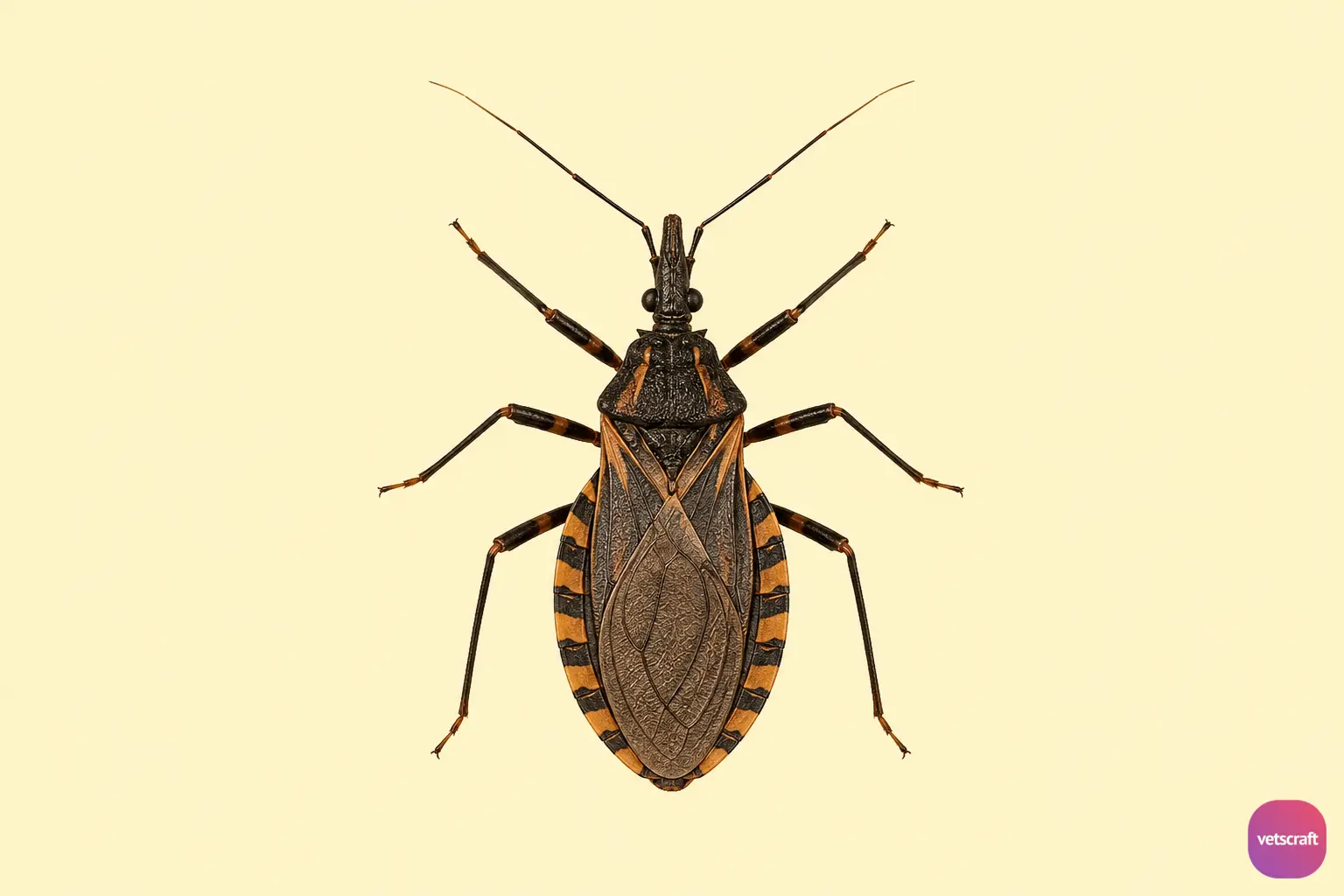
- Triatoma (kissing bug) varies in size from 0.5–4.5 cm.
- Head is snout-like.
- Bears a pair of dark-colored eyes.
- Four-segmented antennae are long and thin and arise from the dorsal surface of the head.
- The basal part of the hemelytra is hard, whereas the distal part is membranous.
- The thorax bears three pairs of legs, each with a pair of claws.
- Abdomen is oval in shape and dull brown to black in color.
Veterinary Significance
Triatoma (kissing bug) is a vector of Trypanosoma cruzi, the causative agent of American trypanosomiasis (Chagas disease).
The bug is a biological vector of T. cruzi and can also transmit T. rangeli.