Classification of Parasites in Veterinary Parasitology with Examples
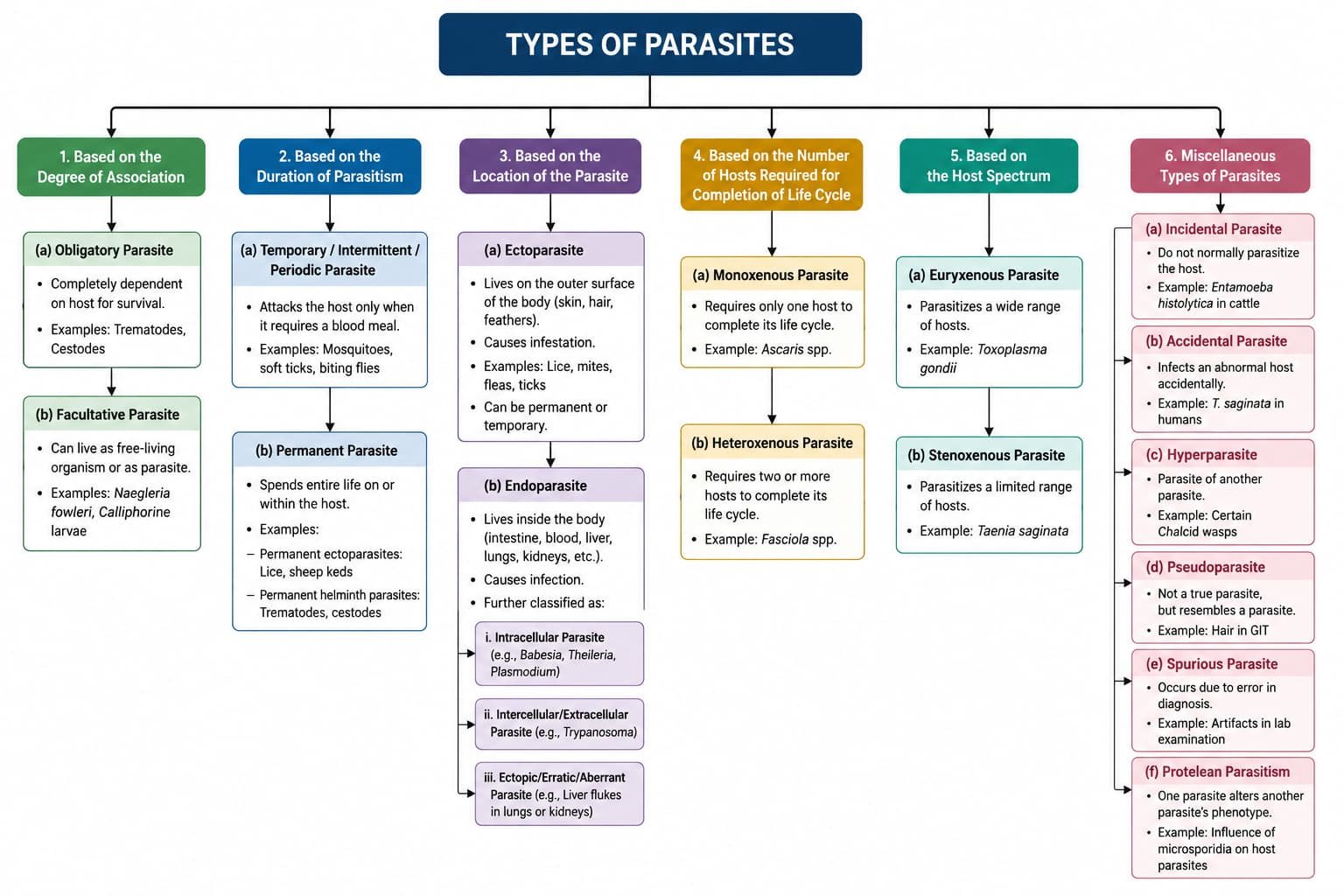
Parasites are classified into different categories according to their relationship with the host, duration of parasitism, location in the host body, host spectrum, and life cycle requirements. Understanding the classification of parasites is important in veterinary parasitology for the diagnosis, prevention, and control of parasitic diseases in animals.
Parasites can be classified into different types according to their relationship with host:
- Based on the Degree of Association
- Based on the Duration of Parasitism
- Based on the Location of the Parasite
- Based on the Number of Host Required for Completion of Life Cycle
- Based on the Host Spectrum
- Miscellaneous Parasite
| Classification Basis | Types |
|---|---|
| Degree of Association | Obligatory, Facultative |
| Duration of Parasitism | Temporary, Permanent |
| Location | Ectoparasite, Endoparasite |
| Host Requirement | Monoxenous, Heteroxenous |
| Host Spectrum | Euryxenous, Stenoxenous |
1. Based on the Degree of Association
(a) Obligatory Parasite
An obligate parasite is an organism completely adapted to a parasitic mode of life. It cannot survive without a host. Examples include trematodes and cestodes.
(b) Facultative Parasite
A facultative parasite is an organism that can live either as a free-living organism or as a parasite. It can survive without a host, but if it accidentally enters a host, it can adapt to a parasitic mode of life. Example: Naegleria fowleri in humans.
It is a free-living amoeba, also known as an opportunistic amoeba. However, when it enters the nasal passages of humans during swimming, it causes primary amoebic meningoencephalitis.
Similarly, calliphorine larvae normally live in decaying organic matter, but they can become parasitic in pre-existing wounds on the body and produce wound myiasis.
2. Based on the Duration of Parasitism
(a) Temporary Parasite / Intermittent / Periodic Parasite
A temporary, intermittent, or periodic parasite is a parasite that attacks the host only when it requires a blood meal. Examples include mosquitoes, soft ticks, and biting flies.
(b) Permanent Parasite
A permanent parasite is a parasite that spends its entire life on or within the host and never leaves the host.
Examples:
- Permanent ectoparasites: lice and sheep keds
- Permanent helminth parasites: trematodes and cestodes
3. Based on the Location of the Parasite
(a) Ectoparasite
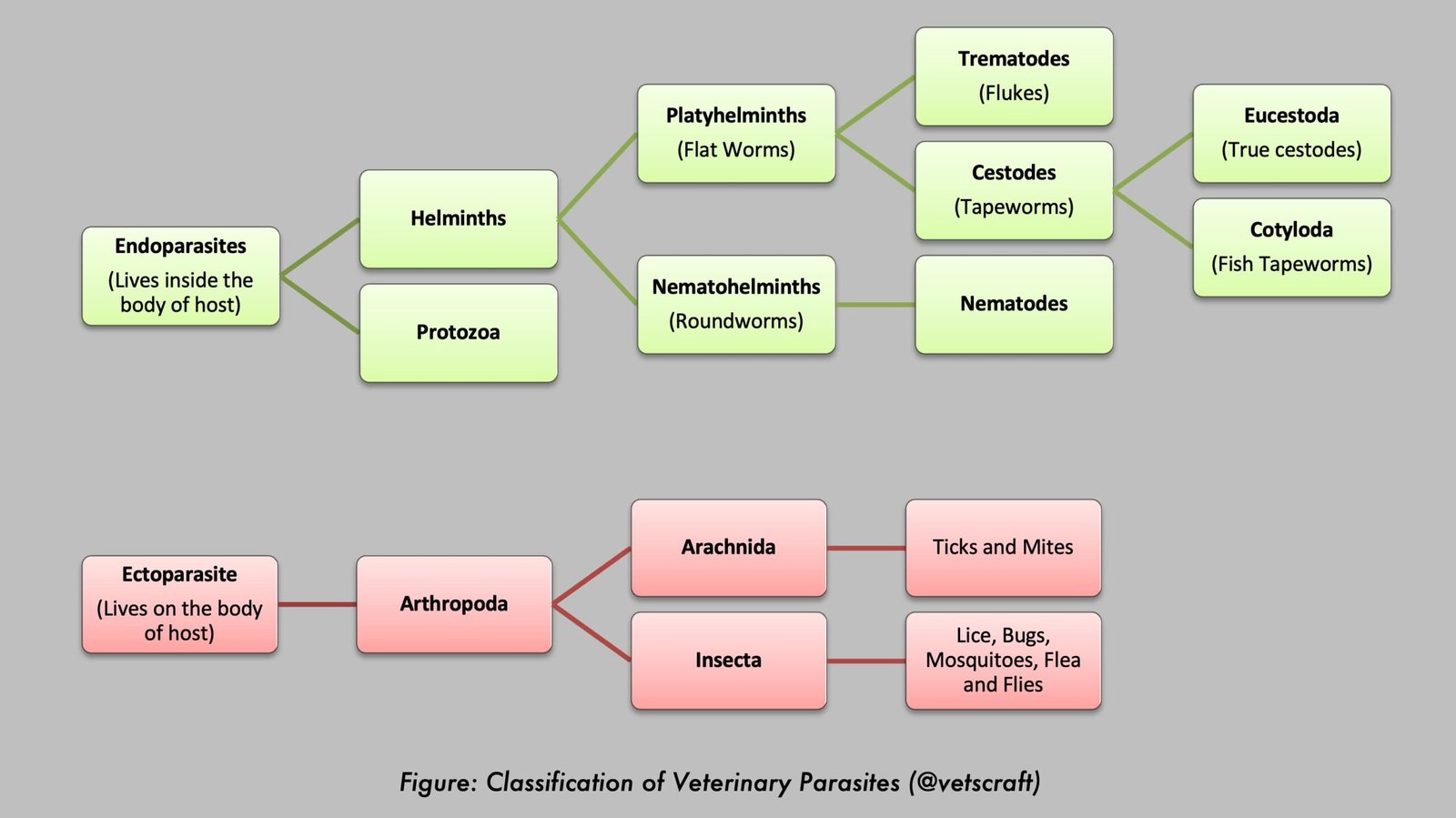
An ectoparasite is a parasite that lives on the outer surface of the body and is usually found attached to the skin, hair, or feathers. Parasitism caused by ectoparasites is known as infestation. Examples include lice, mites, fleas, and ticks.
Ectoparasites can be classified as permanent or temporary ectoparasites.
(b) Endoparasite
An endoparasite is a parasite that lives inside the body and is usually found in the intestinal tract, body cavities (peritoneum), blood, liver, lungs, kidneys, and other internal organs. Parasitism caused by endoparasites is known as infection.
Endoparasites are further classified as follows:
- Intracellular Parasite: A parasite found inside the cells, especially blood cells.
- Examples: Babesia, Theileria, and Plasmodium.
- Intercellular/Extracellular Parasite: A parasite found between the cells or outside the cells.
- Example: Trypanosoma species.
- Ectopic/Erratic/Aberrant Parasite: A parasite found in an organ other than its normal location or site of predilection.
- Example: liver flukes found in the lungs or kidneys.
4. Based on the Number of Host Required for Completion of Life Cycle
(a) Monoxenous Parasite
A monoxenous parasite is a parasite that requires only one host to complete its life cycle. This type of cycle is known as a direct life cycle. Examples include Eimeria species, Ascaris, and strongyle nematodes.
(b) Heteroxenous Parasite
A heteroxenous parasite is a parasite that requires more than one host to complete its life cycle. This type of life cycle is known as an indirect life cycle. Examples include trematodes and cestodes.
Obligatory Heteroxenous Parasite
An obligate heteroxenous parasite is a parasite that compulsorily requires more than one host to complete its life cycle. An example is Sarcocystis, a tissue cyst–forming coccidian parasite.
Facultative Heteroxenous Parasite
A facultative heteroxenous parasite is a parasite that may or may not require more than one host to complete its life cycle. An example is Toxoplasma gondii.
Cats are the only definitive hosts for this parasite, whereas more than 200 species of mammals, birds, and rodents can act as intermediate hosts. However, cats can also serve as intermediate hosts; therefore, both asexual and sexual reproduction occur in cats, while only asexual reproduction occurs in the intermediate hosts.
5. Based on the Host Spectrum
(a) Euryxenous Parasite
A euryxenous parasite is a parasite that has a wide host spectrum. An example is Dicrocoelium dendriticum, which affects a wide range of animal species, including sheep, goats, cattle, deer, rabbits, and humans.
(b) Stenoxenous Parasite
A stenoxenous parasite is a parasite that has a narrow host spectrum. An example is Echinococcus granulosus, a dog tapeworm that primarily infects dogs and foxes.
6. Miscellaneous Types of Parasites
(a) Incidental Parasite
An incidental parasite is a parasite that does not normally infect a particular animal species, but if it is found in that host, the condition is referred to as incidental parasitism. An example is Ascaris in sheep.
(b) Accidental Parasite
An accidental parasite is an organism that normally lives as a free-living organism, but if it accidentally enters a host through food or other means, it may cause disease. An example is the larvae of Musca domestica, which can cause pseudo or intestinal myiasis.
(c) Hyperparasite
A hyperparasite is a parasite that lives on or within another parasite. Examples include Plasmodium species in mosquitoes and Histomonas meleagridis within the eggs of Heterakis gallinarum.
(d) Pseudoparasite
A pseudoparasite refers to objects that may be mistaken for parasite eggs or larvae during fecal examination. Examples include pollen grains and starch granules.
(e) Spurious Parasite
A spurious parasite refers to parasitic forms, such as eggs or larvae, that accidentally enter an unnatural host through contaminated feed or water. These ingested forms merely pass through the gastrointestinal tract and are excreted in the feces without establishing infection.
For example, if a dog ingests Moniezia eggs through food contaminated with sheep feces, the eggs will simply be passed out in the feces.
(f) Protelean Parasitism
Protelean parasitism refers to parasitism caused by the larval stage of insects. An example is nasal bots, which are the larval stage of Oestrus ovis.