TABLE OF CONTENTS
Babesiosis in Sheep and Goats: Causes, Diagnosis, Treatment & Babesia Species
Babesiosis in sheep and goats is a tick-borne hemoprotozoan disease caused by several species of the genus Babesia. The parasites invade and multiply within red blood cells, leading to intravascular hemolysis, anemia, fever, hemoglobinuria, reduced productivity, and, in severe cases, death. The disease is transmitted primarily by ixodid ticks and is of significant veterinary and economic importance in many sheep- and goat-producing regions worldwide.
The principal Babesia species affecting small ruminants include Babesia motasi, Babesia ovis, Babesia foliata, and Babesia taylori. Among these, B. motasi and B. ovis are the most clinically important. This article provides an overview of the major Babesia species infecting sheep and goats, including their morphology, life cycle, pathogenesis, immunity, diagnosis, treatment, and key distinguishing characteristics.
The species of Babesia affecting sheep and goats are:
- Babesia motasi
- Host: Sheep and goats
- Vector: Dermacentor silvarum, Haemaphysalis punctata, Rhipicephalus bursa
- Babesia ovis
- Host: Sheep and goats
- Vector: R. bursa
- Babesia foliata
- Host: Sheep in India
- Vector: Not known
- Babesia taylori
- Host: Goats in India
- Vector: Not known
Babesia motasi
Morphology
- The merozoites are large and pyriform, resembling Babesia bigemina.
- They occur singly or in pairs at the center of RBCs.
Life Cycle
The life cycle is similar to that of Babesia bigemina, but both transovarian and transtadial transmission occur in R. bursa.
Pathogenesis
Babesia motasi causes either acute or chronic disease. The acute form is characterized by fever, prostration, marked anemia, hemoglobinuria, and death. In contrast, no characteristic clinical signs are observed in the chronic form.
Immunity
- Recovered animals are immune to reinfection.
- Sheep that are immune to B. motasi are not immune to B. ovis.
Diagnosis
Based on clinical signs and examination of peripheral blood smears.
Treatment
- Trypan blue: 20–25 mL of a 1% solution – i/v
- Berenil: 5.5 mg/kg – i/m, single dose
- Imidocarb: 0.5–1 mg/kg – i/m, two doses at a 24-hour interval
- Diampron: 5 mg/kg – i/m
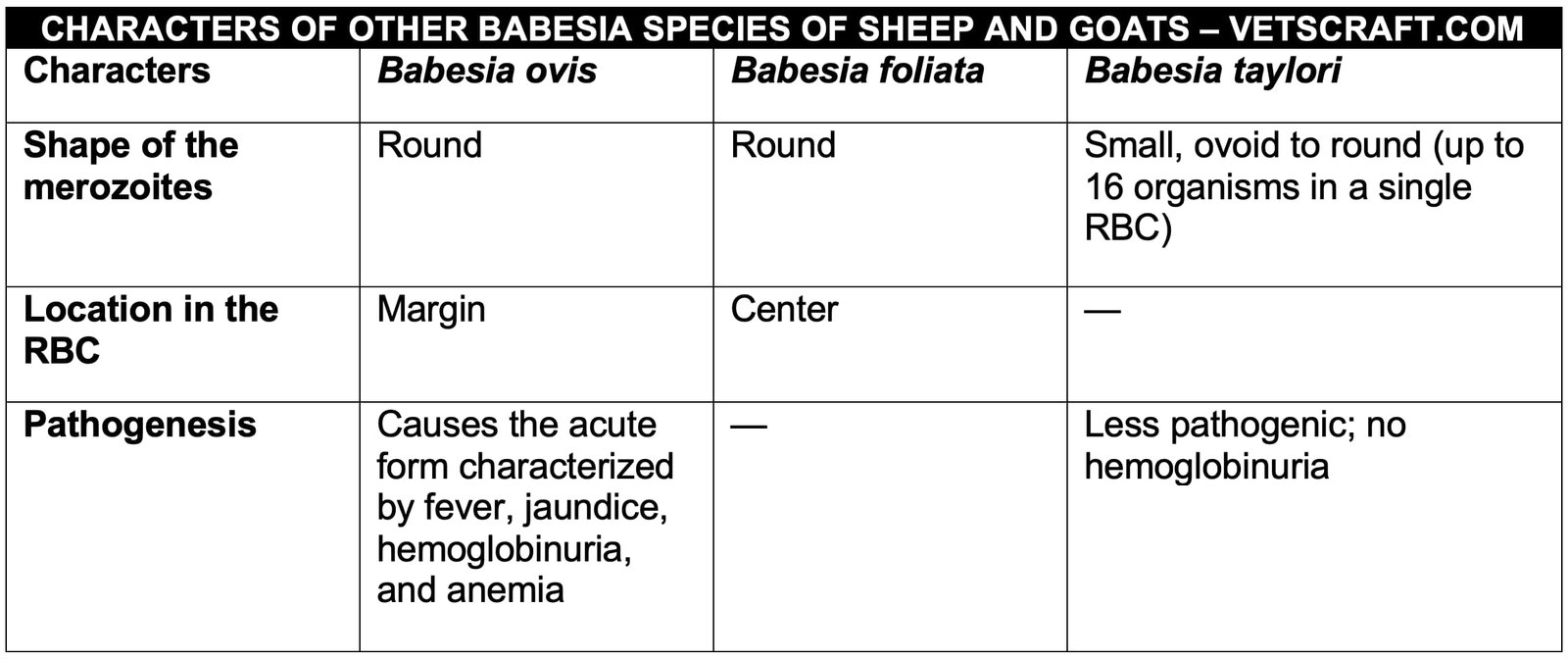
Comparative Characters of Other Babesia Species of Sheep and Goats