TABLE OF CONTENTS
Difference Between Anopheles, Culex, and Aedes Mosquitoes: Morphology, Life Cycle, and Vector Potential
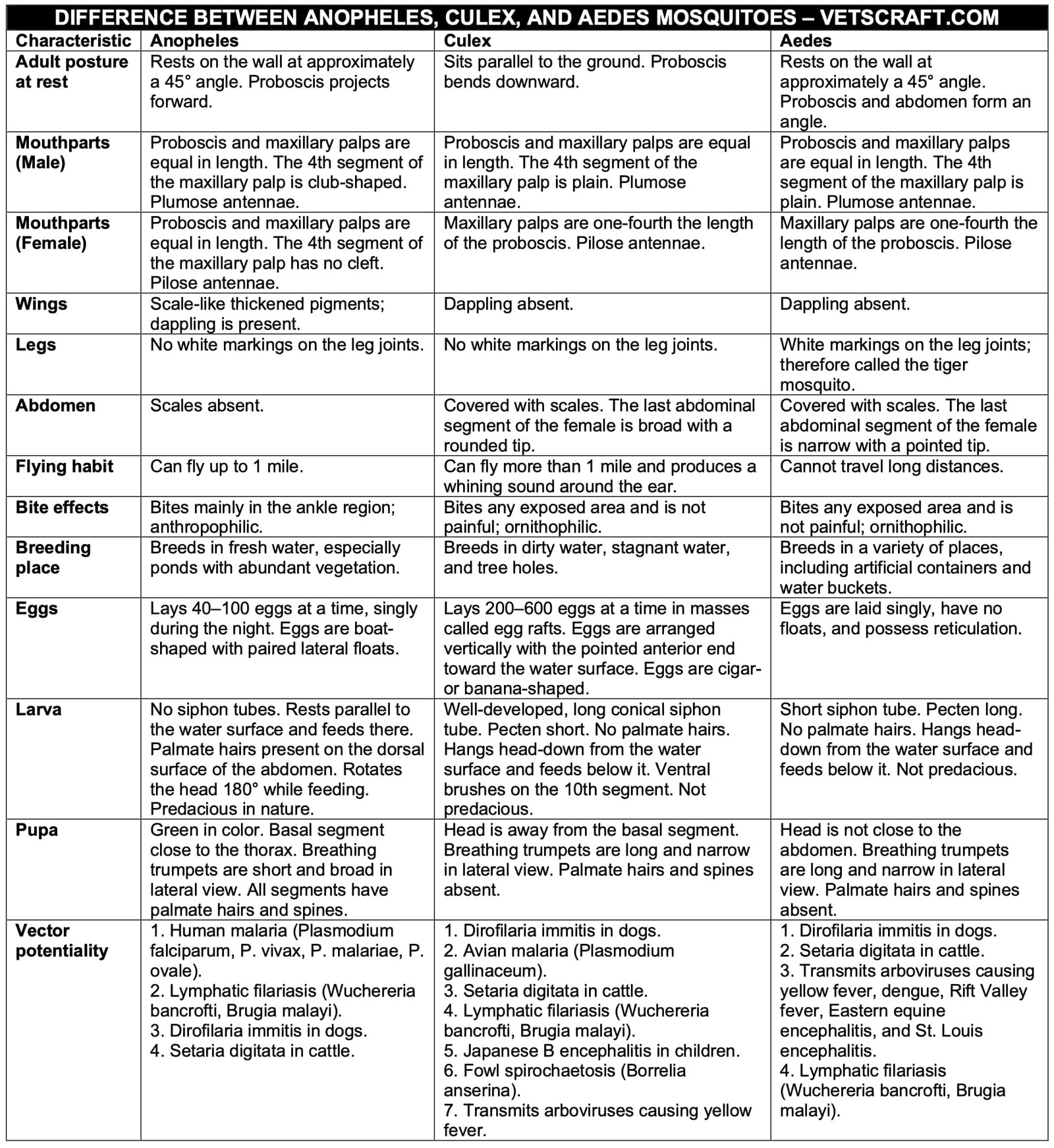
Anopheles, Culex, and Aedes are the three most important mosquito genera of medical and veterinary significance. Although they share a similar life cycle, they differ in their morphology, resting posture, breeding habitats, egg and larval characteristics, biting behavior, and vector potential.
Accurate identification of these mosquitoes is essential for the diagnosis, surveillance, and control of mosquito-borne diseases affecting both humans and animals. This article provides a detailed comparison of Anopheles, Culex, and Aedes mosquitoes, including their morphology, life cycle, distinguishing characteristics, and the diseases they transmit.
- Genus Anopheles: Anopheles stephensi
- Genus Culex: Culex fatigans, Culex tarsalis (robust mosquito), and Culex pipiens (house mosquito)
- Genus Aedes: Aedes aegypti (tiger mosquito) and Aedes albopictus
Anopheles
- Adult posture at rest: Rests on a wall at approximately a 45° angle. The proboscis projects forward.
- Mouthparts (Male): The proboscis and maxillary palps are equal in length. The fourth segment of the maxillary palp is club-shaped. Antennae are plumose.
- Mouthparts (Female): The proboscis and maxillary palps are equal in length. The fourth segment of the maxillary palp has no cleft. Antennae are pilose.
- Wings: Thickened pigmented scales are present. Dappling is present.
- Legs: No white markings are present on the leg joints.
- Abdomen: Scales are absent.
- Flying habit: Can fly up to 1 mile.
- Bite effects: Usually bites around the ankle region. It is anthropophilic.
- Breeding place: Breeds in fresh water, especially ponds with abundant vegetation.
- Eggs: Lays 40–100 eggs at a time, usually during the night. Eggs are laid singly, are boat-shaped, and possess paired lateral floats.
- Larva: Lacks a siphon tube. Rests parallel to the water surface and feeds there. Palmate hairs are present on the dorsal surface of the abdomen. Rotates its head 180° while feeding. Predacious in nature.
- Pupa: Green in color. The basal segment is close to the thorax. Breathing trumpets are short and broad in lateral view. All segments possess palmate hairs and spines.
- Vector potentiality:
- Human malaria (Plasmodium falciparum, P. vivax, P. malariae, and P. ovale).
- Lymphatic filariasis caused by Wuchereria bancrofti and Brugia malayi.
- Dirofilaria immitis in dogs.
- Setaria digitata in cattle.
Culex
- Adult posture at rest: Rests parallel to the ground. The proboscis bends downward.
- Mouthparts (Male): The proboscis and maxillary palps are equal in length. The fourth segment of the maxillary palp is unmodified. Antennae are plumose.
- Mouthparts (Female): The maxillary palps are approximately one-fourth the length of the proboscis. Antennae are pilose.
- Wings: Dappling is absent.
- Legs: No white markings are present on the leg joints.
- Abdomen: Covered with scales. The terminal abdominal segment of the female is broad with a rounded tip.
- Flying habit: Can fly more than 1 mile and produces a characteristic whining sound around the ear.
- Bite effects: Bites any exposed area, and the bite is generally not painful. It is ornithophilic.
- Breeding place: Breeds in dirty water, stagnant water, and tree holes.
- Eggs: Lays 200–600 eggs at a time in masses called egg rafts. Eggs are arranged vertically, with the pointed anterior end directed toward the water surface. Eggs are cigar- or banana-shaped.
- Larva: Has a well-developed, long, conical siphon tube. The pecten is short. Palmate hairs are absent. Hangs head downward from the water surface and feeds below it. Ventral brushes are present on the tenth segment. Not predacious.
- Pupa: The head is away from the basal segment. Breathing trumpets are long and narrow in lateral view. Palmate hairs and spines are absent.
- Vector potentiality:
- Dirofilaria immitis in dogs.
- Avian malaria (Plasmodium gallinaceum).
- Setaria digitata in cattle.
- Lymphatic filariasis caused by Wuchereria bancrofti and Brugia malayi.
- Japanese encephalitis.
- Fowl spirochaetosis caused by Borrelia anserina.
- Transmits arboviruses that cause yellow fever.
Aedes
- Adult posture at rest: Rests on a wall at approximately a 45° angle. The proboscis and abdomen form an angle.
- Mouthparts (Male): The proboscis and maxillary palps are equal in length. The fourth segment of the maxillary palp is unmodified. Antennae are plumose.
- Mouthparts (Female): The maxillary palps are approximately one-fourth the length of the proboscis. Antennae are pilose.
- Wings: Dappling is absent.
- Legs: White markings are present on the leg joints; therefore, it is commonly known as the tiger mosquito.
- Abdomen: Covered with scales. The terminal abdominal segment of the female is narrow with a pointed tip.
- Flying habit: Cannot travel long distances.
- Bite effects: Bites any exposed area, and the bite is generally not painful. It is ornithophilic.
- Breeding place: Breeds in a variety of locations, including artificial containers and water buckets.
- Eggs: Eggs are laid singly, lack floats, and possess reticulation.
- Larva: Has a short siphon tube. The pecten is long. Palmate hairs are absent. Hangs head downward from the water surface and feeds below it. Not predacious.
- Pupa: The head is not close to the abdomen. Breathing trumpets are long and narrow in lateral view. Palmate hairs and spines are absent.
- Vector potentiality:
- Dirofilaria immitis in dogs.
- Setaria digitata in cattle.
- Transmits arboviruses that cause yellow fever, dengue, Rift Valley fever, Eastern equine encephalitis, and St. Louis encephalitis.
- Lymphatic filariasis caused by Wuchereria bancrofti and Brugia malayi.