Reproduction in Protozoa: Asexual and Sexual Reproduction (Binary Fission, Schizogony, Budding & Conjugation)
Reproduction in protozoa is the biological process by which these unicellular eukaryotic organisms produce new individuals and ensure the continuation of their species. Depending on the species and stage of the life cycle, protozoa reproduce through either asexual or sexual mechanisms. These reproductive strategies enable rapid multiplication, genetic variation, adaptation to different environments, and transmission between hosts in parasitic species.
The major modes of asexual reproduction in protozoa include binary fission, multiple fission (schizogony or merogony), and budding, whereas sexual reproduction involves gametogony, syngamy, and, in certain ciliates, conjugation. Sporogony, a specialized developmental process that follows syngamy in many apicomplexan protozoa, results in the formation of infective sporozoites.
Types of Reproduction in Protozoa
Protozoa reproduce by two principal methods:
- Asexual reproduction – includes binary fission, multiple fission (schizogony/merogony), and budding.
- Sexual reproduction – includes gametogony, syngamy, and conjugation, followed by sporogony in many apicomplexan protozoa.
Asexual Reproduction
Binary Fission
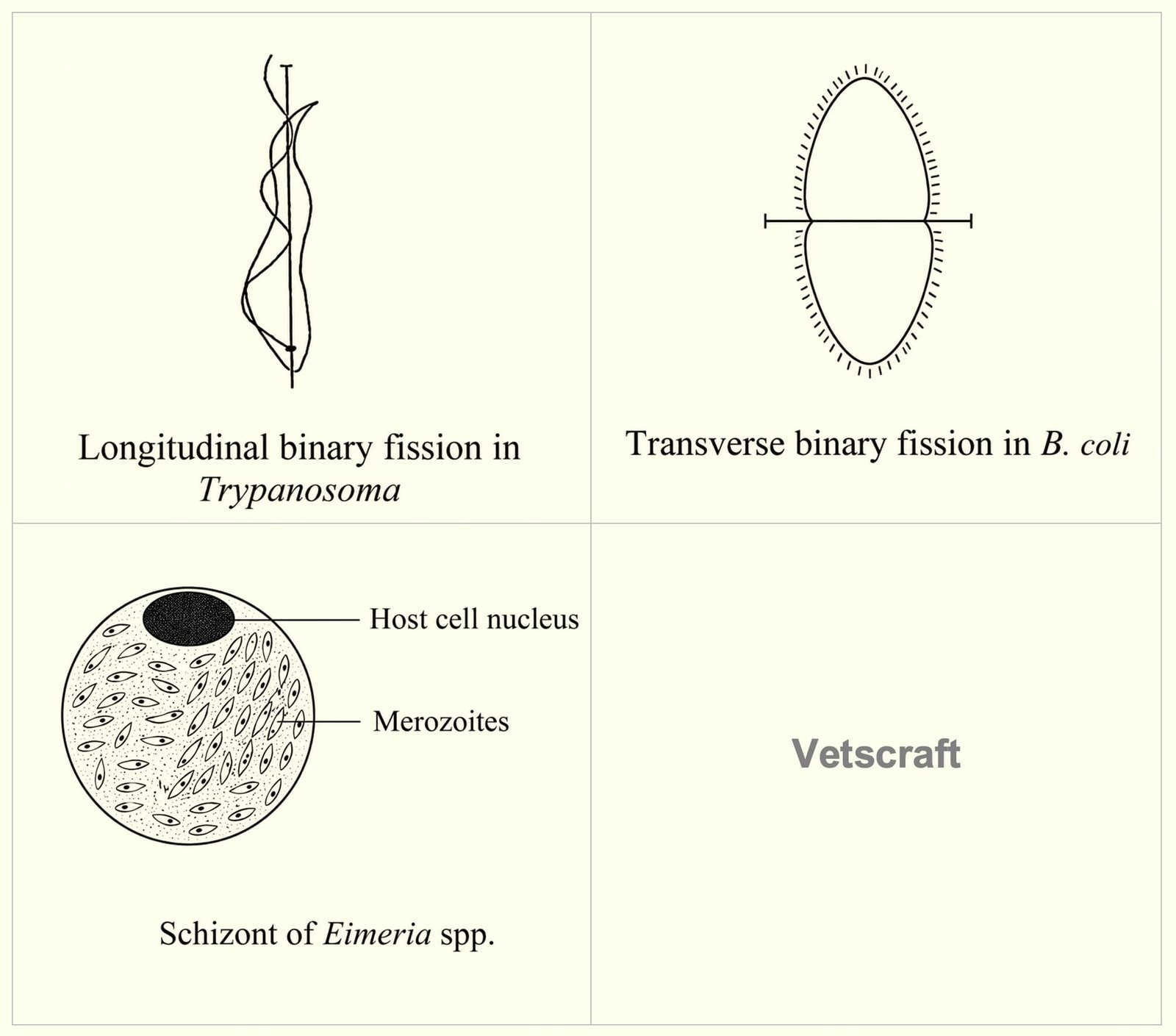
Binary fission is the most common type of asexual reproduction in which the nucleus divides first, followed by cytoplasmic division and separation of the daughter cells. Two daughter cells are formed from a parent cell. Binary fission may be either longitudinal or transverse.
Longitudinal Binary Fission
Longitudinal binary fission is a type of binary fission in which the organism divides along the long axis of the parent cell. It occurs in trypanosomes and other flagellates.
Transverse Binary Fission
Transverse binary fission occurs along the transverse axis of the parent cell. It occurs in ciliates, e.g., Balantidium coli.
Multiple Fission
Multiple fission (schizogony/merogony) is a type of asexual reproduction found in members of the Apicomplexa (e.g., Eimeria, Toxoplasma) in which the nucleus divides several times before the cytoplasm divides.
Each nuclear fragment is enclosed by a fragment of cytoplasm. These dividing forms are called meronts or schizonts, and the resultant daughter cells are called merozoites or schizozoites.
Budding
Budding is another form of asexual reproduction in which two or more daughter cells are formed by the parent cell. The daughter cells separate and grow to full size. In this process, division is amitotic, with unequal fragmentation of the nucleus and cytoplasm.
Budding may be either internal or external, and the number of buds may also vary among species.
- Endodyogeny is a type of internal budding in which two daughter cells are formed within the parent cell and are released by destroying it, e.g., Toxoplasma and Sarcocystis.
- Endopolygeny is also a type of internal budding in which more than two daughter cells are formed within the parent cell.
- Ectopolygeny is a type of external budding in which more than two daughter cells are formed.
Sexual Reproduction
Sexual reproduction in protozoa involves the formation and fusion of specialized gametes, resulting in genetic recombination and the production of a zygote.
Gametogony (Gamogony)
Gametogony (gamogony) is the process of gamete formation. Gametes are produced by specialized cells called microgamonts and macrogamonts. The smaller male gamete is called a microgamete, whereas the larger female gamete is called a macrogamete.
Syngamy
Syngamy is the fusion of female (♀) and male (♂) gametes, resulting in the formation of a zygote. If the gametes are similar in appearance, they are known as isogametes, whereas dissimilar gametes are called anisogametes.
Sporogony
Sporogony is a post-fertilization developmental process rather than a true mode of sexual or asexual reproduction. It occurs following syngamy, usually outside the host, except in Sarcocystis and Cryptosporidium, where it occurs inside the host (endosporogony).
During sporogony, the zygote divides to form a number of sporocysts, which in turn produce a varying number of sporozoites depending on the species.
Conjugation
Conjugation is a form of sexual reproduction that occurs in ciliates, e.g., Balantidium coli. In this process, no progeny are produced; instead, only the exchange of nuclear material occurs between two individuals, a process known as nuclear reorganization.
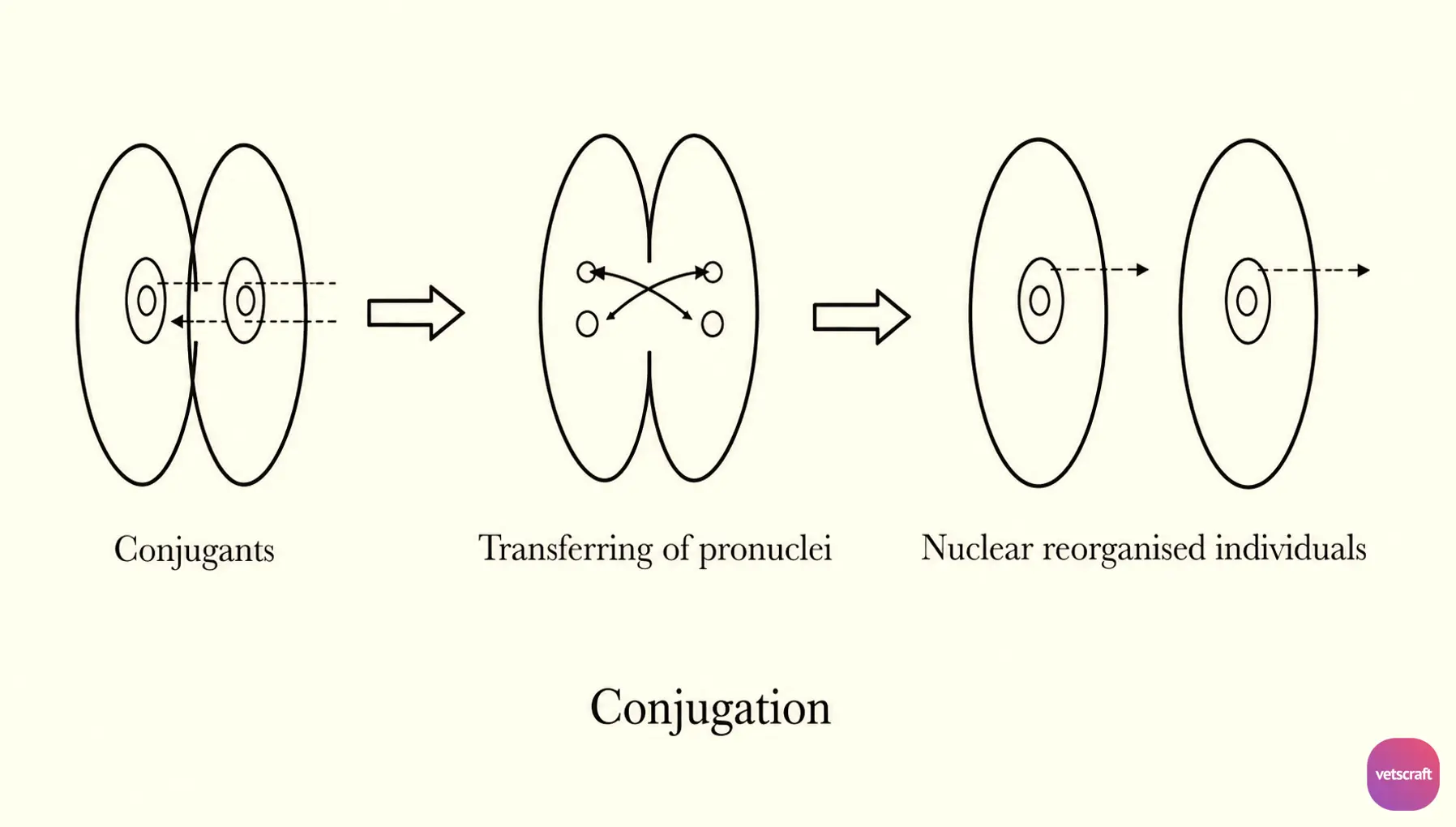
During conjugation, two individuals come together temporarily and fuse along their long axis. These individuals are called conjugants. The macronuclei of the conjugants degenerate, while the micronuclei divide several times until haploid pronuclei are formed. One haploid pronucleus from each conjugant passes into the other. The conjugants then separate, and nuclear reorganization takes place.