Locomotion of Protozoa: Types, Organelles, and Mechanisms of Movement
Protozoa move by means of flagella, cilia, pseudopodia, and gliding. Pseudopodia are temporary locomotory organelles that are formed when required and retracted when not needed. There are four types of pseudopodia, viz., lobopod, filopod, myxopod, and axopod, of which the lobopod type is seen in amoebae.
Flagella are whip-like organelles composed of a central axoneme and an outer sheath. The axoneme arises from a kinetosome, basal granule, or blepharoplast in the cytoplasm and is composed of nine peripheral doublet microtubules and two central microtubules.
In some species, the flagellum may extend backward, attached to the body along its entire length or at several points by an undulating membrane, and it may extend beyond the body as a free flagellum.
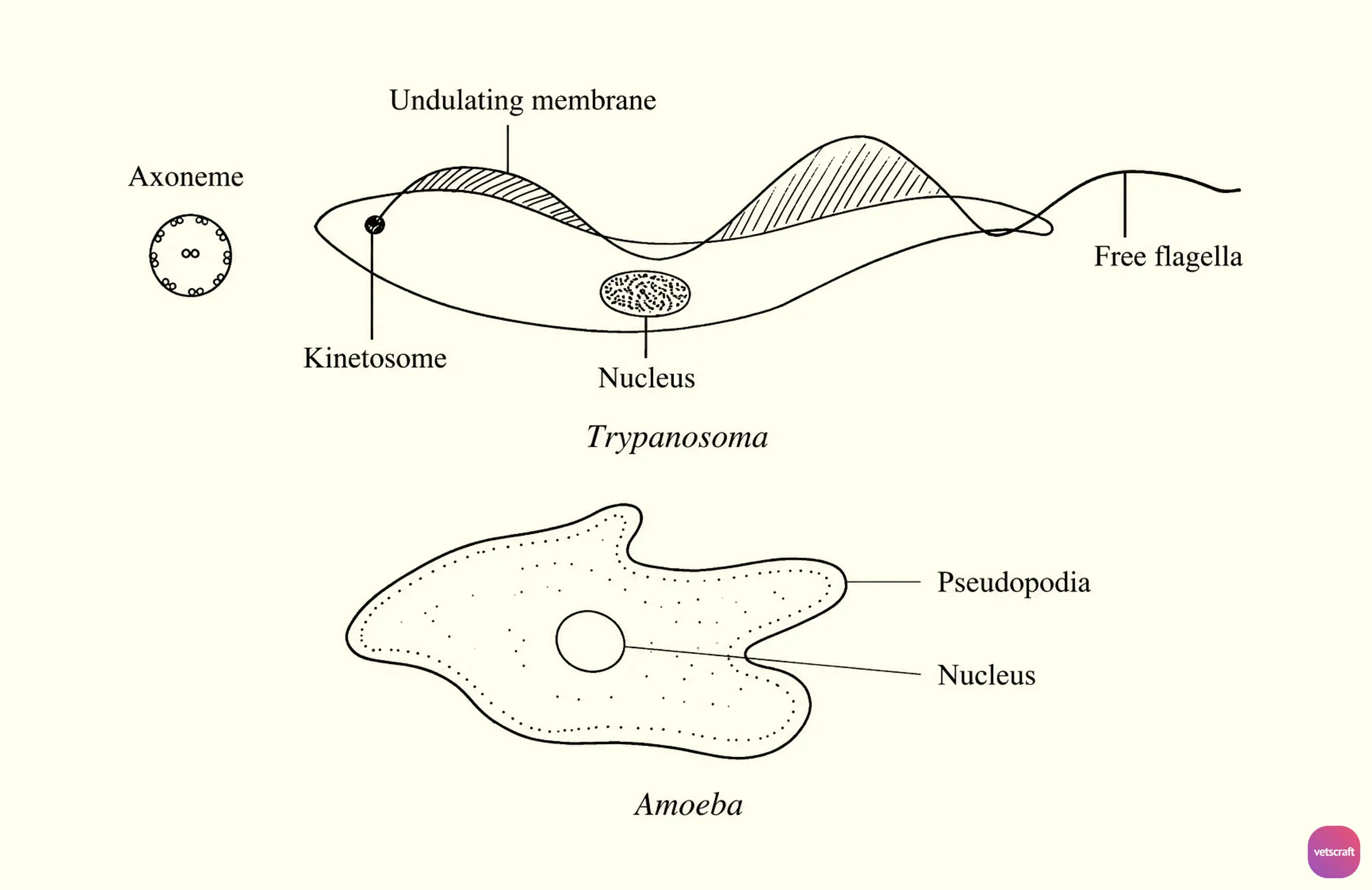
Flagella are found in Mastigophora and in some developmental stages of Apicomplexa, e.g., the microgamete.
Cilia are eyelash-like organelles (small flagella) arising from basal granules embedded in the ectoplasm. Cilia are usually arranged in rows. A tuft of fused cilia is called a cirrus. The fusion of two or more rows of cilia forms a flap called a membranelle.
Cilia are not only locomotory organelles in ciliates, but they also aid in food ingestion.
Gliding is a type of locomotion in which protozoa move smoothly without any change in body shape. It is seen in Toxoplasma, Sarcocystis, coccidian merozoites, and gregarines.