Argas Ticks in Birds: Argas persicus and Argas reflexus
Argas is a genus of soft ticks belonging to the family Argasidae that primarily parasitize birds. Two important species, Argas persicus (fowl tick) and Argas reflexus (pigeon tick), are associated with domestic and wild birds. These ticks can cause irritation, blood loss, reduced egg production, and tick paralysis in heavily infested birds. This article covers their morphology, life cycle, pathogenesis, and control.
Two important species of genus Argas are:
- Argas persicus (fowl tick, blue tick, blue bug, adobe tick)
- Argas reflexus (pigeon tick)
Hosts of Argas persicus and Argas reflexus include domestic fowl, turkeys, pigeons, ducks, and other birds.
Morphology
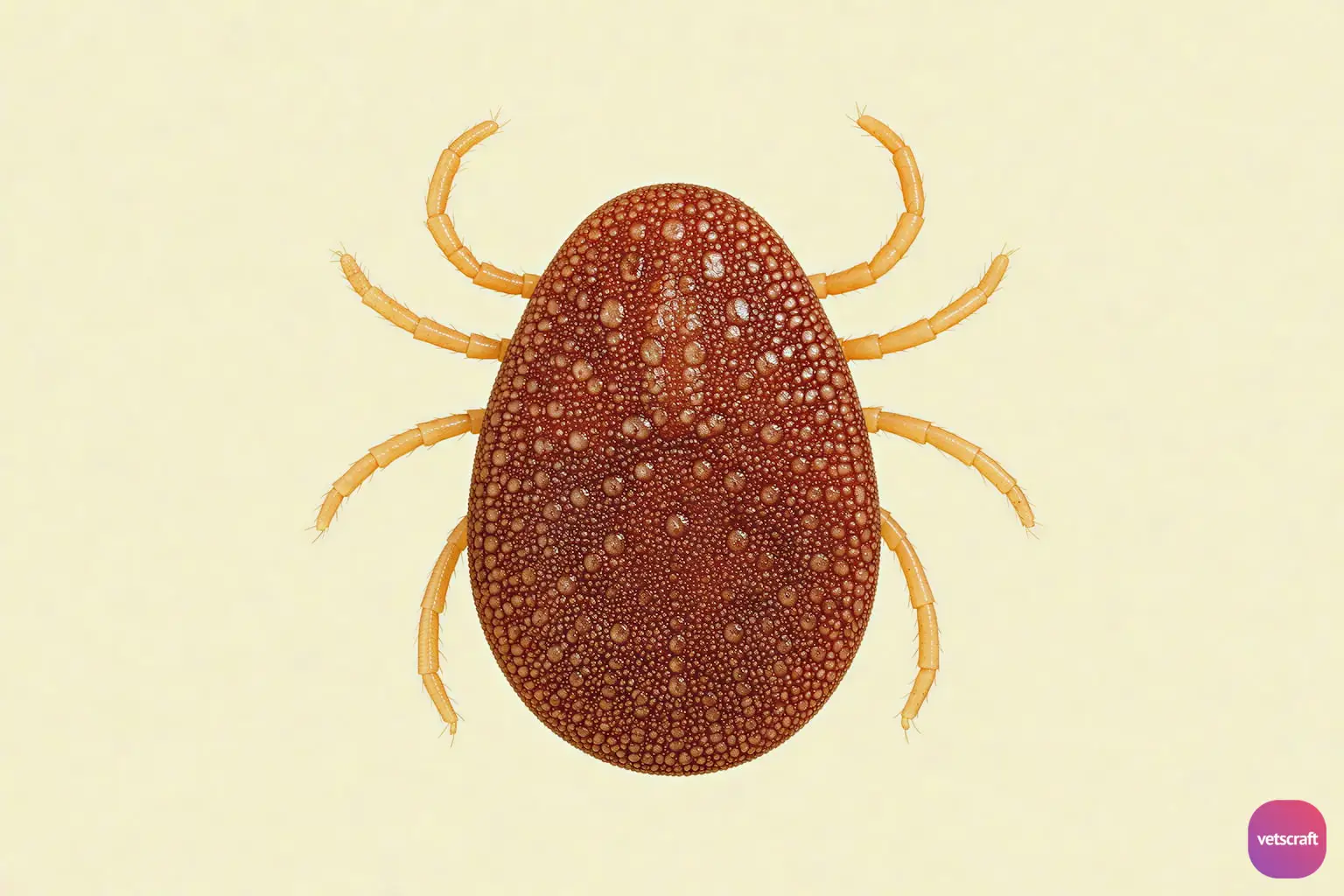
- Oval in shape, narrower anteriorly than posteriorly, slate-blue in color, with a sharp body margin, absent eyes, and a cuticle with radially arranged, disc-like thickenings called mammillations. There are four pairs of legs, the mouthparts are located on the ventral aspect, and festoons are absent.
- Males and females can be differentiated only by the shape of the genital opening, which is situated anteriorly on the ventral surface and is larger in females than in males.
- In males, the genital opening is semilunar, whereas in females, it is a horizontal or transverse slit.
Life Cycle
- Eggs are laid in batches in cracks and crevices in poultry houses and under the bark of trees. The eggs hatch in about 3 weeks.
- Larvae have three pairs of legs, and the mouthparts are visible dorsally.
- Larvae engorge in about 5–10 days, drop off, hide away, and molt in 7 days to become nymphs.
- There are two nymphal stages, each lasting 2 weeks, with one blood meal during each stage.
- Nymphs and adults hide in sheltered spots and attack their hosts at night. Larvae are diurnal and feed for a few minutes. Adults feed once a month and lay batches of eggs after each meal.
- Nymphs and adults can survive without feeding for 5 years, whereas larvae can survive for only up to 3 months.
- The life cycle is completed in 8 months.
Pathogenesis
Fowl ticks disturb birds at night, causing restless sleep. In heavy infestations, anemia results from blood loss.
Egg production decreases or may stop completely. In heavy infestations, it causes range paralysis or tick paralysis in ducks. Turkeys are seriously affected. They also bite humans.
It acts as a vector for Borrelia anserina (fowl spirochetosis). The spirochete is transmitted transovarially through the eggs to the offspring of an infected female tick. It also transmits Aegyptianella pullorum (Rickettsia) and Anaplasma marginale.
Control
Effective control requires treatment of both the birds and their environment because Argas ticks hide in cracks, crevices, roosts, and other sheltered areas during the day. Infested poultry houses should be thoroughly cleaned, and cracks, crevices, roosts, nesting areas, and other hiding places should be treated.
Synthetic pyrethroids such as permethrin, cypermethrin, and deltamethrin have demonstrated acaricidal activity against Argas.
Newly introduced birds should also be inspected and appropriately treated before being added to the flock.
Because soft ticks can persist in the environment for prolonged periods, integrated control, combining environmental sanitation, treatment of infested areas, and appropriate acaricide use, is important for reducing reinfestation.