Self Cure Phenomenon in Gastrointestinal Nematodes (GIN): Mechanism and Significance
The self cure phenomenon is an important immunological mechanism involved in the spontaneous expulsion of gastrointestinal nematodes (GINs) from previously sensitized hosts. It occurs in haemonchosis in endemic areas after a period of heavy rainfall, during which adult worms are expelled and fecal egg counts drop to nearly zero.
The expulsion of adult worms is an immediate (Type I) hypersensitivity reaction to antigens derived from developing larvae.
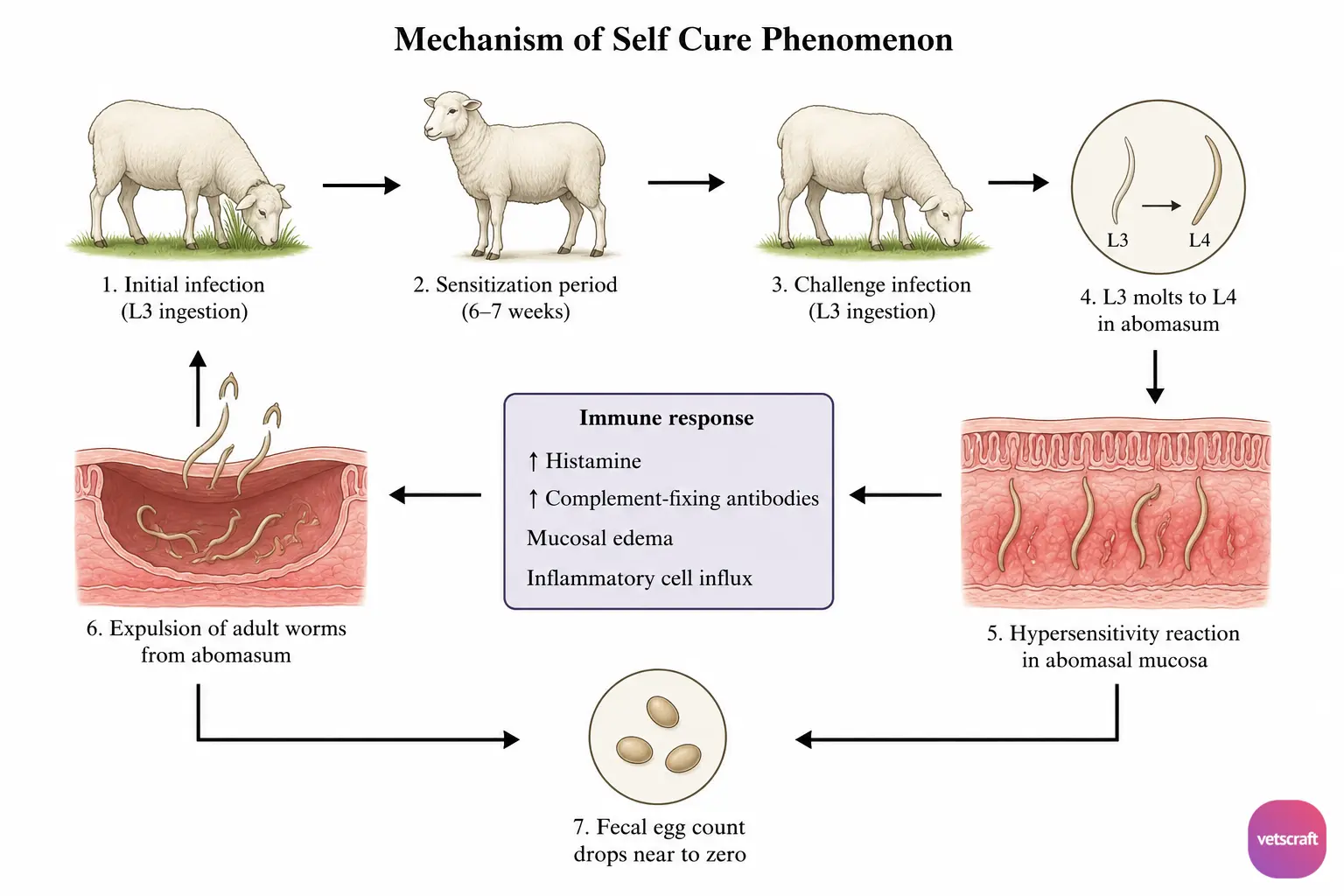
A minimum period of 6–7 weeks is required between the initial infection and the challenge infection to initiate the self cure phenomenon. This phenomenon is induced by newly ingested infective larvae (L3) in sensitized sheep and is initiated when the newly entered L3 larvae molt into L4 larvae.
The self cure phenomenon commonly occurs in sheep that have had several previous exposures to this parasite and does not occur in sheep experiencing an initial infection (first exposure). During the self cure phenomenon, there is a transient increase in blood histamine levels, complement-fixing antibodies, and intense mucosal edema.
This phenomenon is not species-specific. A challenge infection with H. contortus may expel adult trichostrongyle worms, but the reverse does not occur. Although it is considered an immunological mechanism, it is not associated with protection against reinfection, as the larvae continue to develop to maturity.
It is probably of mutual benefit to both the host and the parasite, as the host obtains relief from persistent blood loss while the adult parasites are replaced by a younger generation.
Both host and parasite genetic factors influence this reaction. It may also occur on lush green pastures in the absence of reinfection. This may be due to anthelmintic or allergenic substances present in fresh grass or physiological alterations in the abomasum.