Fasciolopsis buski: Largest Intestinal Fluke of Humans and Pigs
Fasciolopsis buski is the largest intestinal fluke infecting humans and pigs. It is an important food-borne trematode found primarily in Asia and is transmitted through the consumption of aquatic plants contaminated with infective metacercariae. In this article, we will discuss the classification, morphology, life cycle, pathogenesis, treatment, and prophylaxis of Fasciolopsis buski.
- Family: Fasciolidae
- Common name: Giant (largest) intestinal fluke of humans and pigs
- Host: Primarily a parasite of humans but also occurs in pigs, which serve as reservoir hosts
- Location: Small intestine
- Intermediate host: Flat, spiral-shelled snails such as Planorbis and Segmentina
- Distribution: India, Pakistan, Bangladesh, China, and Southeast Asia
Morphology
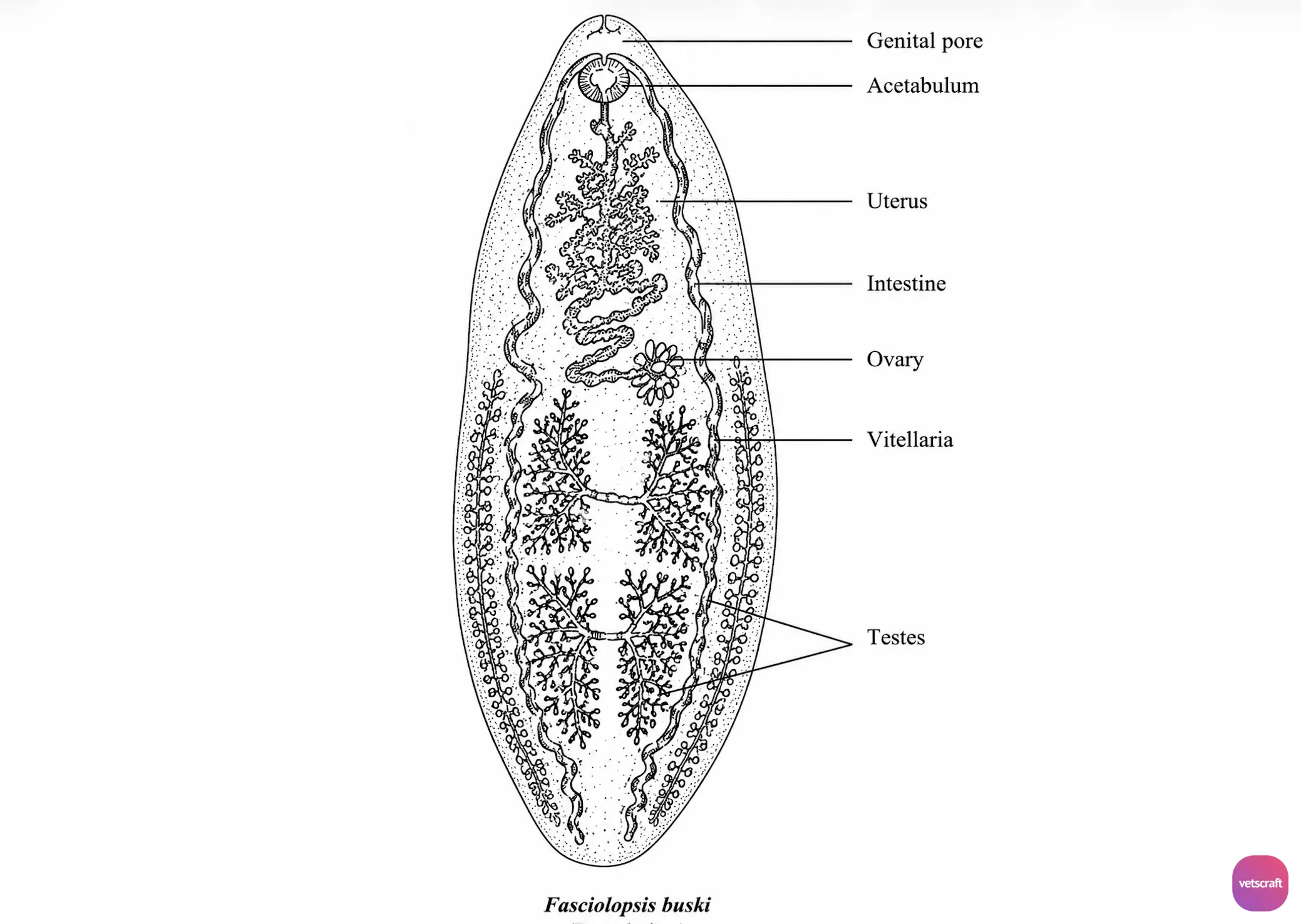
- A large, thick-set fluke without shoulders or a cephalic cone, measuring about 30–75 × 8–20 mm.
- The body is elongate-oval, slightly broader posteriorly than anteriorly.
- The ventral sucker is situated near the anterior extremity and is much larger than the oral sucker.
- The cuticle bears spines, which are frequently lost.
- A pharynx and short esophagus are followed by unbranched (wavy) intestinal ceca, which form a deep constriction at about the middle of the body and extend almost to the posterior end.
- The testes are tandem, branched, and located posteriorly.
- The cirrus sac is long and tubular, opening anterior to the ventral sucker.
- The ovary is branched, lies to the right of the midline, and the uterus forms coils in the anterior region below the ventral sucker.
- The vitelline glands occupy the lateral fields.
- The eggs are oval, large, brown in color, and have thin shells with an operculum.
Life Cycle
- Miracidia hatch from eggs in 16–18 days and penetrate flat, spiral-shelled snails of Planorbis, Pila, and Segmentina species.
- These snails feed on certain plants, especially aquatic tubers such as water caltrop (Trapa natans and T. bicornis), water chestnut (Eleocharis tuberosa), lotus, and bamboo. These plants are cultivated for food and are often fertilized with human night soil.
- The cercariae emerge from the snails during the summer months and encyst as metacercariae on the tubers or nuts of these plants.
- These tubers are often eaten raw; however, the outer shell of the nut is commonly peeled off with the teeth, particularly by children, resulting in heavier infections in children than in adults.
- In some areas, the nuts are cooked before being consumed by humans. Consequently, animal infection rates are often higher than human infection rates because the nuts are fed uncooked to animals.
- These plants, and possibly other aquatic plants, may also transmit the infection to pigs.
Pathogenesis
Fasciolopsis buski is an important fluke because it causes disease in humans. The parasites attach to the intestinal mucosa, causing local inflammation or severe ulcerative lesions in heavy infections.
Most infections are mild and asymptomatic. In heavier infections, symptoms include diarrhea, abdominal pain, fever, ascites, anasarca, and intestinal obstruction.
Infection may be common, and up to 39% of children have been reported to be infected in some regions of India and Bangladesh.
Treatment
- Hexylresorcinol: 1 g is an effective treatment.
- Tetrachloroethylene: 0.08–0.14 ml/kg. Effective in humans.
- Niclosamide: 160 mg/kg. It is less effective but has fewer side effects than tetrachloroethylene.
- Praziquantel: 25 mg/kg orally, three times daily for 1 day.
- Niclofolan
Praziquantel is currently the drug of choice for fasciolopsiasis.
Prophylaxis
- Proper disposal of human night soil and pig feces.
- The tubers and nuts of water caltrop and water chestnut should not be consumed without at least scalding them in boiling water.
- Health education programs should promote the cooking of water nuts and avoidance of drinking unfiltered or unboiled water.