Phylum Apicomplexa: Characteristics, Classification and Class Sporozoa
Phylum Apicomplexa comprises a diverse group of obligate intracellular protozoan parasites that infect both vertebrates and invertebrates. This phylum includes medically and veterinary important parasites such as Eimeria, Isospora, Toxoplasma, Plasmodium, Babesia, and Sarcocystis.
Members of Apicomplexa possess a specialized apical complex that enables host cell invasion and exhibit complex life cycles involving asexual and sexual reproduction. This article discusses the characteristics, classification, apical complex, Class Sporozoa, and the general life cycle of Apicomplexa.
All members of the phylum Apicomplexa are obligate intracellular parasites of vertebrates and invertebrates. The members include gregarines (parasites of invertebrates), hemogregarines (mostly blood parasites of lower vertebrates), coccidia (mostly intestinal parasites of vertebrates), malarial parasites, and piroplasms (blood parasites of mammals).
Characteristics of Apicomplexa
The members of this phylum possess a characteristic structure called the apical complex, which can be seen only with an electron microscope. The structures that form the apical complex include a polar ring, micronemes, rhoptries, subpellicular microtubules, micropore(s), and a conoid. The apical complex is usually present at some stage of the life cycle and is situated at the anterior end of the organism.
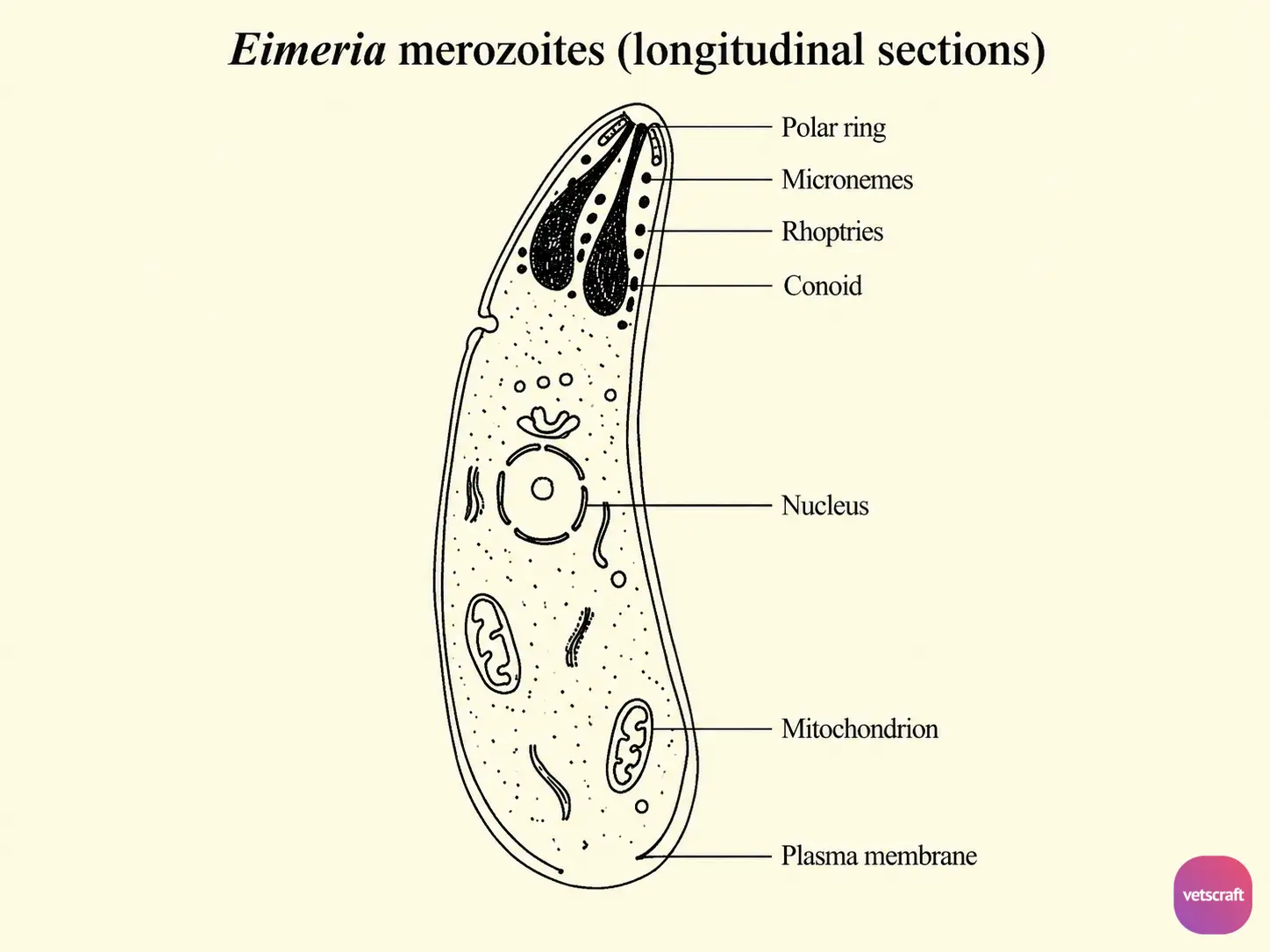
The functions of the apical complex are host cell recognition and penetration. The conoid is considered the organ of penetration. Members of Apicomplexa have a single vesicular nucleus, and with the exception of microgametes, they lack cilia or flagella for locomotion.
Class: Sporozoa
Members of the class Sporozoa are either homoxenous or heteroxenous parasites, and most produce a resistant oocyst. Locomotion occurs by body flexion, gliding, and undulation of longitudinal ridges.
In the life cycle, asexual and sexual reproduction occur alternately, a process called metagenesis. Asexual reproduction occurs by binary fission, multiple fission, or endopolygeny. Sexual reproduction begins with gametogony, followed by the fusion of male and female gametes (syngamy), resulting in the formation of a zygote.
The zygote usually undergoes division in the environment to form sporocysts, which in turn produce a number of sporozoites; this process is called sporogony or sporulation. In Sarcocystis, sporulation (sporogony) takes place in the intestine of the host and is called endosporulation. Following sporulation, a variable number of sporocysts containing sporozoites are formed.
The number of sporocysts in each oocyst and the number of sporozoites within each sporocyst depend on the species. Oocysts become infective to susceptible hosts only after sporulation.
The number of sporocysts and sporozoites in the oocysts of different genera is compared below:
| S. No. | Species | Number of Sporocysts | Number of Sporozoites per Sporocyst |
|---|---|---|---|
| 1 | Cryptosporidium | No sporocysts | 4 sporozoites |
| 2 | Tyzzeria | No sporocysts | 8 sporozoites |
| 3 | Isospora | 2 sporocysts | 4 sporozoites |
| 4 | Eimeria | 4 sporocysts | 2 sporozoites |
| 5 | Wenyonella | 4 sporocysts | 4 sporozoites |
This arrangement of sporocysts and sporozoites is an important taxonomic feature used in the identification and differentiation of coccidian parasites.