TABLE OF CONTENTS
Veterinary Entomology and Acarology: Introduction, Arthropoda Classification & Characteristics
Veterinary entomology and acarology is an important branch of veterinary parasitology that focuses on insects and acarines of veterinary significance. These arthropods not only cause direct harm to animals through blood feeding, irritation, and tissue damage but also serve as vectors for numerous bacterial, viral, protozoal, rickettsial, and helminthic diseases. This article provides an introduction to veterinary entomology and acarology, along with the classification of Phylum Arthropoda and its important characteristics.
The word entomology is derived from the Greek words entomon (insect) and logos (science or study). It is the study of insects, including flies, fleas, lice, and bugs. Acarology is the study of acarines, including ticks and mites.
It is the branch of parasitology that deals with arthropods causing diseases in animals. The name of the phylum Arthropoda is derived from the Greek words arthros (joint) and podos (legs), referring to the fact that members of this phylum have jointed legs. Most arthropods lead an ectoparasitic life, while a few are endoparasitic during certain developmental stages.
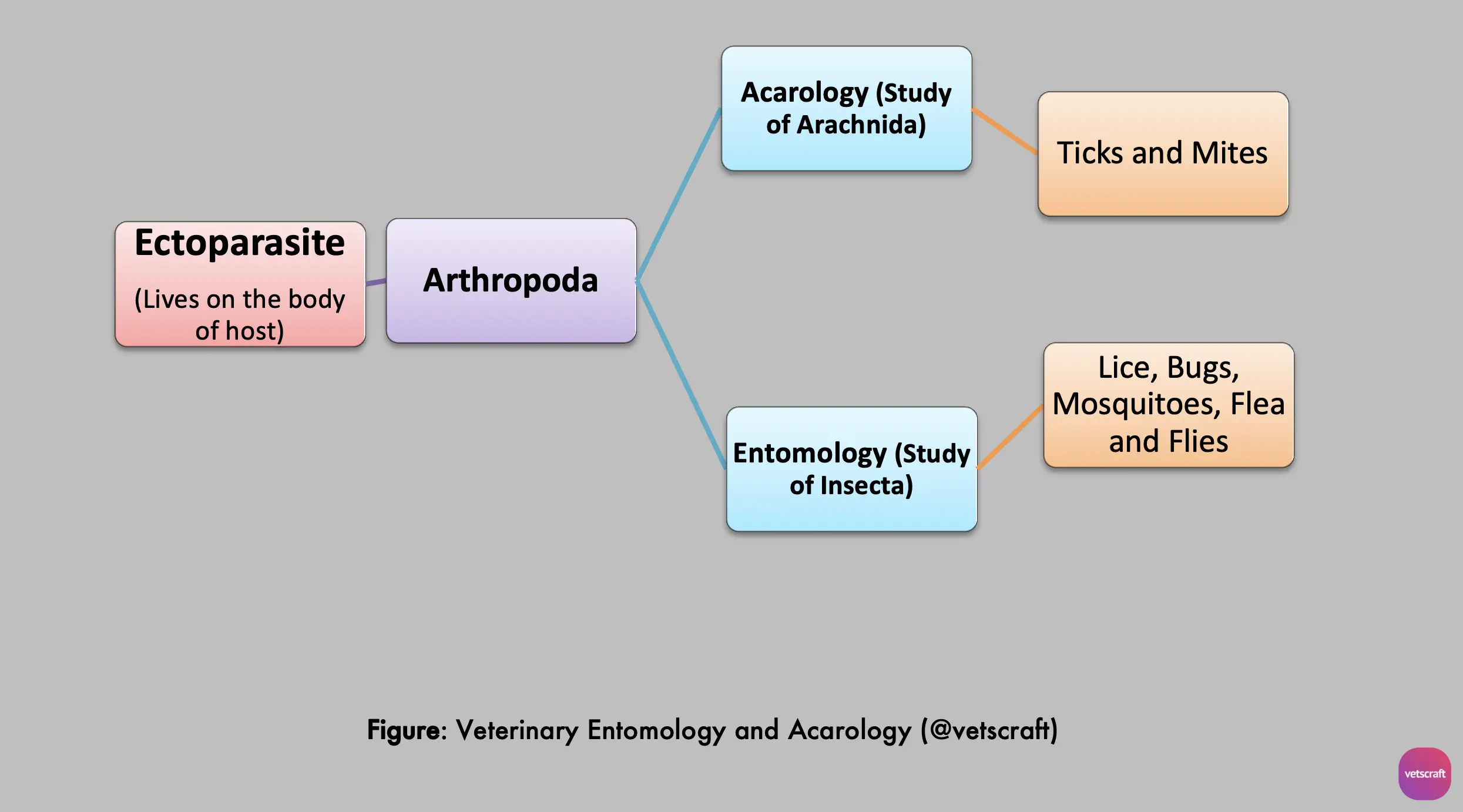
Ectoparasites are further divided into permanent ectoparasites (lice and mites) and temporary ectoparasites, which visit or infest animals only for feeding (e.g., mosquitoes, flies, and fleas).
They act as vectors for bacterial, viral, rickettsial, protozoal, and helminthic infections. These diseases are transmitted either mechanically or cyclically. In addition to disease transmission, insects cause direct injury and may also inject poisons and toxins during feeding.
Important Features of the Phylum Arthropoda
They are bilaterally symmetrical and metamerically segmented. The body consists of the head, thorax, and abdomen, and this body segmentation is referred to as tagmatization, with each segment called a tagma. They possess a chitinous exoskeleton, jointed legs, a haemocoel, a dorsal blood vessel, a double ventral nerve cord, and respiration occurs through gills or tracheae.
Sexes are separate. In vertebrates, the circulatory system is ventrally placed, whereas in insects it is dorsally placed. Similarly, the nervous system is dorsally placed in humans but ventrally placed in insects.
All insects and arachnids have an external skeleton (exoskeleton). The exoskeleton of invertebrates is composed of several hardened plates called sclerites, which are made of a chemical compound known as chitin.
Chitin is a nitrogenous polysaccharide that is highly insoluble in water, alcohol, and dilute solutions of acids and alkalis. The hardened plates are united by means of sutures, and each junction is called a suture. The body consists of the head (6 segments), thorax (3 segments), and abdomen (11 segments).
Each segment consists of a dorsal sclerotized plate called the tergum and a ventral plate known as the sternum. The tergum and sternum are connected laterally by membranous pleura. The chemical formula of chitin is C₃₂H₅₄N₄O₂₁.
The phylum Arthropoda comprises five classes, and the class Insecta includes insects, which constitute approximately 70% of the animal kingdom.
- Class: Crustacea (e.g., crabs, crayfish, and Cyclops)
- Class: Myriapoda (e.g., centipedes and millipedes)
- Class: Insecta (e.g., mosquitoes, flies, fleas, lice, and bugs)
- Class: Arachnida (e.g., ticks, mites, spiders, and scorpions)
- Class: Pentastomida (e.g., tongue worms)