TABLE OF CONTENTS
Balantidium coli in Veterinary Parasitology: Morphology, Transmission, Pathogenesis, Diagnosis & Treatment
Balantidium coli is the largest protozoan parasite infecting the intestinal tract of mammals and the only ciliated protozoan known to cause disease in humans. It primarily infects pigs, which serve as the principal reservoir host, but can also be found in other mammals, including non-human primates, dogs, and rodents. Although infections in animals are often asymptomatic, B. coli can become pathogenic under certain conditions, causing enteritis, colitis, and ulceration of the intestinal mucosa.
This article provides a comprehensive overview of Balantidium coli, including its classification, morphology, transmission, development, pathogenesis, clinical signs, diagnosis, treatment, and control, making it a valuable resource for veterinary parasitology students and professionals.
Parasite Overview
- Phylum: Ciliophora
- Class: Kinetofragminophora
- Order: Trichostomatida
- Family: Balantidiidae
- Genus: Balantidium
- Species: Balantidium coli
- Host: Pigs, humans, chimpanzees, rhesus monkeys, guinea pigs, and rarely dogs and rats
- Predilection Site: Cecum and colon
- Distribution: Worldwide, but most common in tropical regions
Morphology
Trophozoites are ovoid in shape (30–150 × 25–120 µm). The cytostome (mouth) is located subterminally at the anterior end, while the cytopyge (anus) is located near the posterior end.
The macronucleus is sausage- or kidney-shaped, and the micronucleus is small and lies in the notch of the macronucleus. There are two contractile vacuoles, one located near the posterior end and the other near the center. Numerous food vacuoles contain starch grains, cell fragments, bacteria, erythrocytes, etc.
The body surface is covered with slightly oblique longitudinal rows of cilia. The trophozoite is the vegetative, actively motile stage and moves rapidly across the microscopic field.
Cysts are ovoid to spherical in shape and measure 40–60 µm in diameter. The cyst wall is thick and slightly yellowish to greenish, through which the parasite may be seen. The cysts remain viable for up to 2 weeks at room temperature.
Transmission and Development of the Parasite
Infection of the definitive host occurs through the ingestion of cysts in contaminated food or water. The ingested cysts undergo excystation and release trophozoites in the intestine.
These trophozoites multiply by transverse binary fission, although conjugation may also occur. Encystation begins when the feces pass into the posterior part of the intestine, where dehydration of the fecal material promotes cyst formation.
Pathogenesis and Clinical Signs
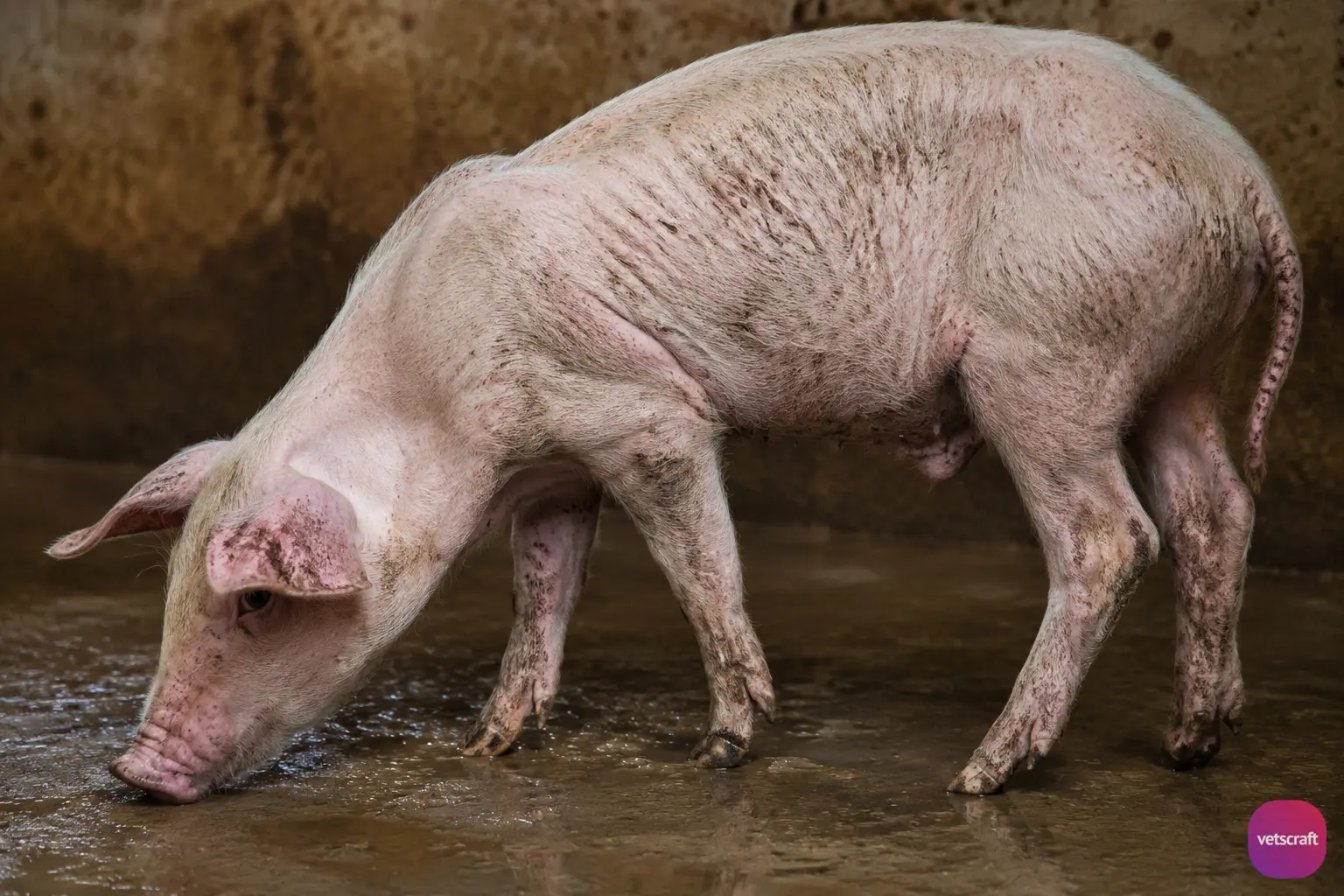
The pig is considered the primary host of B. coli. It generally lives as a commensal because, under normal conditions, large numbers of B. coli may be present in the cecum without causing pathological changes in the mucosa.
However, if lesions develop in the intestinal mucosa due to another etiology, B. coli may invade the mucosa as a secondary invader, causing superficial or deep ulceration and mild to severe enteritis. It may also cause colitis, anemia, stunted growth, and emaciation in young piglets.
Balantidium coli is a zoonotic parasite. Humans usually acquire the infection from swine through food contaminated with pig feces. B. coli is more pathogenic in humans, causing diarrhea or dysentery and superficial to deep ulcers similar to those produced by Entamoeba histolytica.
Occasionally, B. coli may be found in the muscularis mucosae, where ulcers are infiltrated and hemorrhagic areas may be present. B. coli may also occur in nests within tissues or even in capillaries, lymphatic ducts, and lymph nodes. In dogs, it causes ulceration and dysentery.
Diagnosis
- Microscopic examination of intestinal contents for the presence of trophozoites or cysts.
- Histopathological examination of intestinal lesions.
Treatment
- No treatment is necessary for swine
- Humans: Tetracycline
Control
Maintain good personal hygiene and prevent contamination of food with pig feces.