Dissemination of Parasites: Methods, Survival, and Transmission
Dissemination of parasites refers to the mechanisms by which parasites leave infected hosts, survive in the environment, and reach new susceptible hosts. Parasites possess several adaptations that help them spread efficiently through water, vectors, intermediate hosts, environmental stages, and behavioral manipulation of hosts.
The dissemination of parasites involves the exit of parasites from infected hosts, survival and dispersal of parasites in the environment, parasite-induced behavioral changes in the hosts, and strategies adopted by parasites to reach new hosts.
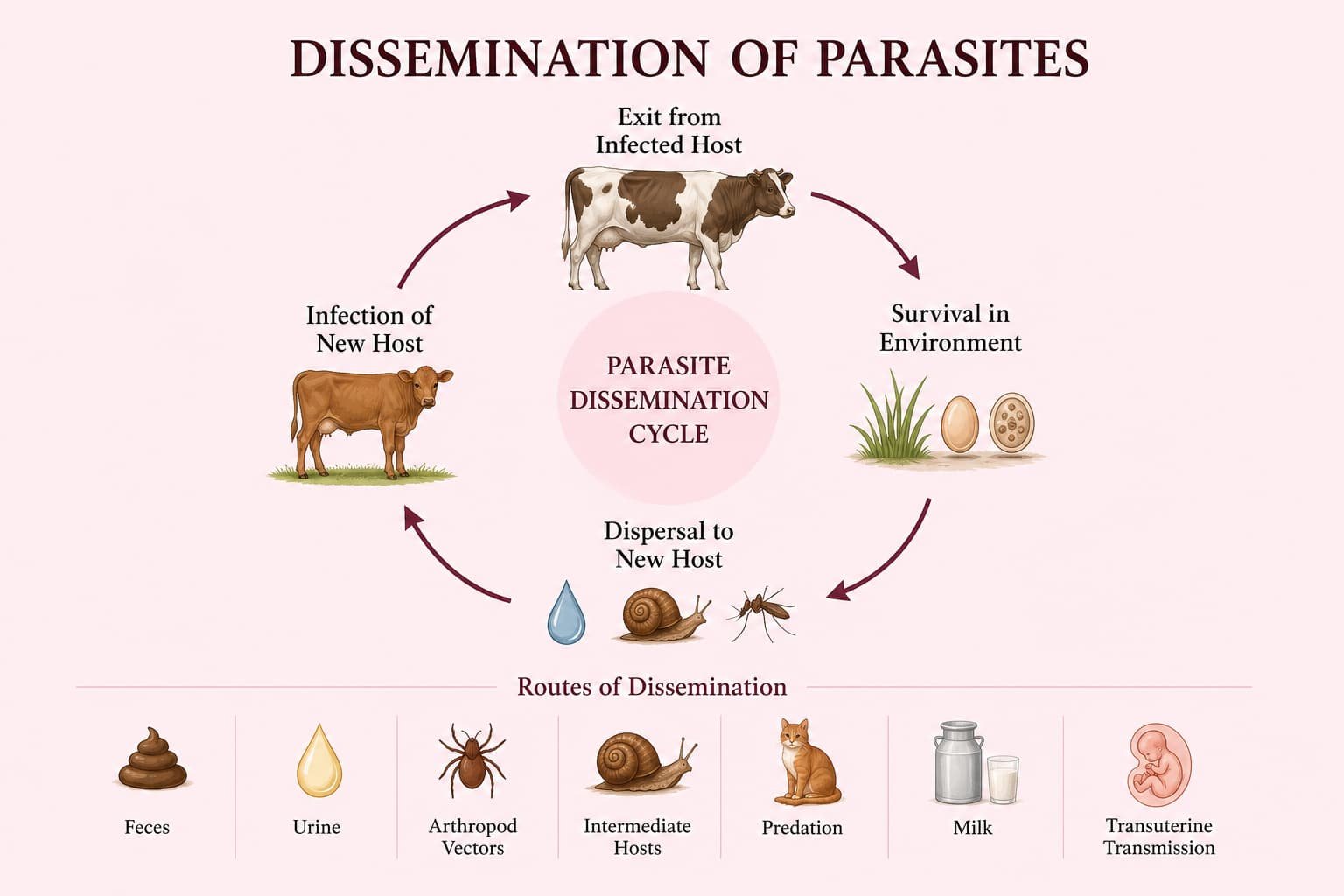
Dissemination of parasites includes the following steps:
- Exit of parasites from infected hosts
- Methods of dissemination of infective stages of parasites
- Parasite-induced host behavioral changes
- Strategies adopted by parasites to infect hosts
Exit of Parasites from the Infected Hosts
Parasites can exit the host either passively or actively.
I. Passive Exit of Parasites
1. Exit of Parasite through Excretion or Discharge
Most parasites leave the host passively through feces as eggs in trematodes and nematodes (except filarids), as gravid segments in eucestodes, as cysts in Entamoeba histolytica and Giardia, as oocysts in coccidian parasites, and as larvae in Gasterophilus equi.
However, a few parasites such as Stephanurus dentatus, Schistosoma haematobium, and Dioctophyma renale leave the host as eggs through urine.
2. Exit of Parasites through Arthropod Vectors
In blood parasites such as Theileria, Babesia, and Plasmodium, the gamont stages are passively ingested by blood-sucking arthropods while feeding on infected hosts.
Inside the vector’s body, the parasites undergo sexual reproduction to produce infective-stage sporozoites. These infected vectors are then capable of transmitting the infection to susceptible hosts.
Examples: Mosquitoes for Plasmodium and ticks for Theileria and Babesia.
3. Exit of Parasites through Intercalary Host
Capillaria hepatica is a nematode parasite that occurs in the liver of rats and mice. The eggs laid by this nematode in the liver cannot exit directly. However, when infected rodents are eaten by cats (predators), the eggs are released from the liver and passed in the feces of the cat. Hence, the cat, which facilitates the exit of the parasite eggs, is called the intercalary host.
4. Exit of Parasites through Predation
In tissue cyst-forming coccidia such as Neospora, Sarcocystis, and Toxoplasma, the extraintestinal stages (tachyzoites and bradyzoites) present in the muscles of herbivores (prey) are consumed by carnivores (predators).
The ingested parasites subsequently infect the predator and are later excreted as oocysts in the feces.
II. Active Exit of Parasites
Ectoparasites such as lice, mites, and fleas actively exit the host by crawling or jumping onto a new host. A few parasites also actively pass from the mother to the fetus through the placenta (transuterine transmission), for example, Toxoplasmaand Toxocara canis.
Some parasites actively exit through milk to reach the newborn (transmammary or lactogenic infection), e.g., Toxocara vitulorum and Toxocara canis. In Hypoderma lineatum, the larva wriggles out from the nodule and falls onto the ground to pupate.
Methods of Dissemination of Infective Stages of Parasites
1. Survival of Parasites in the Environment
Once parasites are outside the host, they must survive in the environment until they encounter a suitable host. Since environmental conditions are generally adverse or hostile to parasite survival, the infective stages of parasites must possess adaptations that enable them to survive and remain infective.
For example, ascarid eggs have a thick shell; therefore, embryonated eggs can remain viable for up to 5 years. Similarly, the oocyst wall of coccidian parasites is highly resistant to adverse conditions. The longevity of the infective stage of strongyle nematodes is approximately 3 months.
Temperature and moisture are two important factors that may either facilitate or hinder parasite survival and development. Parasites generally do not develop below 10°C or above 40°C. When climatic conditions become unfavorable for parasite survival, they tend to cease development until favorable conditions return, e.g., hibernation, aestivation, and diapause in arthropods.
However, due to climate change, even a 1°C rise in temperature may accelerate the breeding and growth of arthropods. This is one reason why vector-borne infections have become more prevalent in recent years.
2. Dispersal of Parasites
Parasites are disseminated in the environment mechanically through water, arthropods, and human intervention. Water is an important agent for the dissemination of parasites that require an aquatic habitat for the development of their stages, e.g., trematodes.
The eggs of trematodes are carried by surface water to water bodies, where they undergo embryonation and hatch to release miracidia. The miracidia, in turn, infect suitable snail intermediate hosts in the water bodies for further development.
Normally, the cercariae released from the snail swim in water and eventually encyst as metacercariae on vegetation or in a second intermediate host. The definitive hosts become infected by ingesting the metacercariae. However, when water currents are strong in canals or streams, infected snails may be carried to distant locations.
Similarly, arthropods that breed in aquatic habitats (mosquitoes, Simulium, etc.) lay their eggs in water, and their larval and pupal stages also require water for development. Hence, during the rainy season, eggs, larvae, and pupae may be carried over long distances by streams, irrigation channels, and rivers.
Human interventions, such as the construction of irrigation canals, directly facilitate the breeding of arthropods that develop in water and aid in the dissemination of trematode parasites. Insects may also mechanically disseminate parasites from one place to another.
The use of sewage water and sludge as fertilizer for vegetable cultivation and pasture irrigation may further facilitate the dissemination of parasites, e.g., Fasciolopsis buski, the intestinal fluke of humans and pigs. Humans become infected by consuming raw tubers (water caltrop) and nuts (water chestnuts) fertilized or irrigated with sewage containing metacercariae.
The fungus Pilobolus aids in the dispersal of the lungworm Dictyocaulus viviparus in cattle. Lungworm larvae are relatively inactive and therefore migrate only short distances from the dung pat to surrounding herbage. However, these larvae may accumulate on the sporangia of Pilobolus fungi, which are commonly found in cattle dung. When the sporangium explodes, the larvae may be propelled as far as 3 meters. This facilitates the larvae reaching the definitive host. Otherwise, the chances of larvae reaching the host are low because cattle generally avoid grazing near dung pats.
Parasites Induced Host Behavioural Changes
In Dicrocoelium, the metacercariae enter the brain of the ant (second intermediate host), causing paralysis and making the ants more likely to be consumed by grazing animals during the early morning.
Grasshoppers infected with larvae of Tetrameres (a nematode of chickens) and beetles infected with cysticercoids of poultry tapeworms become sluggish, thereby increasing the likelihood of being eaten by birds.
Ruminants heavily infected with hydatid cysts become weak and debilitated; therefore, they are more easily preyed upon by predators.
Strategies Adopted by the Parasites to Infect Hosts
Some parasites employ specific strategies to increase their chances of reaching the definitive or intermediate hosts.
Liver flukes and amphistomes encyst on the upper green parts of plants and grasses, thereby increasing the likelihood of being ingested by herbivores.
Human tapeworms such as Taenia saginata and Taenia solium use cattle and pigs, respectively, as intermediate hosts. Since cattle do not ingest human feces, the gravid segments of T. saginata migrate out of the feces and release eggs onto the pasture. This behavior facilitates transmission of the parasite to the intermediate host. In contrast, because pigs may consume human feces, the gravid segments of T. solium do not migrate.
Some parasites possess sensory organs that help them locate their hosts. Warmth, CO₂, fatty acids, amines, and other chemical cues serve as stimuli for parasites, especially arthropods.