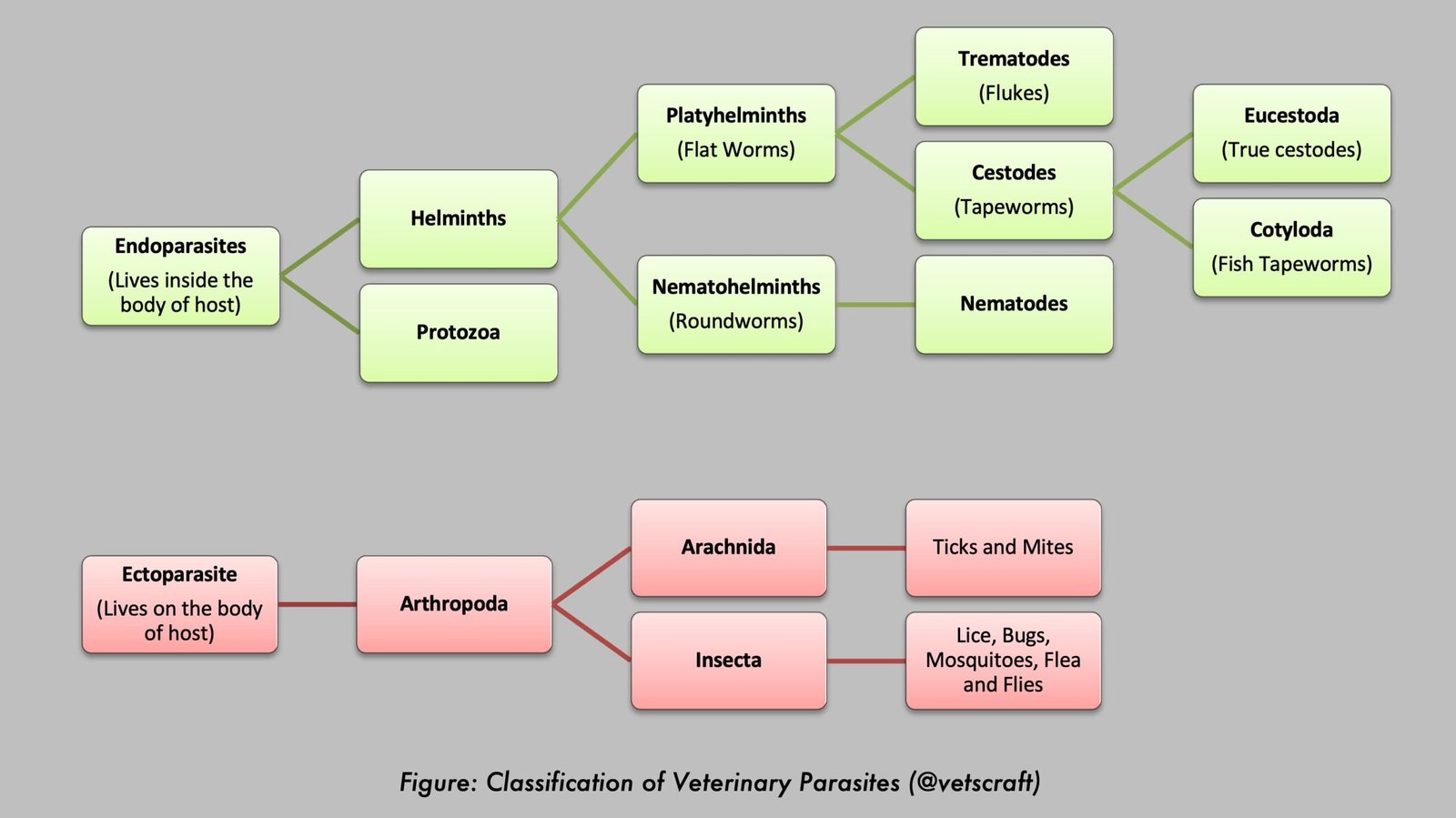
Systematics of Parasites: Zoological Nomenclature and Classification of Parasites
Systematics is the scientific study of the diversity of living organisms and their evolutionary relationships. In parasitology, systematics helps in identification, naming, and classification of parasites based on their characteristics and relationships.
Systematics can broadly be divided into taxonomy, classification, and nomenclature.
Taxonomy
Taxonomy is the study of the principles and practices of classification of organisms. It deals with identification, naming, and arrangement of organisms into different taxonomic groups based on their similarities and differences.
Classification
Classification is the process of arranging organisms into different groups or categories according to their similarities, differences, and evolutionary relationships. It helps in systematic study and proper identification of organisms.
Nomenclature
Nomenclature is the system of assigning scientific names to various groups of organisms. Scientific naming ensures uniformity and avoids confusion caused by local or common names.
Zoological Nomenclature
Zoological nomenclature is the system of naming different taxonomic groups of animals such as family, genus, and species.
The principal objective of zoological nomenclature is to promote stability, universality, and uniqueness of zoological names. It ensures that each organism has one valid and distinct scientific name.
Types of Nomenclature are:
- Uninomial Nomenclature
- Binomial Nomenclature
- Trinomial Nomenclature
Uninomial Nomenclature
Uninomial nomenclature is used for naming organisms up to the genus level.
Example: Genus – Haemonchus
Binomial Nomenclature
Binomial nomenclature was introduced by Carolus Linnaeus, who is regarded as the father of taxonomy. In this system, the scientific name of an organism consists of two parts: the generic name and the specific name.
Each name should be a single latinized word. Both words should be written in italics while printing and underlined separately while handwriting.
Generally, the generic name starts with a capital letter, whereas the specific name starts with a small letter.
Example: Cotugnia digonopora
However, if the specific name is derived from a person’s name, it may begin with a capital letter.
Example: Cotugnia Bhaleraoi
Trinomial Nomenclature
Trinomial nomenclature is used to name subspecies, which are categories below the species level. The subspecies name is also latinized and follows the species name.
Example: Pediculus humanus capitis
The correct method of scientific writing includes the name of the author and the year of description immediately after the scientific name.
Example: Homo sapiens Linnaeus, 1758
The naming of organisms is carried out according to the International Code of Zoological Nomenclature (ICZN).
Based on morphological characters, members of the animal kingdom are classified into phylum, class, order, family, genus, and species. Additional categories such as subphylum, subclass, superfamily, subgenus, and subspecies may also be included.
Each taxonomic category generally ends with a characteristic suffix that helps in identification.
- Order ends with -ida → Ascaridida
- Superfamily ends with -oidea → Ascaridoidea
- Family ends with -idae → Ascarididae
- Subfamily ends with -inae → Ancylostominae
The specific name of a parasite may be based on the host, location in the host, locality, or the scientist associated with its discovery.
Parasites named after the host:
- Ctenocephalides canis – Dog flea
- Oestrus ovis – Sheep nasal fly
Parasites named after the location in the host:
- Schistosoma nasale – Found in nasal veins of cattle
- Dioctophyma renale – Found in the kidney of dogs
Parasites named after locality:
Stephanofilaria assamensis – First recorded in Assam.
Parasites named after scientists/persons:
Leishmania donovani – Named after the scientist Donovan.
If the original classification name is changed later for valid reasons, the original author’s name and year are written within brackets after the new scientific name. This follows the “law of priority”.
Example:
- Artyfechinostomum sufrartyfex Lane, 1915
- Paryphostomum sufrartyfex (Lane, 1915) Bhalerao, 1931
If different names are given by various authors to the same organism, all names except the valid name become synonyms.
Example: Toxocara cati Schrank, 1788 and Toxocara mystax Zeder, 1800
If a scientific name already assigned to one species is reused for another species, the later name becomes a homonym and must be changed because no two species can have the same scientific name.
SNOPAD
SNOPAD stands for Standardized Nomenclature for Animal Parasitic Diseases.
A committee appointed by the World Association for the Advancement of Veterinary Parasitology (WAAVP) proposed a uniform system of terminology for animal parasitic diseases to improve clarity in scientific communication.
Generally, the name of a parasitic disease is formed by adding the suffix “-osis” to the parasite name.
Examples of SNOPAD:
- Schistosome → Schistosomosis
- Strongyle → Strongylosis